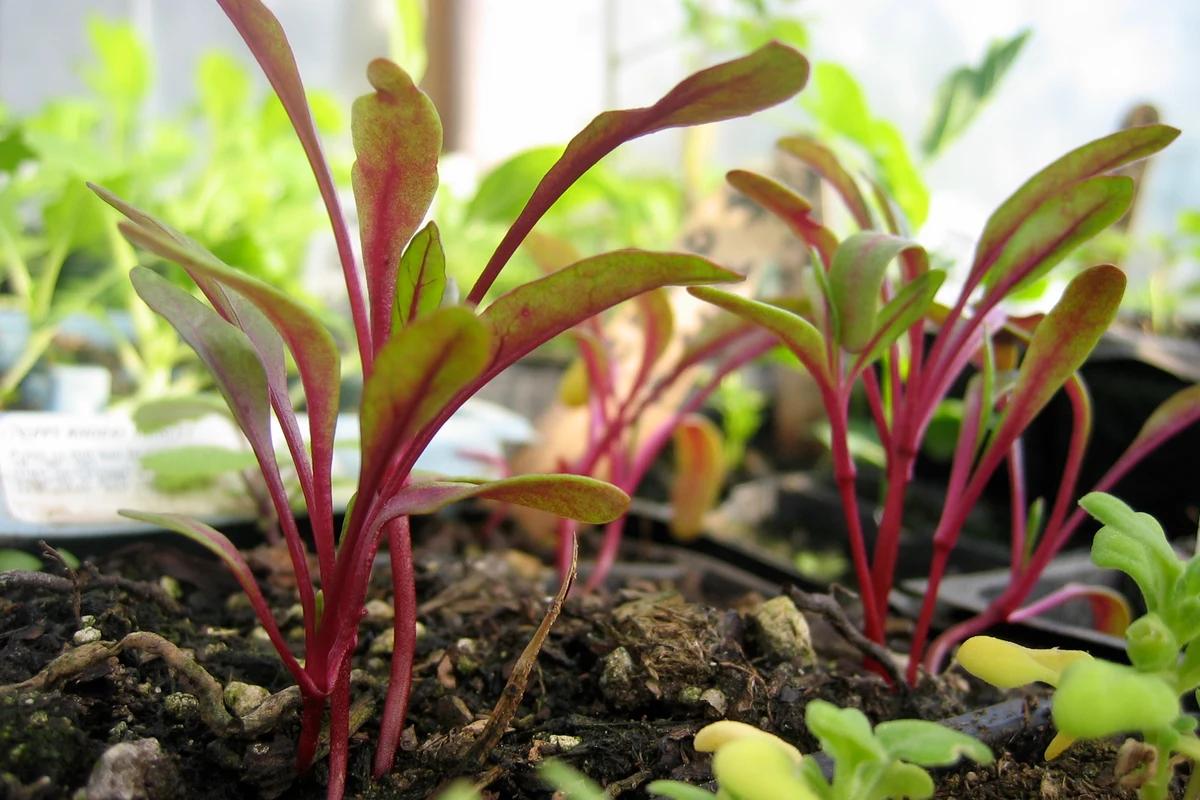
About This Plant
Chard microgreens are the young seedling shoots of Swiss chard, harvested for vivid magenta stems, tender cotyledons, and an earthy beet-like flavor. They are slower than many brassica microgreens, but controlled studies show strong mineral accumulation, especially potassium, and good performance in shallow trays, fiber mats, and soilless media.
How to Grow Chard Microgreens
Learn how to grow Chard Microgreens from seed to harvest in 17 days. Intermediate difficulty. Planting, care, feeding and the right growing conditions.
Sources cited: 6.
Nutrient Requirements by Growth Stage
Chard microgreens do not need adult-leafy-green feeding. A USDA/Frontiers soilless microgreen trial fertigated beet and other species with a modified half-strength Hoagland solution containing 7.5 mM N, 0.5 mM P, 3.0 mM K, 2.5 mM Ca, 1.0 mM Mg, and 1.8 mM S, with EC 1.3 dS/m and pH 6.2…
Sign in to view nutrient requirements
A free account unlocks NPK targets for all four growth stages, micronutrient levels, a per-stage nutrient calculator, and the full nutrition guide. Signing up takes one click. Truleaf is a free, non-profit project, and every new account helps it grow. No spam, ever.
Growing Environments
Chard microgreens fit indoor shelves, greenhouses, and container trays because harvest occurs while plants are small. Extension guidance explicitly supports year-round indoor production under grow lights and shallow containers…
Temperature
Chard microgreens grow best in a mild seedling environment rather than warm adult-crop conditions. University extension guidance places microgreen germination and growth around 70-75 F, while controlled Beta vulgaris microgreen trials used 21 +/- 2 C indoors or greenhouse set points of 20-28 C. Use 21-24 C for germination, then keep the crop near 20-24 C when possible. Short exposure above that range is tolerated, but warm saturated trays increase disease risk.
Humidity
Use humidity strategically: cover or dome the tray only during germination, then vent or remove the cover when seedlings emerge. UMD Extension recommends trapping warmth and humidity after sowing but also venting covers and maintaining airflow to avoid mold…
Light
Move trays into light promptly after germination and keep light moderate rather than intense. Beet microgreen experiments found the best fresh yield at 120-160 umol m-2 s-1 and a 12 hour photoperiod; 220 umol m-2 s-1 reduced yield, and the authors associated DLI above about 9.5 mol m-2 d-1 with possible…
Airflow
Dense chard microgreen trays need gentle continuous or frequent airflow after germination. UMD Extension specifically recommends good air circulation and a gentle fan to discourage disease, plus venting humidity covers so excess moisture does not encourage mold…
Sign in to view environmental requirements
A free account unlocks exact temperature, humidity, light and airflow targets, including germination and growth ranges, DLI, photoperiod and PPFD, plus the full environment guide. Signing up takes one click. Truleaf is a free, non-profit project, and every new account helps it grow. No spam, ever.
Hydroponic System Compatibility
The best systems are shallow trays, ebb-and-flow/subirrigated flats, floating or mat-based hydroponic trays, and NFT-style sloped channels. The USDA/Frontiers study grew microgreens in separate sloped channels on BioStrate mats with nutrient solution delivered as a film, while UMD Extension supports hydroponic mats…
Growing Media
Use clean, shallow, lightweight soilless media or hydroponic mats. UMD Extension recommends soilless mixes and warns against dense garden soil for indoor microgreens…
Container Specs
Use shallow trays with drainage plus an undrained bottom tray for watering. UMD Extension describes standard 10 x 20 inch flats and shallow food-grade containers as practical microgreen containers and recommends 1-1.5 inches of moist media…
Training & Support
No structural training is required for chard microgreens. Dense stands are managed by sowing density, blackout timing, watering method, and harvest timing rather than pruning or support…
Sign in to view system compatibility
A free account unlocks why each of the six systems fits or fails, plus growing media, container sizes, training methods, companion plants, and the full systems guide. Signing up takes one click. Truleaf is a free, non-profit project, and every new account helps it grow. No spam, ever.
Propagation
Propagation is by seed only. Beet-family seed clusters are slower than many brassica microgreens, and UMD Extension specifically lists beet and Swiss chard among seeds that benefit from a 6-12 hour soak before sowing…
Harvesting
Harvest chard microgreens once cotyledons are expanded and the first true leaves are beginning to appear. In the USDA/Frontiers multi-species trial, beet microgreens were harvested at 18 days after sowing; a hydroponic basil, Swiss chard, and rocket study reported Swiss chard reaching harvest stage at 17 days after…
Planting Calendar
Indoor chard microgreens can be sown and harvested every month because the crop is produced in shallow trays under managed light, temperature, and water. Outdoor production is possible in protected trays from spring through fall, but rain splash, wind, frost, and heat make quality less predictable…
Common Issues
The main problems are damping-off, mold, and weak leggy growth. In table beet microgreens, Pythium aphanidermatum caused severe damping-off, and Trichoderma seed-ball treatments reduced losses in a controlled study…
Get the full science-backed guide
By signing up, you help keep Truleaf free and support the growth of our nonprofit project. Your account unlocks full details for every plant issue—including symptoms, causes, step-by-step solutions, and prevention—plus the month-by-month planting calendar, the complete guide, and all research sources. It only takes one click. No spam, ever.