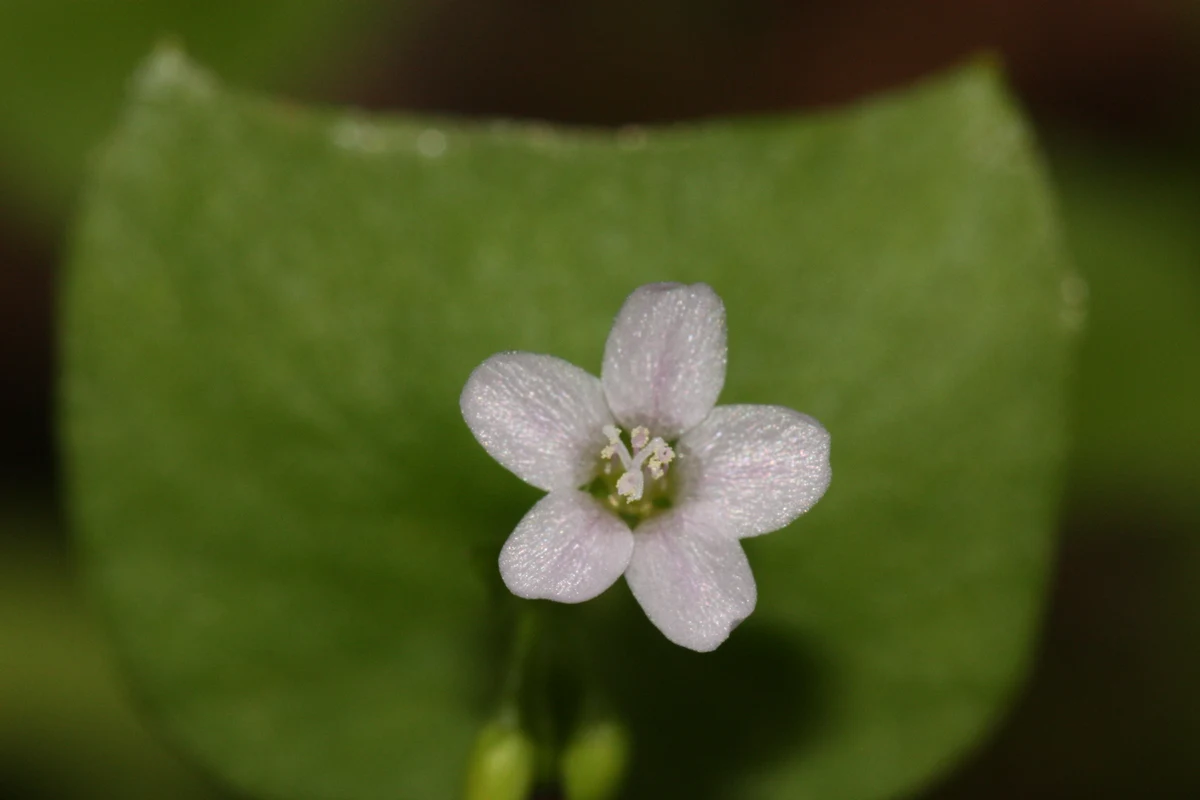
About This Plant
Claytonia, or miner's lettuce, is a cool-season annual leafy green native to western North America. It grows as a tender, shallow-rooted rosette for baby-leaf or cut-and-come-again harvests, favoring cool, moist, partly shaded conditions and declining as hot spring weather arrives. Species-specific hydroponic NPK ppm targets are not available, so fertility should stay conservative and evidence-labeled.
How to Grow Claytonia (Miner's Lettuce)
Learn how to grow Claytonia (Miner's Lettuce) from seed to harvest in 45 days. Beginner-friendly. Planting, care, feeding and the right growing conditions.
Sources cited: 11.
Nutrient Requirements by Growth Stage
Claytonia-specific stage NPK ppm targets are not available from the complete sources reviewed. The current N, P, K, Ca, Mg, and S ppm table should therefore be treated as provisional leafy-green practice, not verified Claytonia science…
Sign in to view nutrient requirements
A free account unlocks NPK targets for all four growth stages, micronutrient levels, a per-stage nutrient calculator, and the full nutrition guide. Signing up takes one click. Truleaf is a free, non-profit project, and every new account helps it grow. No spam, ever.
Growing Environments
Claytonia is suitable outdoors, in containers, greenhouses, and indoor grow setups when the environment stays cool and moist. Outdoors, it behaves as a winter or spring annual in moist, often shaded or disturbed habitats…
Temperature
Claytonia perfoliata is a winter or spring annual, so temperature management should emphasize cool production rather than speed at warm greenhouse setpoints. The current 10-18C germination range and 10-20C growth range are retained as practical operating targets, with 15C as the center point, because government and university sources consistently describe the species as favoring cool, damp sites and drying down as hot spring weather arrives. The exact Celsius thresholds are a horticultural synthesis rather than a direct optimum trial, so avoid presenting them as a strict species curve. A soilless greenhouse salinity study grew winter purslane through transplant and harvest under protected culture, confirming the crop can complete production in a controlled greenhouse when root-zone stress is managed.
Humidity
No complete Claytonia-specific study was found for relative-humidity setpoints, so the 50-70% RH range should be treated as a controlled-environment operating range rather than a verified species requirement. The strongest direct evidence is ecological: miner's lettuce inhabits cool, damp, moist, or vernally moist…
Light
Claytonia is shade tolerant, with USDA FEIS noting stronger presence under canopy than in openings in several communities. That supports moderate light rather than aggressive high-DLI production…
Airflow
Airflow evidence is indirect but important. Claytonia sources verify cool, damp habitat requirements, while controlled indoor production needs enough air movement to prevent stagnant leaf surfaces…
Sign in to view environmental requirements
A free account unlocks exact temperature, humidity, light and airflow targets, including germination and growth ranges, DLI, photoperiod and PPFD, plus the full environment guide. Signing up takes one click. Truleaf is a free, non-profit project, and every new account helps it grow. No spam, ever.
Hydroponic System Compatibility
Drip/substrate culture should be corrected from unsuitable to suitable because a peer-reviewed winter purslane study used perlite grow bags supplied by drip nutrient solution. DWC, NFT, ebb-and-flow, Kratky, and aeroponics remain plausible for a small leafy green, but no complete Claytonia-specific source was found…
Growing Media
Use media that hold steady moisture while preserving oxygen. University propagation guidance says Claytonia may be propagated in several soil media but prefers moist peaty soil…
Container Specs
Containers are appropriate because Claytonia is compact, fibrous-rooted, and harvested young. A 15 cm deep container is adequate for baby-leaf and rosette production, while 20 cm width gives room for an individual rosette or a small cluster…
Training & Support
No structural training is required. Claytonia grows as a low, tender annual rosette with slender flowering stems, not as a vine or top-heavy fruiting crop…
Sign in to view system compatibility
A free account unlocks why each of the six systems fits or fails, plus growing media, container sizes, training methods, companion plants, and the full systems guide. Signing up takes one click. Truleaf is a free, non-profit project, and every new account helps it grow. No spam, ever.
Propagation
Propagate Claytonia from seed. University of Washington protocol evidence is mixed on dormancy: it cites one source saying no pre-planting treatment is required and another saying seeds require two months of cold-moist stratification…
Harvesting
Miner's lettuce is harvested as baby leaves, small rosettes, stems, and sometimes flowers. For cut-and-come-again baby-leaf production, cut above the basal plate and leave the crown intact so plants can regrow in cool, moist conditions…
Planting Calendar
Calendar timing should follow cool-season behavior rather than a single maturity date. In mild climates, sow in late summer through fall for winter and early-spring harvest; in cold climates, sow as soon as soil can be worked and again in late summer for fall crops…
Common Issues
The most source-supported Claytonia issue is heat decline: UC IPM notes miner's lettuce prefers cool, damp conditions and dries up with hot spring weather. Food-safety guidance should also flag oxalate moderation…
Get the full science-backed guide
By signing up, you help keep Truleaf free and support the growth of our nonprofit project. Your account unlocks full details for every plant issue—including symptoms, causes, step-by-step solutions, and prevention—plus the month-by-month planting calendar, the complete guide, and all research sources. It only takes one click. No spam, ever.