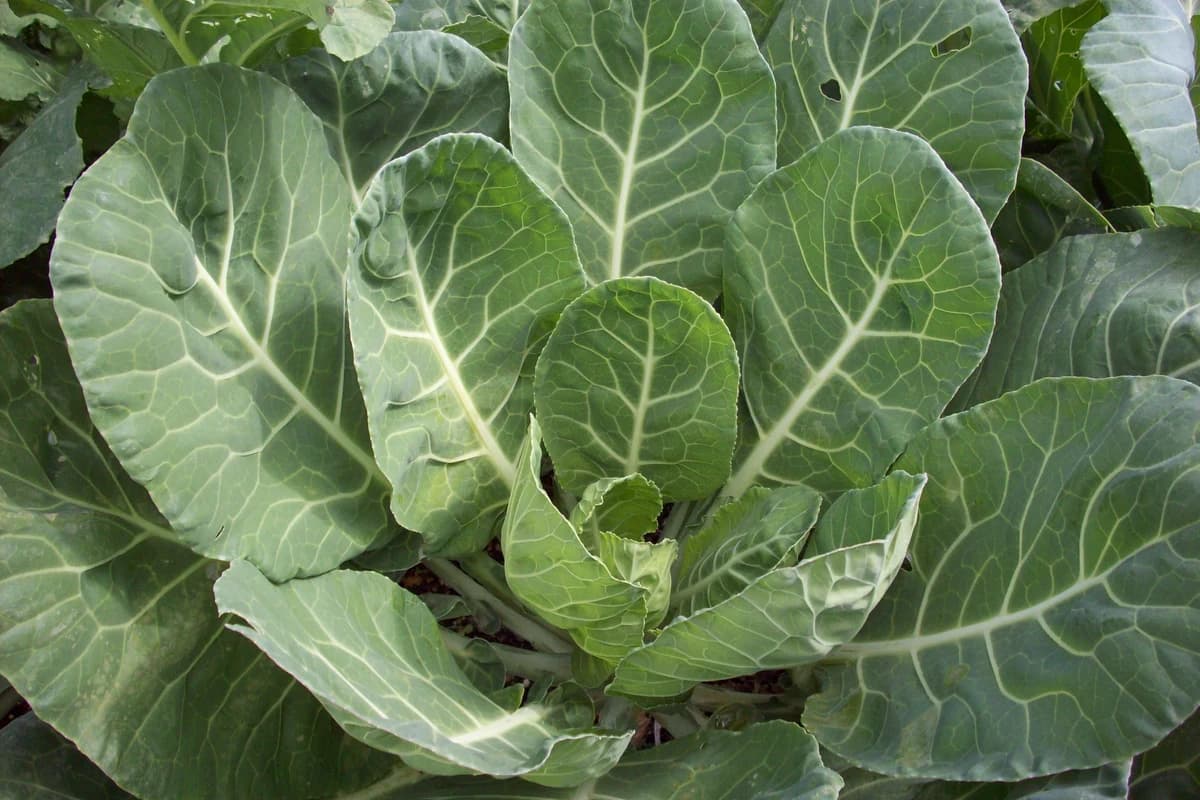
About This Plant
A non-heading member of the cabbage family, collard greens are a hearty leafy green grown for their large, edible leaves. More heat-tolerant than kale, they thrive in USDA zones 3-11 and are well-suited for hydroponic systems including DWC, drip, and NFT. A staple of Southern US cuisine, their flavor improves markedly after frost exposure.
How to Grow Collard Greens
Learn how to grow Collard Greens from seed to harvest in 55 days. Beginner difficulty. Complete nutrient guide, pH/EC requirements, and growing conditions for hydroponics, soil & greenhouse.
Sources cited: 25.
Nutrient Requirements by Growth Stage
Collard greens are heavy-feeding Brassicaceae with K-dominant macronutrient demand, sharing species identity (Brassica oleracea) with kale. Nitrogen drives vegetative growth: deliver 100-140 ppm N (optimal 120) at seedling stage with EC 0.8-1.5, increasing to 150-200 ppm (optimal 175) in the vegetative phase at EC…
Sign in to view nutrient requirements
A free account unlocks NPK targets for all four growth stages, micronutrient levels, a per-stage nutrient calculator, and the full nutrition guide. Signing up takes one click. Truleaf is a free, non-profit project, and every new account helps it grow. No spam, ever.
Growing Environments
Collard greens thrive in all major growing environments and are among the most adaptable brassicas. Outdoors, they grow across USDA zones 3-11, tolerating light frosts to -4C and heat up to 29C before quality declines — more heat-tolerant than kale…
Temperature
Collard greens grow best between 15.5C and 27C, with an optimal temperature of 20C for maximum leaf quality in controlled environments. Unlike kale, collards are notably more heat-tolerant: established plants maintain vegetative production through temperatures up to 27C without significant quality loss, and mature specimens survive brief exposures to 35C. Bolting risk increases substantially above 29C. Germination occurs in 5-10 days at soil temperatures of 13-29C, with 20-24C optimal. Nutrient solution temperature should be maintained at 18-22C; temperatures above 22C suppress dissolved oxygen and promote Pythium. Collards are a strong candidate for summertime CEA production where cooling costs constrain other Brassica crops.
Humidity
Maintain relative humidity between 50% and 70%, targeting 60% as the optimal set point during the vegetative phase. Humidity below 50% increases water stress and slows leaf expansion…
Light
Collard greens require a Daily Light Integral (DLI) of 14-22 mol/m2/day, with 17 mol/m2/day as the optimal target for balanced biomass and leaf quality. Like other Brassica oleracea crops, collards show no growth saturation up to 22 mol/m2/day — fresh weight increases linearly with DLI across this range…
Airflow
Adequate airflow is essential for collard greens. Vertical airflow fans (VAFs) positioned above the canopy are the primary defense against tip burn by promoting transpiration-driven calcium transport to rapidly expanding young leaves…
Sign in to view environmental requirements
A free account unlocks exact temperature, humidity, light and airflow targets, including germination and growth ranges, DLI, photoperiod and PPFD, plus the full environment guide. Signing up takes one click. Truleaf is a free, non-profit project, and every new account helps it grow. No spam, ever.
Hydroponic System Compatibility
Collard greens are broadly compatible with all major hydroponic systems, but their large plant size (60-120 cm height, stem diameter up to 3 cm) imposes system-specific requirements. Deep Water Culture (DWC) is preferred: the large reservoir provides temperature and nutrient stability for this heavy feeder, with…
Growing Media
Rockwool is the industry-standard medium for collard greens in professional hydroponic operations, providing optimal water-to-oxygen ratio and structural support for collard's substantial stem weight. Pre-soak rockwool cubes for 24 hours in pH 5.5 solution to neutralize alkaline bonding agents…
Container Specs
Collard greens grow well in containers but require more space than many leafy greens given their taller stature (60-90 cm). The minimum container size is 5 gallons (19 L) per plant, with 7-10 gallon (26-38 L) containers recommended for larger varieties like Georgia Southern…
Training & Support
Collard greens generally do not require staking or formal training. Unlike vining crops, collards grow as a single main stalk with leaf rosettes and are naturally self-supporting in garden beds…
Sign in to view system compatibility
A free account unlocks why each of the six systems fits or fails, plus growing media, container sizes, training methods, companion plants, and the full systems guide. Signing up takes one click. Truleaf is a free, non-profit project, and every new account helps it grow. No spam, ever.
Propagation
Collard greens are most easily grown from seed and are accessible to all skill levels. Sow seeds 6-13 mm deep in quality seed-starting mix…
Harvesting
Collard greens are a classic cut-and-come-again crop that regrows continuously when harvested correctly. Begin harvesting outer leaves when they reach 20-25 cm in length and are deep green, firm, and fully expanded…
Planting Calendar
Collard greens are cool-season crops with two primary planting windows, but their superior heat tolerance allows year-round production in zones 7-11. For a spring crop, start seeds indoors 6-8 weeks before last frost (January-March in zones 5-8) and transplant 3-4 weeks before last frost…
Common Issues
Collard greens share the full spectrum of pests and diseases common to all Brassica oleracea crops. The most economically significant insect pests are caterpillar species — diamondback moth (Plutella xylostella), cabbage looper (Trichoplusia ni), and imported cabbageworm (Pieris rapae)…
Get the full science-backed guide
By signing up, you help keep Truleaf free and support the growth of our nonprofit project. Your account unlocks full details for every plant issue—including symptoms, causes, step-by-step solutions, and prevention—plus the month-by-month planting calendar, the complete guide, and all research sources. It only takes one click. No spam, ever.