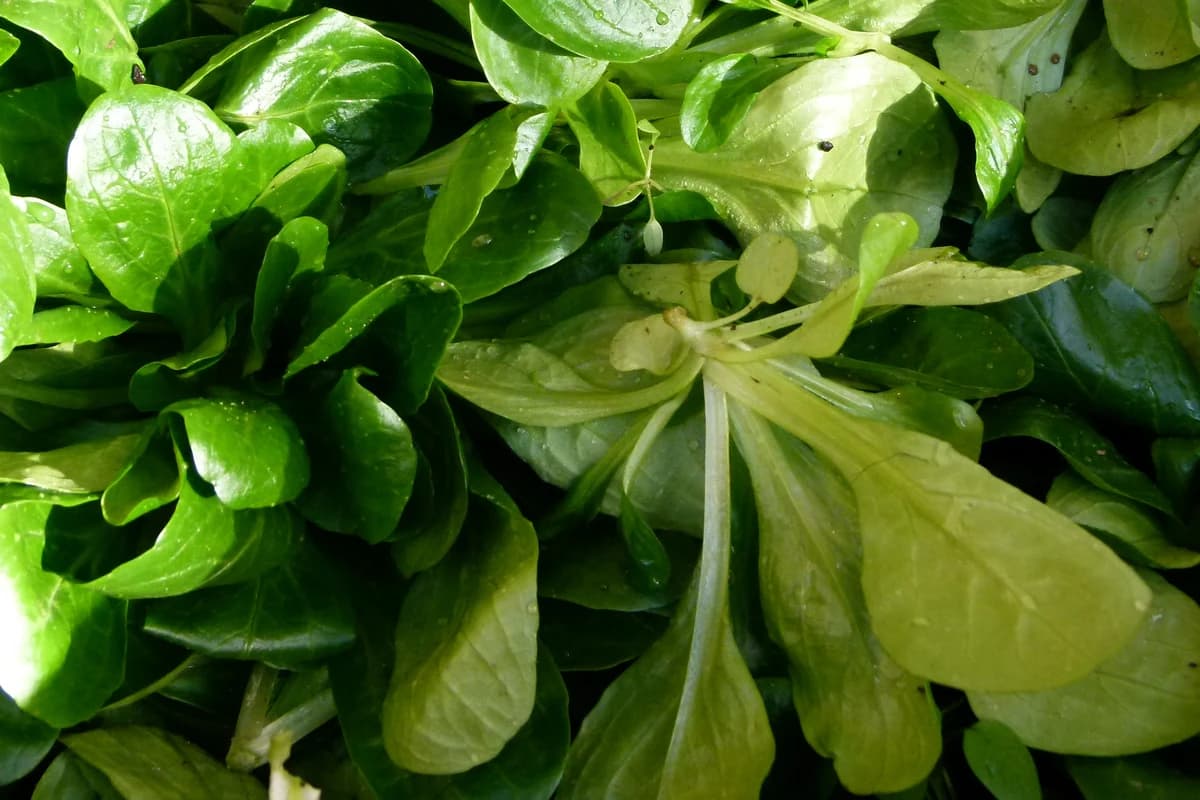
About This Plant
Corn Salad, also known as Mâche or Lamb's Lettuce, is a small, cool-season leafy green with a mild, slightly nutty flavor. It is highly valued in Europe and is typically grown for its tender rosettes, which are harvested before the plant bolts in warm weather. It performs well in both soil and soilless systems.
How to Grow Corn Salad (Mâche)
Learn how to grow Corn Salad (Mâche) from seed to harvest in 45 days. Beginner difficulty. Complete nutrient guide, pH/EC requirements, and growing conditions for hydroponics, soil & greenhouse.
Sources cited: 16.
Nutrient Requirements by Growth Stage
Treat corn salad as a vegetative leafy crop and avoid fruiting-stage nutrient logic. Recent hydroponic and soilless studies used production solutions near 200-210 ppm total mineral N, 43-50 ppm P, 235-291 ppm K, 160-220 ppm Ca, and roughly 50-70 ppm Mg…
Sign in to view nutrient requirements
A free account unlocks NPK targets for all four growth stages, micronutrient levels, a per-stage nutrient calculator, and the full nutrition guide. Signing up takes one click. Truleaf is a free, non-profit project, and every new account helps it grow. No spam, ever.
Growing Environments
Corn salad works indoors, outdoors, in greenhouses, and in containers when the crop is kept cool. Extension guides describe outdoor cool-season bed culture and container-friendly rosette growth, while peer-reviewed studies document greenhouse, vertical-farm, floating, and soilless systems…
Temperature
Corn salad is a cool-season rosette crop. Direct seed when soil is about 5-20 C; temperatures above roughly 21 C can prevent germination or push seed into dormancy. For production, keep air and root zones near 18-20 C where possible; controlled work and hydroponic reviews note quality and yield problems when roots exceed about 25 C. The prior 10-20 C germination range was safe but too narrow, so the structured record now preserves the full cool-soil window while keeping 20 C as the practical production target.
Humidity
Use moderate humidity rather than saturated air. A working range of 50-80% RH is supported by controlled corn salad and greenhouse studies, with 60-65% a practical midpoint for indoor production…
Light
Corn salad needs moderate leafy-green light, not fruiting-crop intensity. Species-specific indoor work supports recipes around 250 PPFD for 12-14 hours, equivalent to about 10.8-12.6 mol m-2 d-1 DLI…
Airflow
Provide gentle continuous air movement and enough exchange to prevent condensation around the low rosette canopy. Dense, wet leaves are vulnerable to downy mildew, and extension disease guidance for lambs lettuce emphasizes avoiding overhead irrigation, sanitation, and moisture control…
Sign in to view environmental requirements
A free account unlocks exact temperature, humidity, light and airflow targets, including germination and growth ranges, DLI, photoperiod and PPFD, plus the full environment guide. Signing up takes one click. Truleaf is a free, non-profit project, and every new account helps it grow. No spam, ever.
Hydroponic System Compatibility
Floating raft and DWC are strongly supported for corn salad, and NFT and ebb-and-flow also have published or commercial research context. Kratky is reasonable for a short, cool leafy crop by floating-system analogy if the air gap and water temperature are protected…
Growing Media
Use fertile, well-drained soil outdoors and clean, moisture-retentive soilless media in protected culture. Peer-reviewed work supports rockwool plugs, peat-perlite, perlite, vermiculite, expanded clay, and peat for lambs lettuce; perlite increased fresh yield in one thin-layer system, while peat reduced leaf nitrate…
Container Specs
A shallow, wide container is enough for full rosettes because corn salad remains compact. Use at least 15 cm depth, reliable drainage, and about 8-10 cm spacing for mature rosettes; denser sowing works for baby-leaf harvest if plants are thinned…
Training & Support
No training support is required. Corn salad forms a low, ground-hugging rosette and is harvested as leaves or small whole plants before flowering stems matter…
Sign in to view system compatibility
A free account unlocks why each of the six systems fits or fails, plus growing media, container sizes, training methods, companion plants, and the full systems guide. Signing up takes one click. Truleaf is a free, non-profit project, and every new account helps it grow. No spam, ever.
Propagation
Propagate from seed. Direct sow shallowly in moist, rich, well-drained soil or clean plugs when soil is cool; Utah State gives 41-68 F, about 5-20 C, and warns that seed may not germinate above 70 F…
Harvesting
Harvest can begin young. Utah State notes harvest may start two to three weeks after emergence or transplanting, while whole plants can be cut when 2-3 inches tall or leaves are about 4 inches across…
Planting Calendar
Schedule corn salad around cool weather. Sow 3-4 weeks before the last spring frost or transplant near the frost-free date, then repeat sowings every two weeks while soils remain cool…
Common Issues
The main risks are heat bolting, downy mildew, damping-off/root rot, physiological tipburn, and low-canopy pests. High summer temperatures reduce quality and cause flowering…
Get the full science-backed guide
By signing up, you help keep Truleaf free and support the growth of our nonprofit project. Your account unlocks full details for every plant issue—including symptoms, causes, step-by-step solutions, and prevention—plus the month-by-month planting calendar, the complete guide, and all research sources. It only takes one click. No spam, ever.