About This Plant
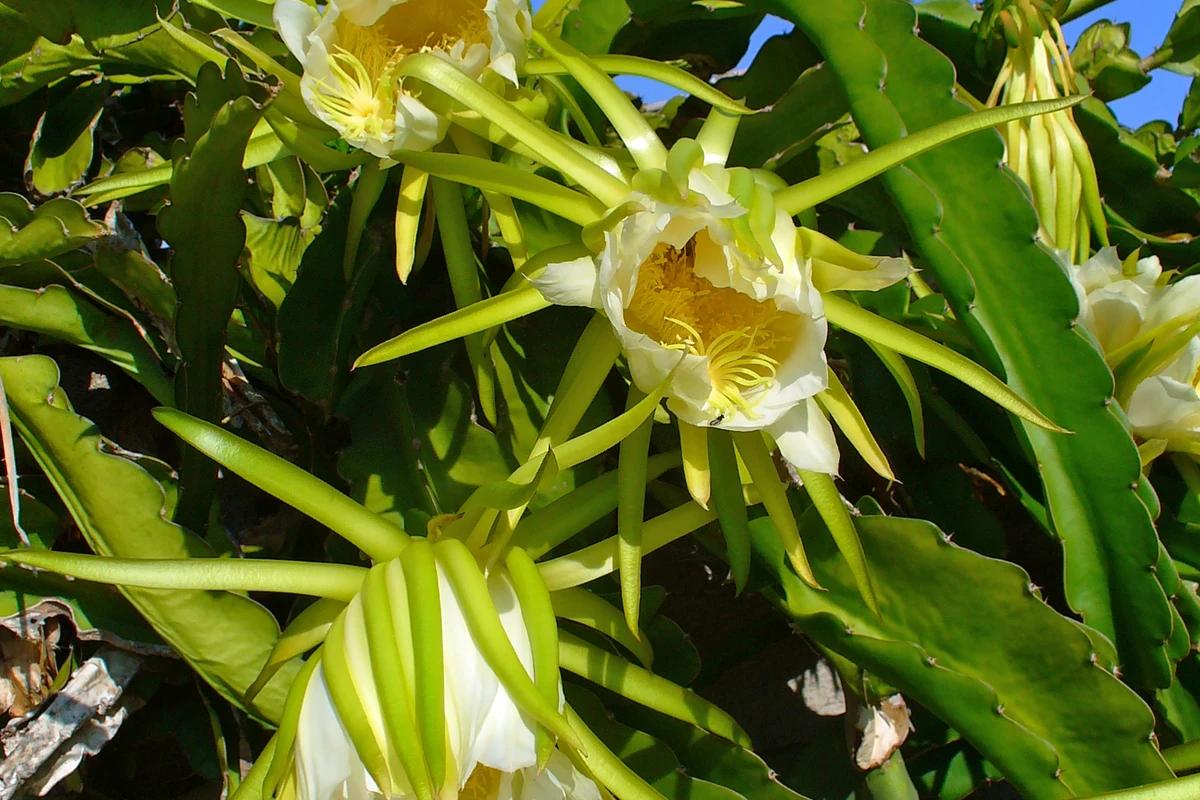
Dragon fruit, or pitaya, is a climbing perennial cactus grown for colorful, mildly sweet fruit. It performs best in warm frost-free sites, uses aerial roots to climb sturdy supports, and is usually propagated from stem cuttings rather than seed. Mature plants need strong trellising, excellent drainage, moderated sun exposure in hot sites, and stage-aware fertility that shifts from vegetative growth support toward flowering and fruiting.
How to Grow Dragon Fruit
Learn how to grow Dragon Fruit from seed to harvest in 365 days. Intermediate difficulty. Planting, care, feeding and the right growing conditions.
Sources cited: 7.
Nutrient Requirements by Growth Stage
The strongest dragon-fruit nutrition evidence supports staged soil or substrate fertility rather than exact hydroponic ppm. Red pitaya accumulated nutrients in the order K > Ca > N > Mg = P > S, with N demand strongest around 120-180 days, P/K/Ca demand strongest around 180-240 days, and fruit export led by K then N…
Sign in to view nutrient requirements
A free account unlocks NPK targets for all four growth stages, micronutrient levels, a per-stage nutrient calculator, and the full nutrition guide. Signing up takes one click. Truleaf is a free, non-profit project, and every new account helps it grow. No spam, ever.
Growing Environments
Dragon fruit is best suited to outdoor frost-free landscapes, orchards, and greenhouses; ordinary indoor fruiting is not source-backed because vines become large, heavy, and light-demanding. It can be container-established in artificial media beside a trellis, but mature production needs strong support and room for…
Temperature
Dragon fruit is a warm tropical to subtropical cactus. UF/IFAS gives 18-25C as an estimated optimum and warns against temperatures above 38C, while the IF Baiano field trial produced growth under a 24C monthly mean and tropical 24-27C regional conditions. Treat the current 10-38C broad range as survival tolerance, not a production target. For active growth, manage around 18-25C where possible, protect from prolonged freezing, and reduce heat-light stress with temporary shade during establishment or in high-radiation sites.
Humidity
Use moderate to high humidity with drying airflow rather than a wet canopy. ICAR notes dragon fruit grows best with good relative humidity and poor performance under extreme heat and light, while UF/IFAS reports severe sunburn in low-humidity or high-altitude regions…
Light
Dragon fruit tolerates some shade but is generally managed as a full-sun crop once established. Young plants or plants in damaging radiation sites benefit from about 30% shade for the first 3-4 months, while heavy shade lowers flowering and fruit quality…
Airflow
Airflow is a disease-control requirement. UF/IFAS links pruning, sunlight penetration, and air movement with lower disease pressure, and ICAR recommends wider spacing, adequate air circulation, proper sunlight, and drainage to minimize Xanthomonas and rot problems…
Sign in to view environmental requirements
A free account unlocks exact temperature, humidity, light and airflow targets, including germination and growth ranges, DLI, photoperiod and PPFD, plus the full environment guide. Signing up takes one click. Truleaf is a free, non-profit project, and every new account helps it grow. No spam, ever.
Hydroponic System Compatibility
Drip-fed soil or substrate production is the best-supported system. ICAR explicitly recommends drip irrigation and fertigation to feed basal and aerial roots, and UF/IFAS warns that overwatering causes decline and root rot…
Growing Media
Use well-drained soil or fast-draining substrate with organic matter. UF/IFAS recommends mixing well-decomposed manure or compost into sandy planting soil and mulching while keeping mulch away from the stem base…
Container Specs
UF/IFAS supports establishing pitaya in artificial-media-filled containers placed beside a trellis, sometimes with the container bottom removed so roots can enter the soil. No complete source gave a precise final pot volume, so the structured 75 L minimum is conservative app guidance rather than a verified threshold…
Training & Support
Training support is mandatory for fruiting dragon fruit. Under cultivation, vine-like stems are supported by post-and-trellis systems, and ICAR recommends erecting supports before planting, tying vines as they climb, allowing branching at the top, and pruning to retain productive branches after harvest…
Sign in to view system compatibility
A free account unlocks why each of the six systems fits or fails, plus growing media, container sizes, training methods, companion plants, and the full systems guide. Signing up takes one click. Truleaf is a free, non-profit project, and every new account helps it grow. No spam, ever.
Propagation
Asexual propagation from stem cuttings is preferred because seedling fruit and stem traits vary and seed-grown plants may take up to seven years to fruit. UF/IFAS recommends whole stem sections about 12-38 cm long, while the IF Baiano trial rooted cladodes from mature 'Vietnamese White' plants for 30 days before field…
Harvesting
Harvest timing is tied to color change and market distance. ICAR reports fruit maturity about 30-35 days after flowering and a July-November harvest season in Indian semi-arid production, with local-market fruit harvested a few days after skin turns red or pink and distant-market fruit harvested earlier…
Planting Calendar
Calendar timing is regional. UF/IFAS provides a Florida home-landscape calendar with NPK every two months, micronutrient sprays during the warm part of the year, pruning to remove weak stems and induce flowering, and insect or disease monitoring year-round…
Common Issues
The old single 'Pests' issue was too broad. UF/IFAS verifies thrips as common pests that scar fruit and may make 20-80% of fruit unmarketable in high-pressure years, and also reports leaf-footed bugs, mites, ants, scales, mealybugs, slugs, birds, and mammals…
Get the full science-backed guide
By signing up, you help keep Truleaf free and support the growth of our nonprofit project. Your account unlocks full details for every plant issue—including symptoms, causes, step-by-step solutions, and prevention—plus the month-by-month planting calendar, the complete guide, and all research sources. It only takes one click. No spam, ever.