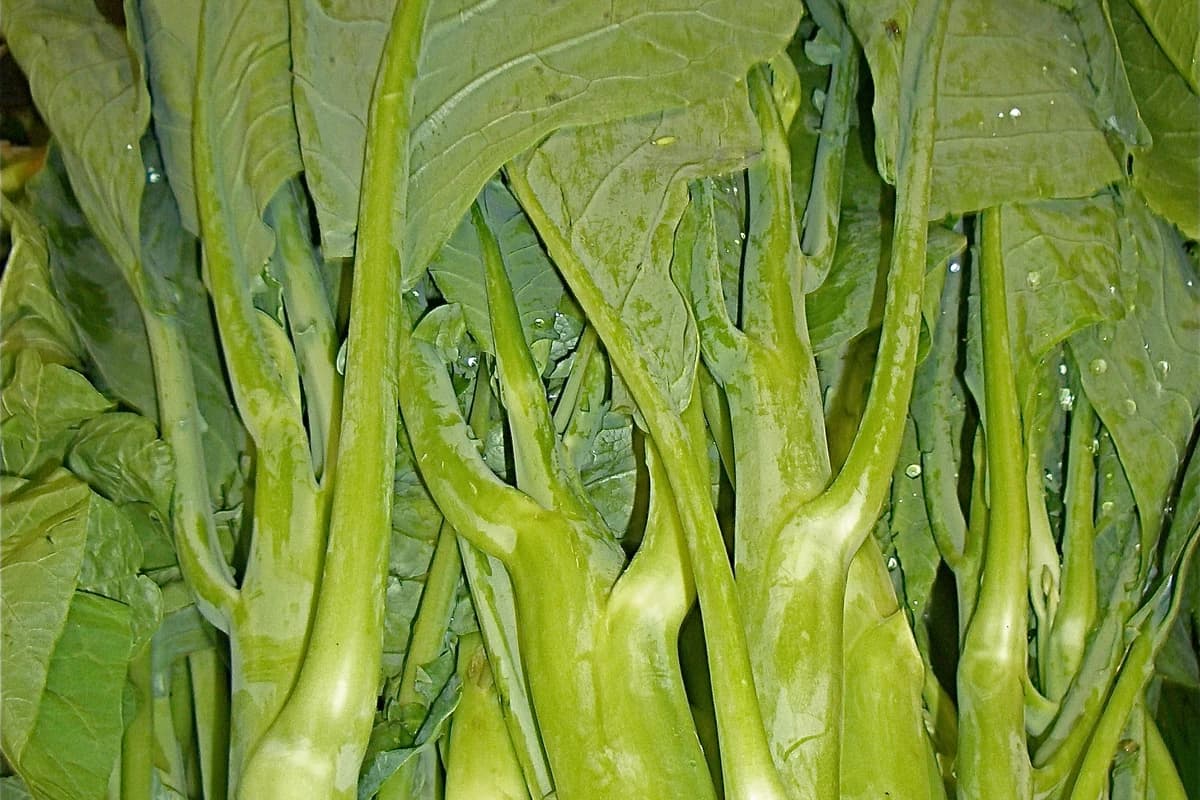
About This Plant
Gai lan, also called Chinese broccoli or Chinese kale, is a cool-season Brassica grown for thick tender stems, glossy blue-green leaves, and small flower buds harvested before full bloom. It performs well in soil, containers, and active hydroponic systems when temperatures stay mild, roots are well oxygenated, and harvest occurs promptly at the bolting stem stage.
How to Grow Gai Lan
Learn how to grow Gai Lan from seed to harvest in 55 days. Beginner difficulty. Complete nutrient guide, pH/EC requirements, and growing conditions for hydroponics, soil & greenhouse.
Sources cited: 20.
Nutrient Requirements by Growth Stage
For hydroponics, use half-strength Hoagland-like nutrition as the primary production baseline: the Chinese broccoli study used 50% Hoagland at pH 6.0-6.5 and EC 1.1-1.2 mS cm-1 after seedlings reached the third true leaf. This supplies roughly 105 ppm N, 15 ppm P, and 117 ppm K; seedling feed can start near half of…
Sign in to view nutrient requirements
A free account unlocks NPK targets for all four growth stages, micronutrient levels, a per-stage nutrient calculator, and the full nutrition guide. Signing up takes one click. Truleaf is a free, non-profit project, and every new account helps it grow. No spam, ever.
Growing Environments
Gai lan can be grown outdoors, in greenhouses, containers, and indoor hydroponic systems. UF/IFAS describes Asian crucifers as raised-bed crops with drip, overhead, or subsurface irrigation, and Chinese broccoli hydroponic research confirms production in aerated containers under greenhouse conditions…
Temperature
Gai lan is a cool-season brassica. Controlled hydroponic work describes Chinese broccoli as cold tolerant and heat sensitive, preferring 15-25C overall, with 25-30C useful for germination and transplant adaptation and 15-20C better for leaf and bolting-stem development. Keep production near 18C when possible; sustained heat pushes premature flowering and tougher stems.
Humidity
A moderate humidity band is safest for gai lan. The hydroponic root-temperature study maintained about 50% relative humidity while producing marketable Chinese broccoli, and brassica disease guidance emphasizes reducing prolonged leaf wetness…
Light
Use bright, steady light rather than shade. Chinese broccoli hydroponic experiments used a 16-hour photoperiod, while controlled-environment Chinese kale mineral studies used leafy-green intensities around 250-350 umol m-2 s-1…
Airflow
Air movement is a disease and calcium-management tool for gai lan. Dense brassica leaves are prone to downy mildew and Alternaria when foliage stays wet, and localized tip burn worsens when transpiration is poor…
Sign in to view environmental requirements
A free account unlocks exact temperature, humidity, light and airflow targets, including germination and growth ranges, DLI, photoperiod and PPFD, plus the full environment guide. Signing up takes one click. Truleaf is a free, non-profit project, and every new account helps it grow. No spam, ever.
Hydroponic System Compatibility
Active hydroponic systems are strongly compatible because Chinese broccoli has been grown successfully in aerated nutrient solution with controlled EC and pH. DWC and NFT are preferred for short-cycle leafy/stem production; ebb-flow and drip work with inert media or containers; Kratky is acceptable for small baby-stem…
Growing Media
Use sterile, moisture-retentive but aerated media. Hydroponic studies germinated Chinese broccoli before transplanting and then grew plants in aerated nutrient solution; practical systems can use rockwool, foam, coco-perlite, clay pebbles, or fertile well-drained soil…
Container Specs
A 20 cm deep container is sufficient for one compact gai lan plant, while field guidance supports dense spacing of 3-5 inches within rows for Chinese broccoli on raised beds. Containers need drainage, steady moisture, and enough spacing for airflow…
Training & Support
No staking, trellising, or structural training is required for gai lan. The crop is harvested as a self-supporting bolting stem with attached young leaves and terminal buds…
Sign in to view system compatibility
A free account unlocks why each of the six systems fits or fails, plus growing media, container sizes, training methods, companion plants, and the full systems guide. Signing up takes one click. Truleaf is a free, non-profit project, and every new account helps it grow. No spam, ever.
Propagation
Gai lan is propagated from seed. UF/IFAS lists Chinese broccoli among Asian crucifers and gives 0.25-0.5 inch seeding depth with dense in-row spacing for field production…
Harvesting
Harvest the tender upper stem at marketable bolting stage, before flowers open fully. In the hydroponic Chinese broccoli study, marketable yield was the main stem with terminal floral buds and 6-7 leaves, harvested when most plants reached marketable maturity…
Planting Calendar
Schedule gai lan for cool windows. UF/IFAS planting tables place Chinese broccoli in late-summer-through-winter or spring windows in Florida, with north Florida Aug-Feb and central/south Florida Sept-Apr…
Common Issues
The main risks are brassica foliar diseases, aphids, tip burn, bolting, and root rots. Alternaria produces target-like lesions and survives on seed, weeds, volunteers, and residue…
Get the full science-backed guide
By signing up, you help keep Truleaf free and support the growth of our nonprofit project. Your account unlocks full details for every plant issue—including symptoms, causes, step-by-step solutions, and prevention—plus the month-by-month planting calendar, the complete guide, and all research sources. It only takes one click. No spam, ever.