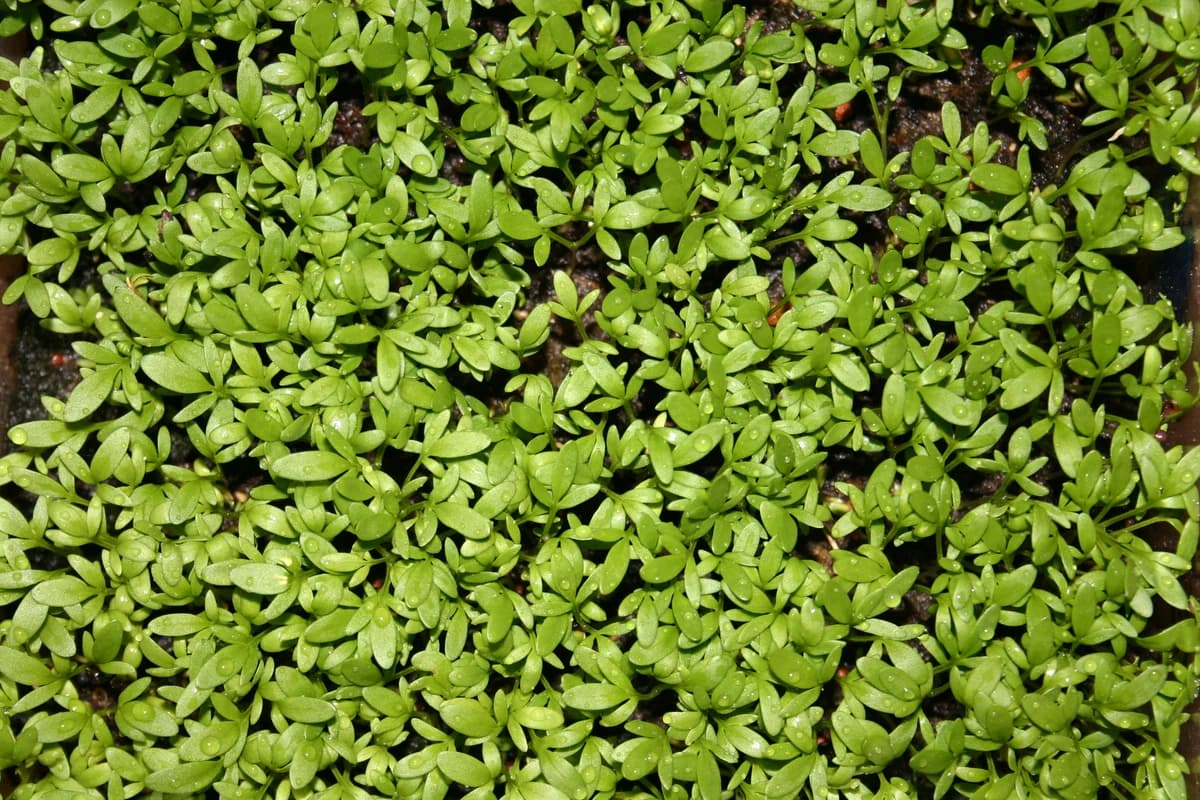
About This Plant
A fast-growing, peppery-flavored microgreen or leafy green, often harvested within two weeks of sowing. It is a member of the mustard family and is popular for salads and garnishes. Due to its rapid growth cycle, it is typically grown as a microgreen or sprout.
How to Grow Cress (Garden Cress)
Learn how to grow Cress (Garden Cress) from seed to harvest in 15 days. Beginner difficulty. Complete nutrient guide, pH/EC requirements, and growing conditions for hydroponics, soil & greenhouse.
Sources cited: 12.
Nutrient Requirements by Growth Stage
The previous 150-39-162 ppm NPK profile was too strong to call cress-specific. Garden-cress microgreen trials showed better growth with mineral nutrition than demineralized water, but 100% and 50% modified Hoagland were close in height, so the safest target is mild complete nutrition rather than high EC…
Sign in to view nutrient requirements
A free account unlocks NPK targets for all four growth stages, micronutrient levels, a per-stage nutrient calculator, and the full nutrition guide. Signing up takes one click. Truleaf is a free, non-profit project, and every new account helps it grow. No spam, ever.
Growing Environments
Garden cress is unusually flexible: it works as an indoor microgreen, a greenhouse tray crop, a shallow container crop, or an outdoor cool-season leafy herb. Indoor and greenhouse trays give the best control over moisture, light, and sanitation…
Temperature
Garden cress is a cool-season Brassicaceae crop. Germinate at 18-25C and target about 20-24C for fast emergence; controlled cress sprout work used 24 +/- 2C, while greenhouse cress grew successfully at 22/18C day/night. After emergence, hold growth around 15-25C, with 18-24C preferred for clean, rapid microgreen production. Avoid hot trays because heat accelerates bolting and quality loss.
Humidity
Use high humidity only briefly while covered trays are germinating, then vent promptly. Cress microgreens were studied at 60/65% RH and sprouts at 50-70% RH, but general microgreen disease guidance supports a drier production target after emergence…
Light
After blackout or covered germination, provide moderate sole-source light. The current target of 200 umol m-2 s-1 for 14 hours gives a DLI of 10.08 mol m-2 d-1; this is close to garden-cress sprout work at 215 +/- 5.5 umol m-2 s-1 for a 16-hour photoperiod…
Airflow
Keep gentle air moving across, not directly blasting into, the tray surface. Airflow is not a yield input for cress by itself, but it is a sanitation and moisture-control tool: damping-off pathogens spread in wet trays, and seedling disease pressure rises when covers, dense sowing, and saturated media keep stems wet…
Sign in to view environmental requirements
A free account unlocks exact temperature, humidity, light and airflow targets, including germination and growth ranges, DLI, photoperiod and PPFD, plus the full environment guide. Signing up takes one click. Truleaf is a free, non-profit project, and every new account helps it grow. No spam, ever.
Hydroponic System Compatibility
Tray culture with bottom watering or ebb-flow benches is the strongest fit for dense cress microgreens. DWC and passive Kratky can work for a short cycle if roots have oxygen and water is clean, while NFT, drip, and aeroponics are technically compatible with leafy greens but usually inefficient for dense 8-15 day…
Growing Media
Use clean shallow media or mats that hold moisture without staying saturated. Garden-cress microgreen research used cellulose paper pads, sterile gauze, and biochar substrates, and extension microgreen practice supports soilless mats or shallow tray media…
Container Specs
A shallow tray is enough because cress is harvested before it develops a deep root system. Use at least 3 cm depth, drainage holes, and a catch tray; a humidity dome or cover is useful only through germination…
Training & Support
No training or support is required. Garden cress is a short-cycle annual herb or microgreen, so trellises, stakes, pruning, topping, and cages add no value…
Sign in to view system compatibility
A free account unlocks why each of the six systems fits or fails, plus growing media, container sizes, training methods, companion plants, and the full systems guide. Signing up takes one click. Truleaf is a free, non-profit project, and every new account helps it grow. No spam, ever.
Propagation
Garden cress is propagated from seed. For microgreens, broadcast untreated food-safe seed evenly over a moist level medium, press for contact, and mist lightly; for garden leaves, shallow direct sowing is supported by extension guides…
Harvesting
Harvest microgreens when cotyledons are open and the first true leaves are just beginning, normally about 8-15 days depending temperature, light, and target size. Cut cleanly just above the medium with sanitized scissors so roots and substrate stay out of the product…
Planting Calendar
Indoor cress trays can be sown every week year-round because the crop is finished quickly and does not need transplanting. Outdoor garden cress belongs in cool seasons: Arkansas extension recommends shallow sowing after frost danger and repeating at two-week intervals, with protected cold frames extending winter…
Common Issues
The main risks are damping-off, mold risk around wet mucilaginous seeds, uneven germination, legginess, and seed hull retention. Damping-off is caused by seedling pathogens such as Pythium, Rhizoctonia, Fusarium, and Phytophthora and is favored by wet media and reused trays…
Get the full science-backed guide
By signing up, you help keep Truleaf free and support the growth of our nonprofit project. Your account unlocks full details for every plant issue—including symptoms, causes, step-by-step solutions, and prevention—plus the month-by-month planting calendar, the complete guide, and all research sources. It only takes one click. No spam, ever.