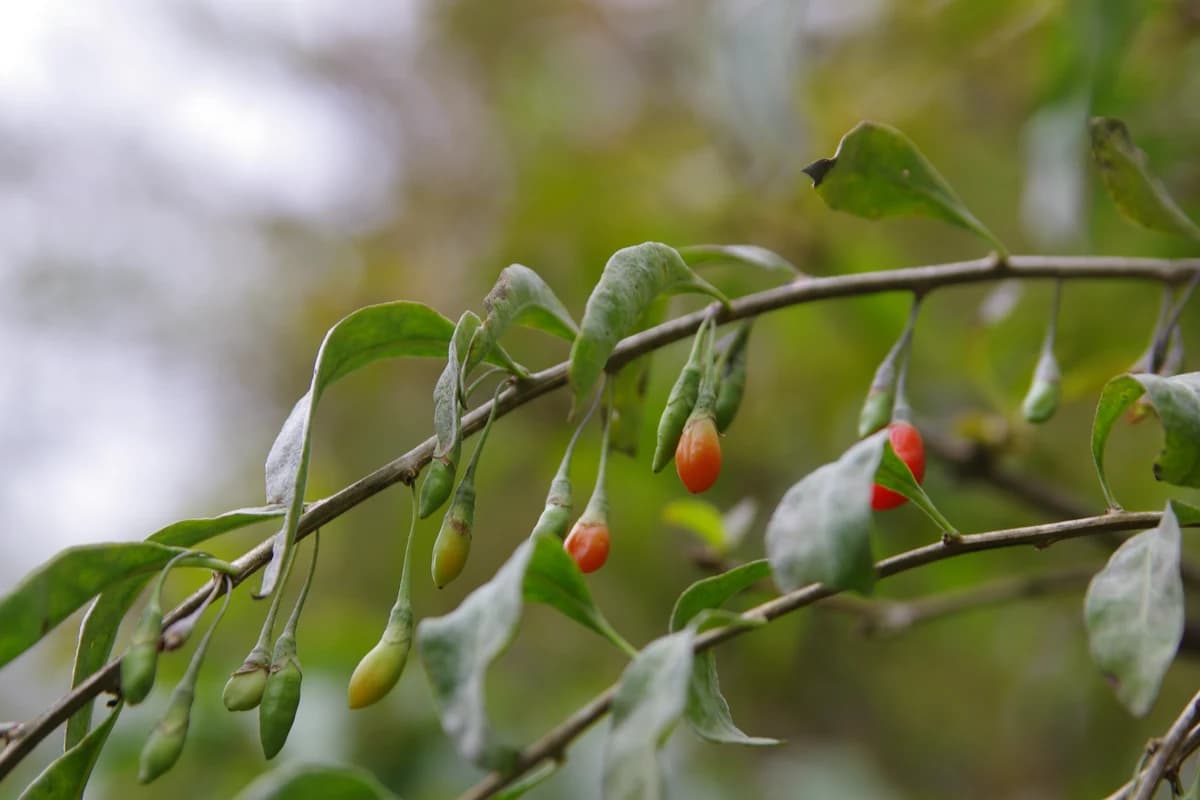
About This Plant
Goji berry is a hardy, thorny perennial fruit shrub grown for small red berries used fresh, dried, frozen, juiced, or in teas. It performs best in full sun, light well-drained slightly alkaline soil, and hot dry fruiting weather, with pruning and careful irrigation needed to keep plants productive and manageable.
How to Grow Goji Berry
Learn how to grow Goji Berry from seed to harvest in 730 days. Intermediate difficulty. Complete nutrient guide, pH/EC requirements, and growing conditions for soil & container.
Sources cited: 9.
Nutrient Requirements by Growth Stage
The old high fruiting K and high N ppm values were not directly verified by goji hydroponic trials. Complete field studies instead show that water-nitrogen coupling is the best-supported nutrition signal: moderate nitrogen near 300 kg/ha with mild water deficit repeatedly ranked highest for yield, quality, water-use…
Sign in to view nutrient requirements
A free account unlocks NPK targets for all four growth stages, micronutrient levels, a per-stage nutrient calculator, and the full nutrition guide. Signing up takes one click. Truleaf is a free, non-profit project, and every new account helps it grow. No spam, ever.
Growing Environments
Outdoor and greenhouse culture are the best fits. Goji tolerates harsh sites better than many fruits, prefers full sun, and handles drought once established, but new transplants need regular water…
Temperature
Goji berry should be treated as a hardy outdoor perennial shrub, not a warm-season annual. USU recommends goji for cold-winter zones 4-7, while established plants in garden guides are managed outdoors and fruit best in hot, dry weather. For seed work, a complete wolfberry germination experiment incubated seeds at 28C and tracked germination through day 10. Use 24C as a controlled-environment growth target, protect containers from hard root freezing, and avoid cool humid fruiting weather that lowers fruit quality.
Humidity
Keep humidity moderate rather than tropical. USU reports fruit quality is best in hot, dry conditions and diminishes when weather is cool and humid…
Light
Give goji full sun for reliable flowering and fruiting. USU says plants tolerate some shade but should be planted in full sun, and NC State lists full sun conditions for Lycium fruiting shrubs…
Airflow
Airflow is a disease-management requirement for goji. USU recommends pruning to keep plants open for light penetration and air circulation, and its disease table links powdery mildew management with pruning and reduced wet foliage…
Sign in to view environmental requirements
A free account unlocks exact temperature, humidity, light and airflow targets, including germination and growth ranges, DLI, photoperiod and PPFD, plus the full environment guide. Signing up takes one click. Truleaf is a free, non-profit project, and every new account helps it grow. No spam, ever.
Hydroponic System Compatibility
Drip-irrigated soil or substrate is the supported production system. USU identifies drip as the most efficient irrigation method and notes it helps keep weed and disease pressure low…
Growing Media
Use light, well-drained loam as the preferred medium. USU states goji tolerates many soil types, grows natively in slightly alkaline soil around pH 7-8, dislikes acidic soils, and performs poorly when roots remain wet…
Container Specs
Use the largest practical, well-drained container for patio culture. Extension sources describe mature plants as 3-6 ft when pruned and up to 12 ft when unmanaged, with suckering growth after several years…
Training & Support
Training is optional support plus required pruning. USU emphasizes dormant pruning to remove weak, damaged, and crossing branches, shorten laterals by 6-18 inches, limit height, and pinch terminal growth in early summer so more lateral fruiting wood forms…
Sign in to view system compatibility
A free account unlocks why each of the six systems fits or fails, plus growing media, container sizes, training methods, companion plants, and the full systems guide. Signing up takes one click. Truleaf is a free, non-profit project, and every new account helps it grow. No spam, ever.
Propagation
Use vegetative propagation for cultivar fidelity. USU notes plants can readily be propagated from seed, but named cultivars are preferred to ensure productive, high-quality planting stock…
Harvesting
Harvest by hand when berries reach full red color, about 35 days after full bloom. Goji fruit do not separate cleanly enough for shaking, and bruised berries turn black, so USU recommends pulling fruit slightly to the side and cooling or processing promptly…
Planting Calendar
Start seeds indoors in late winter only when seed propagation is desired; otherwise plant rooted cuttings or nursery plants in spring after hard frost risk passes. USU reports named cultivars can begin bearing 1-2 years after planting and reach full production in 3-5 years…
Common Issues
The existing issue list was directionally useful but needed source-backed normalization. Powdery mildew is a verified goji disease with cultivar-dependent resistance: one study reported 7.85% incidence for resistant Ningqi I but 72.92% for susceptible Huangguo after inoculation…
Get the full science-backed guide
By signing up, you help keep Truleaf free and support the growth of our nonprofit project. Your account unlocks full details for every plant issue—including symptoms, causes, step-by-step solutions, and prevention—plus the month-by-month planting calendar, the complete guide, and all research sources. It only takes one click. No spam, ever.