About This Plant
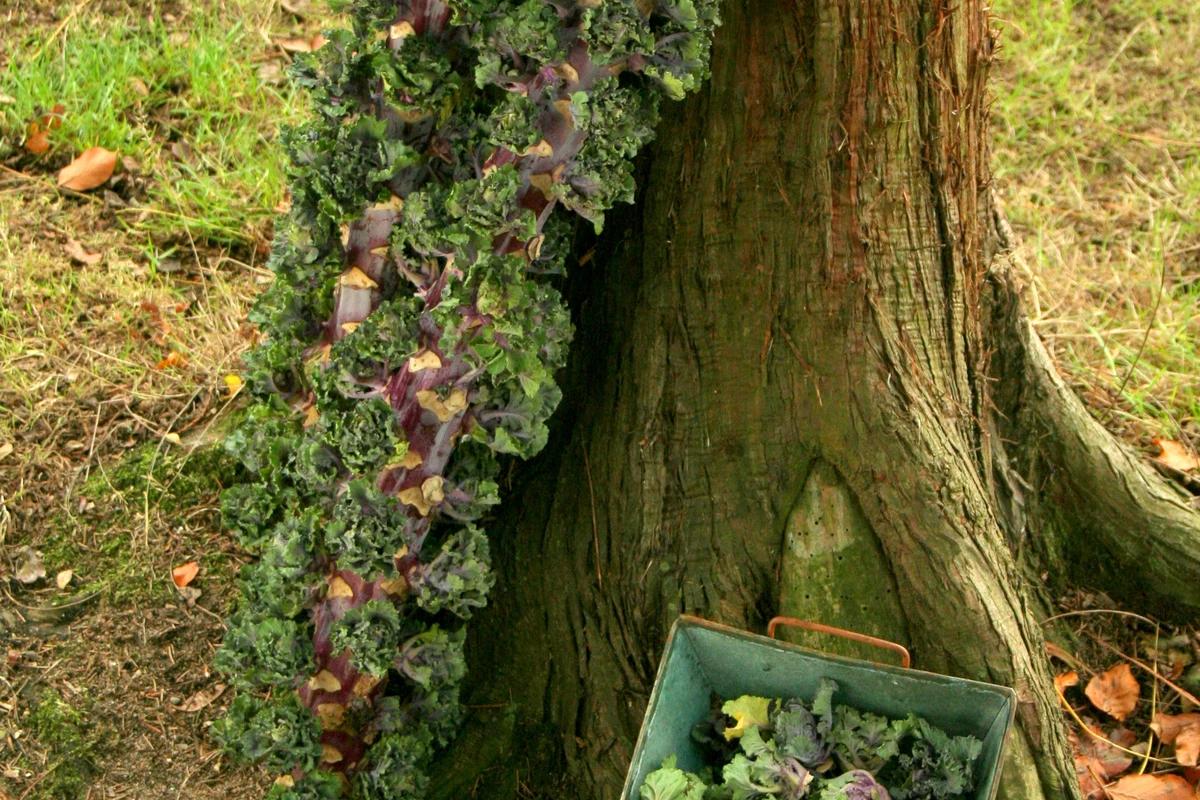
Kalettes (Flower Sprouts) are a proprietary Brassica oleracea hybrid of kale and Brussels sprouts (Tozer Seeds, c.2010), grown as a tall single stalk that bears many small, frilly kale-leaf rosette 'sprouts' in the leaf axils. They are a long-season cool-climate crop, roughly 110-140 days from transplant, timed so the sprouts fill in cold autumn-to-winter weather - a light frost sweetens them. Nutritionally they follow a kale frame phase and a Brussels-sprout sprout-forming phase: high nitrogen while building the stalk and canopy, then tapering nitrogen with rising potassium and critical boron through sprout fill, since excess late nitrogen blows the sprouts and low boron causes hollow, corky stems. As a 60-90 cm top-heavy stalk crop it suits media-anchored drip or ebb-and-flow rather than bare-root systems, and is harvested bottom-up as individual sprouts over several weeks.
How to Grow Kalettes (Flower Sprouts)
Learn how to grow Kalettes (Flower Sprouts) from seed to harvest in 110 days. Intermediate difficulty. Planting, care, feeding and the right growing conditions.
Sources cited: 42.
Nutrient Requirements by Growth Stage
Kalettes carry NO species-specific fertilization literature, so the per-stage solution values below merge peer-reviewed Brassica oleracea analogs - hydroponic kale for the leaf/frame phase and Brussels sprouts for the axillary sprout organ - and should be treated as well-supported defaults, not species-measured…
Sign in to view nutrient requirements
A free account unlocks NPK targets for all four growth stages, micronutrient levels, a per-stage nutrient calculator, and the full nutrition guide. Signing up takes one click. Truleaf is a free, non-profit project, and every new account helps it grow. No spam, ever.
Growing Environments
Kalettes suit indoor, outdoor, greenhouse and container culture. They are a classic cool-season outdoor bed crop, sown in the cool of spring or summer for an autumn-winter harvest, and grow well in large containers (at least 19 L) thanks to a compact but deep root system on a tall stalk…
Temperature
Kalettes are a cool-season Brassica oleracea hybrid that grows best at 15-18C (60-65F), within a practical range of 15-21C; UF/IFAS gives the Brussels-sprout parent (Gemmifera group) an optimum of 58-60F (14.4-15.6C), so the optimal was lowered from 18C to 16C to sit inside the extension optimum. Germinate warm: seed emerges fastest at 18-24C (65-75F) even though the crop is then grown cool, so start seed warm and move seedlings to cool growing temperatures. Sustained heat above about 24C provokes bolting and loss of flavour, while a light frost late in the cycle actually sweetens the sprouts.
Humidity
Hold relative humidity around 60-70% (optimal ~65%) during growth - a standard, low-disease band for cool-season brassicas that keeps foliage dry enough to limit downy mildew and black rot while supporting the transpiration that carries calcium and boron into the developing sprouts. Note that cold STORAGE after…
Light
Target a daily light integral near 15 mol/m2/day over a 16-hour photoperiod at roughly 260 umol/m2/s canopy PPFD (260 x 16 x 3600 / 1e6 = 15.0, so the three values are internally consistent). The stored block was physically impossible - 400 umol/m2/s over 16 h yields DLI 23, not 15 - so intensity was corrected from…
Airflow
Provide steady horizontal air movement across the canopy, roughly 0.3-1.0 m/s. Active airflow keeps the dense sprout rosettes and leaf axils dry to suppress the foliar brassica diseases kalettes are prone to (downy mildew, black rot) and drives the transpiration stream that moves calcium and boron into the tissue,…
Sign in to view environmental requirements
A free account unlocks exact temperature, humidity, light and airflow targets, including germination and growth ranges, DLI, photoperiod and PPFD, plus the full environment guide. Signing up takes one click. Truleaf is a free, non-profit project, and every new account helps it grow. No spam, ever.
Hydroponic System Compatibility
Kalettes are a 60-90 cm tall, top-heavy, single-stalk, 110-day crop with a deep (~40 cm) Brussels-sprout root system, which constrains soilless system choice far more than a small leafy green. Media-anchored systems that ballast the stalk and feed the deep roots across the long cycle work best: media-based drip…
Growing Media
Use media-based hydroponics only (drip or ebb-and-flow). Coco-coir, or a coco-coir/perlite blend, is the most common substrate for large Dutch-bucket brassicas: it holds moisture while draining freely and gives the tall stalk ballast…
Container Specs
Kalettes need a large, deep container to anchor the tall stalk and feed the deep root system over the long season: provide at least a 19 L (5-gal) pot, about 30 cm deep and wide, with reliable drainage. Space plants about 45 cm (18 in) apart, matching the Brussels-sprout parent…
Training & Support
Kalettes benefit from light training on their tall single stalk but do not strictly require it. Staking is optional and useful where a 60-90 cm top-heavy stalk risks lodging in wind or under a heavy sprout load…
Sign in to view system compatibility
A free account unlocks why each of the six systems fits or fails, plus growing media, container sizes, training methods, companion plants, and the full systems guide. Signing up takes one click. Truleaf is a free, non-profit project, and every new account helps it grow. No spam, ever.
Propagation
Grow kalettes from seed only - this proprietary kale x Brussels-sprout hybrid has no cutting or vegetative propagation, and both the transplant and direct-sow routes collapse to seed. Start seed warm at 18-24C (65-75F), sowing about 5 mm (1/4 in) deep; seedlings emerge in roughly 7-10 days…
Harvesting
Kalettes share the Brussels-sprout harvest architecture: the edible product is the small, open, frilly rosette 'sprout' borne in the leaf axils along a tall central stalk. Harvest by hand, picking or snapping individual sprouts when they are firm, well-formed and about 3-4 cm across, taking the lowest (oldest) sprouts…
Planting Calendar
Kalettes are a long-season cool-climate crop timed so sprout fill lands in the cold autumn-to-winter window, when frost sweetens the sprouts. In Northern-Hemisphere temperate zones, sow indoors from April to July, transplant out from May to September (region-dependent), and harvest from October into February after the…
Common Issues
Kalettes carry the full pest and disease complex of the mustard family, inherited from both the kale and Brussels-sprout parents. The everyday insect problems are aphids and caterpillars: the cabbage aphid (Brevicoryne brassicae) forms dense grey-waxy colonies deep inside the sprout rosettes where it contaminates the…
Get the full science-backed guide
By signing up, you help keep Truleaf free and support the growth of our nonprofit project. Your account unlocks full details for every plant issue—including symptoms, causes, step-by-step solutions, and prevention—plus the month-by-month planting calendar, the complete guide, and all research sources. It only takes one click. No spam, ever.