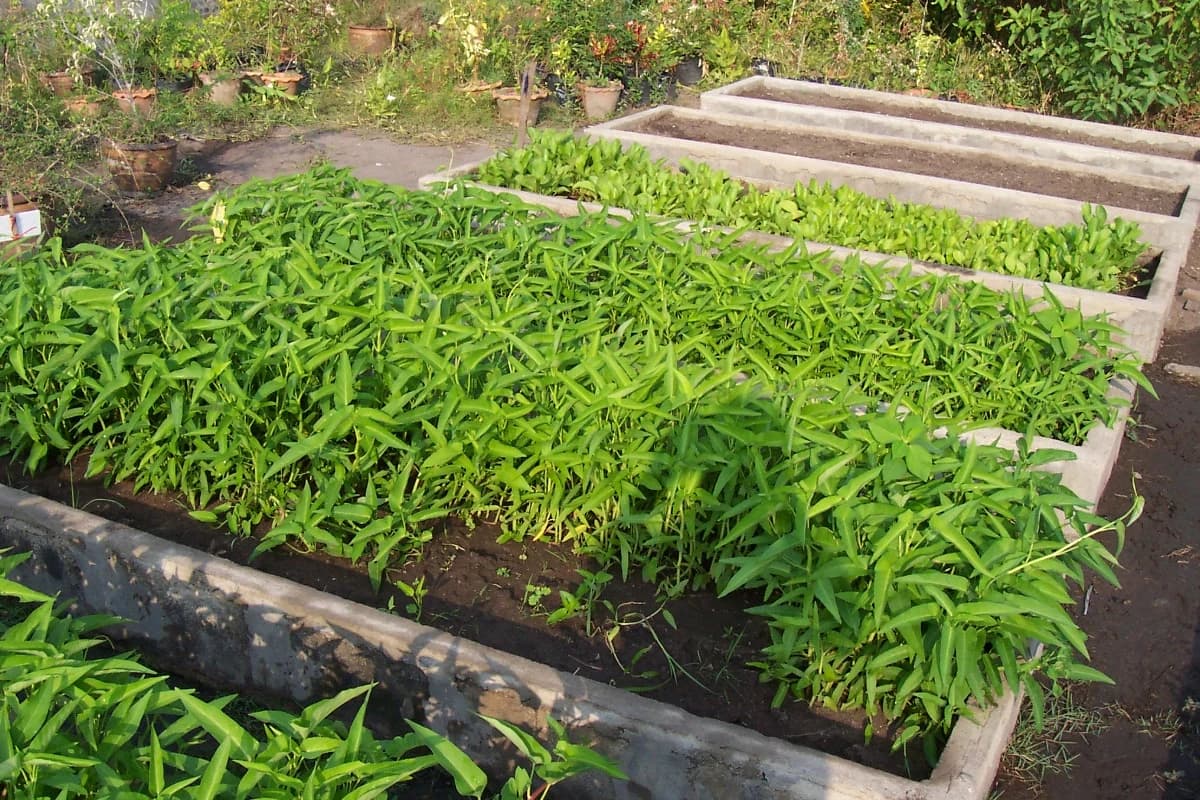
About This Plant
Kangkong (Ipomoea aquatica), or water spinach, in its aquatic (lowland) form is a fast-growing, heat-loving tropical leafy green grown for its tender hollow-stemmed shoots and arrow-shaped leaves. This ecotype is adapted to standing, flooded water with roots continuously submerged, so it thrives in deep water culture, floating rafts and passive Kratky systems rather than free-draining media. It is an exceptionally nitrogen-responsive, potassium-forward crop that takes up roughly three times the nitrogen of lettuce, and it is cut-and-come-again: the first harvest comes about 4-6 weeks after establishing, then repeat cuts every 1-2 weeks as new shoots regenerate from every stem node. Propagated mainly by stem cuttings, it is warm-season and frost-tender. Note it is a US Federal Noxious Weed, so contained culture is advised to keep it from escaping into waterways.
How to Grow Kangkong (Aquatic Type)
Learn how to grow Kangkong (Aquatic Type) from seed to harvest in 30 days. Beginner difficulty. Complete nutrient guide, pH/EC requirements, and growing conditions for hydroponics, soil & greenhouse.
Sources cited: 32.
Nutrient Requirements by Growth Stage
Kangkong is a fast, high-throughput leafy green with an unusually heavy, potassium-forward nutrient appetite: in controlled hydroponics it took up roughly three times the N, P and K of lettuce, at an N:P:K uptake ratio near 100:32:243. The only controlled hydroponic study of the exact species (Wang et al…
Sign in to view nutrient requirements
A free account unlocks NPK targets for all four growth stages, micronutrient levels, a per-stage nutrient calculator, and the full nutrition guide. Signing up takes one click. Truleaf is a free, non-profit project, and every new account helps it grow. No spam, ever.
Growing Environments
Kangkong suits indoor, outdoor, greenhouse and container culture. It grew to best-in-class biomass in an indoor controlled-climate chamber, is a highly productive warm-season outdoor field and paddy crop, and has been grown under greenhouse/protected culture with genotypes selected for temperate regions where warmth…
Temperature
The aquatic type of water spinach (Ipomoea aquatica) is a warm-season tropical wetland crop and must be grown warm. Target a vegetative air temperature of about 21-30C with an optimum near 25C - the setpoint two independent studies used for healthy growth. The species is genuinely heat-resistant, slowing only once prolonged temperatures reach around 42C, but it is frost-tender and suffers chilling damage below roughly 10C, so the pre-enrichment 18-25C range was a cool-season misread and the growth ceiling has been raised from 25 to 30C. Germinate seed warm, around 25-30C (28C in the reference study), for fast, uniform emergence. Outside the tropics the crop needs the warm season or protected/heated culture to hold these temperatures.
Humidity
Hold relative humidity around 60-80% with an optimum near 70%. Cheng et al…
Light
Give a 12-hour photoperiod at roughly 300 umol/m2/s canopy PPFD (about DLI 13 mol/m2/day). Cheng et al…
Airflow
Provide gentle, steady air movement of about 0.3-1.0 m/s across the canopy. No species-specific airflow measurement exists, so this is the general leafy-green standard, reasoned from the crop's own needs: active airflow strengthens the hollow, succulent stems and keeps the warm, humid (~70% RH) canopy below the…
Sign in to view environmental requirements
A free account unlocks exact temperature, humidity, light and airflow targets, including germination and growth ranges, DLI, photoperiod and PPFD, plus the full environment guide. Signing up takes one click. Truleaf is a free, non-profit project, and every new account helps it grow. No spam, ever.
Hydroponic System Compatibility
Because the aquatic ecotype is adapted to standing, flooded water with roots continuously submerged, deep-water systems are the natural choice. Deep water culture (DWC) is excellent: in pumpless standing-water tanks water spinach out-grew five other wetland species with a 9.8-fold shoot-biomass gain, and floating-raft…
Growing Media
In DWC/floating-raft/DFT culture the aquatic ecotype is grown in net pots where the medium only anchors the seedling or cutting - the standing nutrient solution supplies water and nutrition. Khozin et al…
Container Specs
This is the AQUATIC/lowland type, so the container must HOLD STANDING WATER rather than drain - drainage is set to false, the single most important container difference from the upland type. Use any watertight tub, pond-margin tray or deep container at least 20 cm deep so it can carry a mud/medium layer plus 3-8 cm of…
Training & Support
No trellis, cage or staking is used. Kangkong is a prostrate/trailing to free-floating vine - the aquatic type's hollow, air-filled internodes make it buoyant, so it sprawls flat across the water surface rather than climbing…
Sign in to view system compatibility
A free account unlocks why each of the six systems fits or fails, plus growing media, container sizes, training methods, companion plants, and the full systems guide. Signing up takes one click. Truleaf is a free, non-profit project, and every new account helps it grow. No spam, ever.
Propagation
The aquatic (lowland) type of kangkong is propagated PRIMARILY by vegetative stem cuttings - the dominant commercial and home method for this form, which is 'usually propagated vegetatively'. Cuttings root readily: detached shoots stood in plain water form adventitious roots from the nodes within ~10-20 days, and…
Harvesting
Kangkong is a classic cut-and-come-again / ratooned crop (regrows = true), the defining feature of its harvest workflow. The first harvest is ready about 4-6 weeks after establishing; Linnemann et al…
Planting Calendar
Kangkong is a warm-season, frost-tender tropical perennial with an optimum air/water temperature of ~25-30C. In the tropics it grows and is harvested YEAR-ROUND…
Common Issues
Kangkong's main disease is white rust, caused by the obligate oomycete Albugo ipomoeae-aquaticae (syn. A…
Get the full science-backed guide
By signing up, you help keep Truleaf free and support the growth of our nonprofit project. Your account unlocks full details for every plant issue—including symptoms, causes, step-by-step solutions, and prevention—plus the month-by-month planting calendar, the complete guide, and all research sources. It only takes one click. No spam, ever.