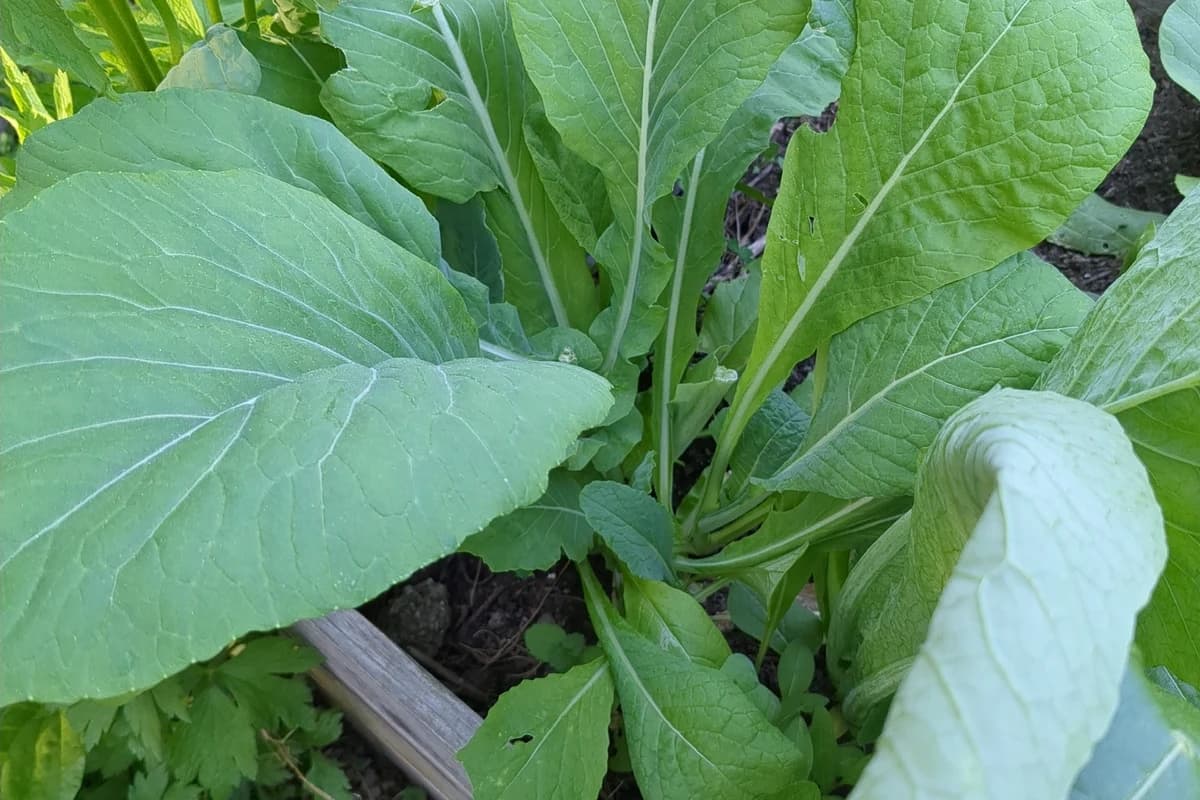
About This Plant
Komatsuna (Japanese mustard spinach) is a fast-growing, cold-hardy leafy green of Brassica rapa var. perviridis, closely related to bok choy and turnip. Prized for its mild, slightly sweet flavor, it is harvested young: baby-leaf at 20-25 days and full rosettes at about 40 days. A heavy but salt-sensitive feeder, it thrives at 15-25C, EC 1.5-2.0 dS/m, and pH 5.8-6.5, and suits every major hydroponic system (NFT, DWC, ebb-and-flow, drip, Kratky, and aeroponics). It is harvested vegetatively, either as a whole plant or cut-and-come-again, before bolting.
How to Grow Komatsuna
Learn how to grow Komatsuna from seed to harvest in 40 days. Beginner difficulty. Complete nutrient guide, pH/EC requirements, and growing conditions for hydroponics, soil & greenhouse.
Sources cited: 32.
Nutrient Requirements by Growth Stage
Komatsuna is a heavy but salt-sensitive leafy feeder with a K-forward, N-forward profile and no reproductive feed stage. During the seedling stage (EC 0.8-1.2), run half-strength nutrients: N 100-150 opt 118, P 15-25 opt 20, K 100-150 opt 118 ppm…
Sign in to view nutrient requirements
A free account unlocks NPK targets for all four growth stages, micronutrient levels, a per-stage nutrient calculator, and the full nutrition guide. Signing up takes one click. Truleaf is a free, non-profit project, and every new account helps it grow. No spam, ever.
Growing Environments
Komatsuna excels across indoor, outdoor, greenhouse, and container environments. Indoor and vertical-farm production is ideal: a plant-factory study cultured komatsuna under white LED at 250 plants/m2 with a full closed-system nutrient recipe, and the short cycle, compact habit, and moderate light needs make it a…
Temperature
Komatsuna is a fast cool-season Brassica. Germinate at 18-25C and grow at 15-25C with an optimum near 20C. It tolerates cool root and air temperatures well; Onoue et al. (2018) studied komatsuna growth under low temperature and confirmed its cool-season vigor and tolerance of sub-20C conditions. Sustained temperatures above 25C trigger bolting and bitterness (see commonIssues), and root-zone heat above 24C in recirculating systems accelerates the reproductive switch. As a traditional Japanese winter green, komatsuna is more cold-hardy than most brassicas and withstands light frost, which makes it well-suited to fall and overwintered production. Keep the nutrient solution below 22C to limit damping-off and to hold quality through rapid leaf expansion.
Humidity
Hold relative humidity at 50-70% with about 60% as the optimum. This is the standard leafy-green controlled-environment band, and it is corroborated by komatsuna's own failure modes: humidity above 70% promotes downy mildew and suppresses the transpiration that carries calcium to young leaves, causing tip burn…
Light
Target a DLI of about 14 mol/m2/day, delivered as roughly 250 umol/m2/s PPFD over a 16 hour photoperiod. The stored DLI was corrected from 12 to 14 to remove an internal inconsistency: 250 umol/m2/s across 16 hours yields 14.4 mol/m2/day, not 12…
Airflow
Maintain gentle continuous airflow of 0.3-1.0 m/s across the canopy. Air movement is functionally important for komatsuna: it sustains the transpiration stream that moves calcium into rapidly expanding young leaves, preventing tip burn, and it keeps leaf surfaces dry to suppress downy mildew…
Sign in to view environmental requirements
A free account unlocks exact temperature, humidity, light and airflow targets, including germination and growth ranges, DLI, photoperiod and PPFD, plus the full environment guide. Signing up takes one click. Truleaf is a free, non-profit project, and every new account helps it grow. No spam, ever.
Hydroponic System Compatibility
Komatsuna is compatible with all major hydroponic systems, and its all-suitable rating is a genuine reflection of a fast leafy green rather than a mis-inherited template. NFT is arguably ideal: the compact, upright, short-cycle habit fits shallow-channel recirculation, and a direct NFT study confirmed good komatsuna…
Growing Media
Rockwool is the preferred hydroponic medium for komatsuna, giving a sterile, pH-neutral substrate with good moisture retention and root-zone aeration for propagation and anchoring. Clay pebbles (Leca) are well-suited to DWC and ebb-and-flow channels; coco coir combined with perlite gives a moisture-retentive yet…
Container Specs
Komatsuna grows well in containers, making it suitable for balcony, patio, and windowsill gardens. Use a pot at least 15 cm deep and 15 cm wide; the shallow, compact root zone means deeper containers are unnecessary…
Training & Support
Komatsuna requires no training, staking, trellising, or support structures. It grows as a compact, upright rosette that is entirely self-supporting, and the short, sturdy stem provides natural stability…
Sign in to view system compatibility
A free account unlocks why each of the six systems fits or fails, plus growing media, container sizes, training methods, companion plants, and the full systems guide. Signing up takes one click. Truleaf is a free, non-profit project, and every new account helps it grow. No spam, ever.
Propagation
Komatsuna is propagated exclusively from seed, either by direct sowing or by starting plugs indoors for transplant. Sow seed 0.5-1 cm deep in moist, sterile media at 18-25C; emergence is very fast and uniform, typically 2-4 days, with germinated seedlings ready to place onto a propagation mat within about a day of…
Harvesting
Komatsuna is fast and forgiving. Baby-leaf grades are ready 20-25 days from sowing, and full-size heads at 35-40 days…
Planting Calendar
Komatsuna follows a cool-season planting pattern but is unusually flexible thanks to both cold-hardiness and moderate heat tolerance. Sow in early spring (Feb-Apr) and again in late summer to autumn (Aug-Sep) for outdoor crops; harvest spring sowings May-Jun and fall sowings Sep-Nov…
Common Issues
Komatsuna faces the specialist Brassica pest and disease complex plus two physiological disorders. The dominant insect pests are flea beetles (Phyllotreta cruciferae, P…
Get the full science-backed guide
By signing up, you help keep Truleaf free and support the growth of our nonprofit project. Your account unlocks full details for every plant issue—including symptoms, causes, step-by-step solutions, and prevention—plus the month-by-month planting calendar, the complete guide, and all research sources. It only takes one click. No spam, ever.