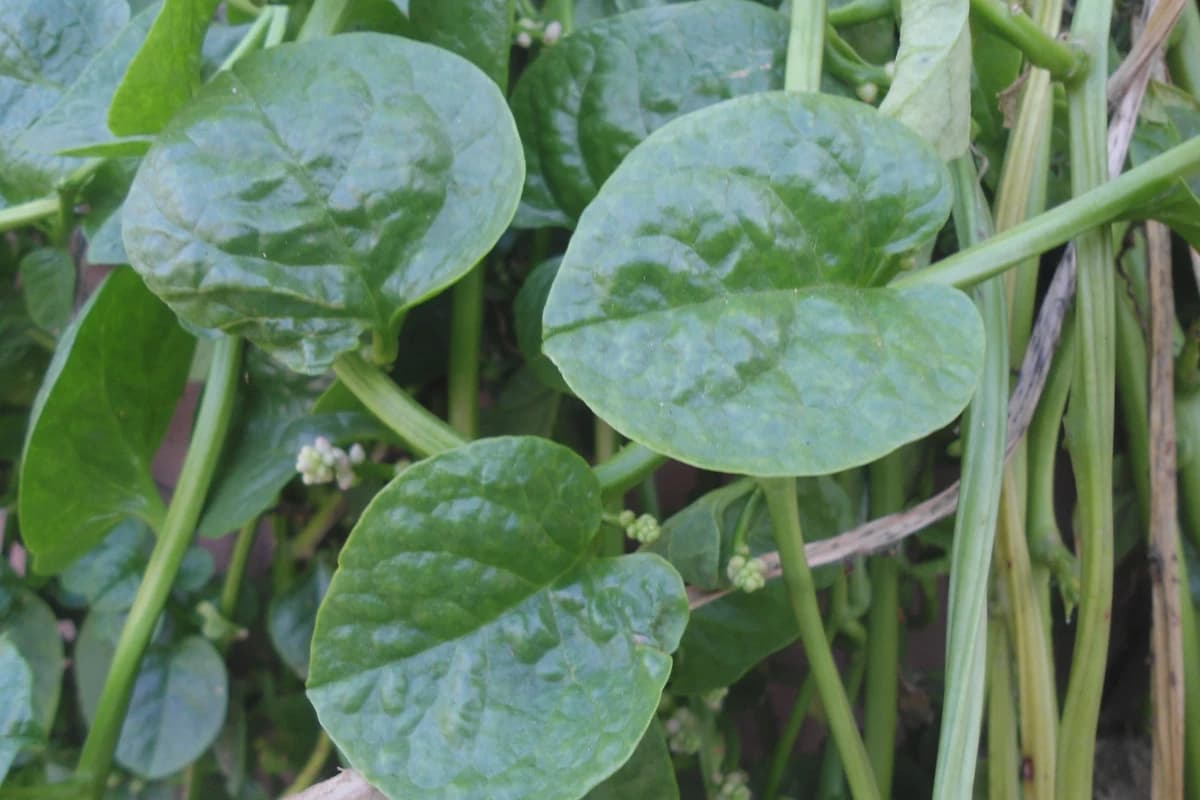
About This Plant
Malabar spinach (Basella alba) is a fast-growing, heat-loving tropical vine grown as a leafy green, a warm-season substitute for true spinach that is perennial in the tropics and grown as an annual in temperate zones. Its mild, slightly peppery leaves and young shoots are harvested cut-and-come-again from the terminal tips, with first harvest around 45-70 days from sowing and repeated cutting across the season. A short-day plant, it stays leafy under roughly 14 h days and bolts to bitterness under short days or water stress. It grows best at 27-32 C in humid conditions, climbs vigorously and needs a trellis, and prefers a humus-rich, near-neutral root zone (pH 5.5-7.0). Direct hydroponic nutrient data is not established for the species; the published evidence base is soil and field agronomy.
How to Grow Malabar Spinach
Learn how to grow Malabar Spinach from seed to harvest in 70 days. Beginner difficulty. Complete nutrient guide, pH/EC requirements, and growing conditions for hydroponics, soil & greenhouse.
Backed by 17 peer-reviewed citations.
Nutrient Requirements by Growth Stage
Direct nutrition evidence for Malabar spinach is entirely soil and pot agronomy; no study reports a hydroponic nutrient-solution recipe, so the per-stage ppm values in this record are unverified analogs carried at lowered confidence rather than measured targets. What the literature does establish: shoot tissue at…
Sign in to view nutrient requirements
A free account unlocks NPK targets for all four growth stages, micronutrient levels, a per-stage nutrient calculator, and the full nutrition guide. Signing up takes one click. Truleaf is a free, non-profit project, and every new account helps it grow. No spam, ever.
Growing Environments
Malabar spinach is adaptable but firmly warm-season. Outdoors, grow it in full sun through the frost-free hot season; it thrives in humid tropical and subtropical conditions and will not survive frost…
Temperature
Malabar spinach is a heat-loving tropical vine that grows best at 27-32 C (optimal about 30 C), well within the 20-35 C optimum reported for the species. It does not tolerate frost; brief exposure near 8 C is survived as a stress rather than killing the plant. Germination proceeds across a warm range and is not confined to the often-quoted 20-24 C: seeds germinate readily in water held below 37 C at 65-75% efficiency, with an optimum near 25 C under light and reliable emergence at roughly 18-30 C. Pair warm air with the scarification and light guidance in the propagation section for the fastest, most even germination.
Humidity
No controlled-environment humidity study exists for Malabar spinach, so the 60-80% range (target about 70%) is an analog estimate rather than a measured optimum. What is documented is a preference for humid, high-rainfall tropical conditions: the species tolerates heavy rainfall and short dry spells, and field crops…
Light
Malabar spinach is a high-light C4 species with fast photosynthesis and high dry-matter production under strong light, though it tolerates light shade by making larger, more succulent leaves. Give it full sun or bright supplemental light…
Airflow
No quantitative airflow rate has been measured for Malabar spinach, so no numeric setpoint is given. The qualitative requirement is clear: the plant dislikes stagnant water and needs a well-aerated root zone…
Sign in to view environmental requirements
A free account unlocks exact temperature, humidity, light and airflow targets, including germination and growth ranges, DLI, photoperiod and PPFD, plus the full environment guide. Signing up takes one click. Truleaf is a free, non-profit project, and every new account helps it grow. No spam, ever.
Hydroponic System Compatibility
No first-party hydroponic, aquaponic or aeroponic trial exists for Malabar spinach, so the system verdicts here are reasoned inferences from its biology, not measured results. The plant dislikes stagnant water and needs an aerated root zone, which favors flowing or well-oxygenated systems (NFT, drip, ebb-and-flow,…
Growing Media
Every media study for Malabar spinach used solid, soil-based substrates. Field and pot trials grew it in garden soil, sand, a 1:1 sand-and-soil blend, and a 2:1:1 mix of garden soil, carbonized rice hull and aged chicken dung, on soils from pH 5.0 up to neutral…
Container Specs
No study establishes a production-container size or root-zone volume for Malabar spinach, so the container figures here are inferred from its roughly 30 cm root depth and field spacing rather than measured. Give it depth for the root system (about 30 cm) and support for the vine…
Training & Support
Malabar spinach is a vigorous climbing vine and performs best with support. In a field trial, trailing the vine on a low bower (a trellis) beat both ground-trailing and no-trailing for growth and yield, giving the best per-plant yield of about 202 g…
Sign in to view system compatibility
A free account unlocks why each of the six systems fits or fails, plus growing media, container sizes, training methods, companion plants, and the full systems guide. Signing up takes one click. Truleaf is a free, non-profit project, and every new account helps it grow. No spam, ever.
Propagation
Malabar spinach grows from botanical seed or stem cuttings and also spreads by rhizomes. Cuttings establish readily: a four-node cutting reached 100% survival in soil, tip cuttings gave the longest vines, and tough stems reroot in soil…
Harvesting
Malabar spinach is harvested cut-and-come-again for its terminal shoots, the young succulent stem tips with their leaves. Cut the terminal shoots weekly, roughly 38 cm from the tip, and grade them marketable (free of disease and insect damage) versus non-marketable…
Planting Calendar
Malabar spinach is a warm-season crop: sow or transplant only after the soil has warmed and all frost risk has passed, then grow it through the hot months. Germination and emergence are fastest around 25-30 C…
Common Issues
Malabar spinach is a robust crop with a few characteristic problems. The signature physiological issue is bolting and bitterness: as a short-day plant it is triggered to flower by days shorter than about 13 hours and by water stress, so a roughly 14 h photoperiod, steady moisture and regular harvesting keep it…
Get the full science-backed guide
By signing up, you help keep Truleaf free and support the growth of our nonprofit project. Your account unlocks full details for every plant issue—including symptoms, causes, step-by-step solutions, and prevention—plus the month-by-month planting calendar, the complete guide, and all research sources. It only takes one click. No spam, ever.