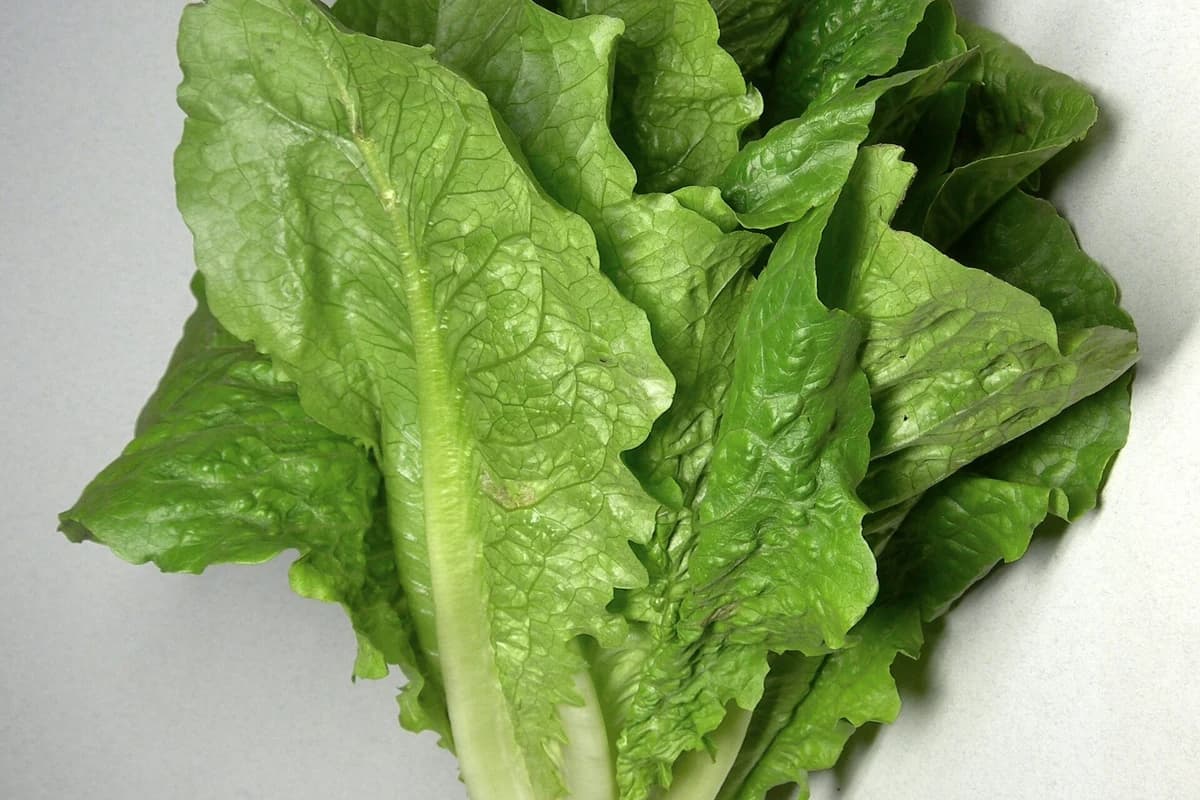
About This Plant
Romaine (Cos) lettuce, Lactuca sativa var. longifolia, grows a tall, upright head of sturdy dark-green leaves with a firm central rib. A cool-season, K-dominant leafy crop, it is one of the most popular hydroponic lettuces for its fast growth, high yield, and compatibility with every major soilless system (NFT, DWC, ebb-and-flow, drip, Kratky, aeroponics). It is grown at 18-22C air with a cool root zone, EC 1.2-1.8 dS/m and pH 5.5-6.2, and is harvested vegetatively before bolting. Its two dominant risks are heat-induced bolting and calcium-transport tip burn, both managed primarily through temperature, airflow, and steady transpiration rather than raw nutrient dose.
How to Grow Lettuce (Romaine)
Learn how to grow Lettuce (Romaine) from seed to harvest in 60 days. Beginner difficulty. Complete nutrient guide, pH/EC requirements, and growing conditions for hydroponics, soil & greenhouse.
Sources cited: 39.
Nutrient Requirements by Growth Stage
Romaine is a K-dominant leafy feeder with no reproductive feed stage; every peer-reviewed formulation and tissue dataset shows K > N > P, with K roughly 1.5-2x N. During the seedling stage (EC 0.8-1.2, pH 5.5-6.0) run half-to-two-thirds strength: N 75-130 opt 105, P 20-40 opt 30, K 130-210 opt 165 ppm…
Sign in to view nutrient requirements
A free account unlocks NPK targets for all four growth stages, micronutrient levels, a per-stage nutrient calculator, and the full nutrition guide. Signing up takes one click. Truleaf is a free, non-profit project, and every new account helps it grow. No spam, ever.
Growing Environments
Romaine grows across all four environments: indoor vertical farm, greenhouse, outdoor field, and container. Indoor and greenhouse hydroponic production is where it excels for CEA growers, with well-documented performance under LED at PPFD 200-250 and in NFT/DWC systems…
Temperature
Romaine is a cool-season crop, and temperature is the single most important lever for keeping it vegetative and sweet. Germinate at 16-22C: lettuce seed is thermodormant and germination collapses above ~25-28C. Grow at 10-22C air with an optimum near 18C; the verified non-bolting regime is roughly 20C day / 13C night. Bolting is heat-induced, not day-length-induced: sustained day temperature at or above 27C, and definitively 33C day / 25C night, initiates the reproductive switch within about 8 days, while plants held near 20C stay vegetative. Warm nights matter as much as warm days. Root-zone (nutrient-solution) temperature is a distinct, high-leverage control: ~21C solution maximized shoot fresh weight (+15% over ambient) and ~18C maximized Brix across 17 cultivars, and in warm conditions cooling the root zone rescued biomass that ran 47% lower in an uncooled 24.6-31.6C control. Hold the solution below 22C, especially in Kratky and DWC reservoirs.
Humidity
Hold relative humidity at 50-70% with about 60% as the optimum, the verified experimental band for healthy vegetative lettuce. This range is not just comfort: at the high end, low vapor-pressure deficit combined with still air suppresses transpiration and the calcium mass-flow that protects the growing head, so high…
Light
Target a DLI of about 13 mol/m2/day delivered as roughly 220 umol/m2/s PPFD over a 16-hour photoperiod. The verified indoor-lettuce growth optimum is a DLI near 11.5 at 200 umol/m2/s; DLI 14.4 already cut fresh and dry weight through photoinhibition, and sustained DLI at or above ~17 drives calcium-deficiency tip burn…
Airflow
Maintain gentle, continuous airflow of 0.3-1.0 m/s across the canopy. Air movement is a functional control for romaine, not a comfort setting: low-evaporative (still-air) conditions limit transpiration-driven calcium delivery and caused tip burn in every tested cultivar, including romaine, within about 22 days after…
Sign in to view environmental requirements
A free account unlocks exact temperature, humidity, light and airflow targets, including germination and growth ranges, DLI, photoperiod and PPFD, plus the full environment guide. Signing up takes one click. Truleaf is a free, non-profit project, and every new account helps it grow. No spam, ever.
Hydroponic System Compatibility
Romaine is compatible with every major hydroponic system, and its all-suitable rating reflects a genuinely versatile leafy green rather than a mis-inherited template; the stub wrongly marked ebb-and-flow and drip as unsuitable, and both are corrected to true. NFT is one of the best-documented systems for romaine: cos…
Growing Media
Rockwool is the preferred medium for romaine, giving a sterile, pH-neutral substrate with good moisture retention and root-zone aeration for propagation and anchoring. Coco-coir blends and perlite mixes give a moisture-retentive yet free-draining root zone well-suited to drip and container culture, and clay pebbles…
Container Specs
Romaine has a shallow, fibrous root system, so a container at least 15-20 cm deep is sufficient and deeper pots are unnecessary. Give each plant about 4-6 L, use lightweight free-draining media, and ensure drainage holes, since the root zone must stay evenly moist but never waterlogged…
Training & Support
Romaine requires no training, staking, trellising, or pruning. It forms a self-supporting, upright cos head, and the sturdy central ribs give it natural stability…
Sign in to view system compatibility
A free account unlocks why each of the six systems fits or fails, plus growing media, container sizes, training methods, companion plants, and the full systems guide. Signing up takes one click. Truleaf is a free, non-profit project, and every new account helps it grow. No spam, ever.
Propagation
Romaine is propagated exclusively from seed, either by raising plugs indoors for transplant or by direct-sowing into the final system. The seed is small and positively photoblastic, so sow shallow (~3-5 mm, surface-pressed) and keep the medium continuously moist…
Harvesting
Romaine gives two harvest strategies from the same plant, and the choice sets both timing and yield. For a full head, wait until the upright leaves overlap into a firm head about 15-20 cm tall (roughly 60-70 days from sowing) and cut the whole plant at the base just above the crown; this ends the cycle and gives…
Planting Calendar
Romaine follows a cool-season pattern. For outdoor and unheated-greenhouse crops, sow in spring (Jan-Mar indoors, Mar-Apr direct) and again in late summer to fall (Jul-Aug indoors, Aug-Sep direct), and harvest spring sowings Apr-Jun and fall sowings Sep-Nov…
Common Issues
Romaine's three physiological headaches and one insect pest account for most hydroponic losses, and each has a specific, research-backed fix. Tip burn is the signature disorder: brown, dead margins on the youngest inner leaves while outer leaves look perfect…
Get the full science-backed guide
By signing up, you help keep Truleaf free and support the growth of our nonprofit project. Your account unlocks full details for every plant issue—including symptoms, causes, step-by-step solutions, and prevention—plus the month-by-month planting calendar, the complete guide, and all research sources. It only takes one click. No spam, ever.