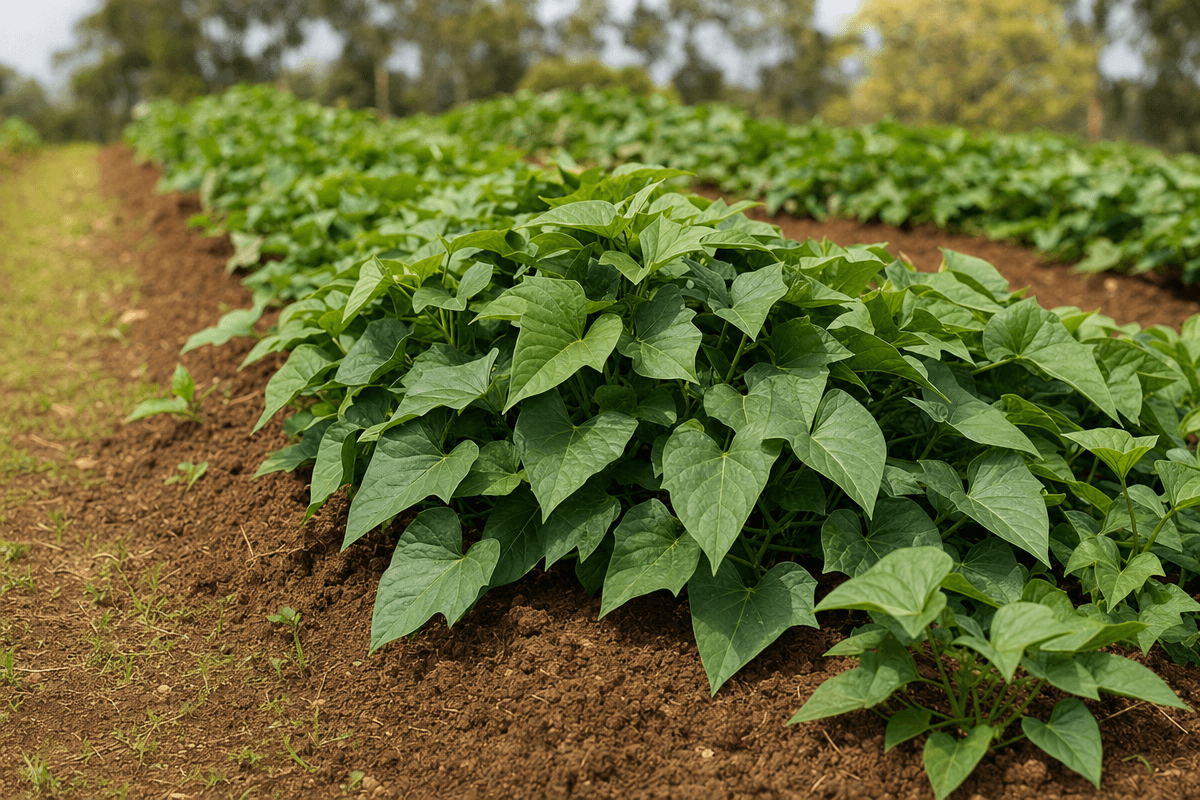
About This Plant
Sweet potato is a warm-season storage-root crop that needs high light, strong potassium support, and aerated root zones to shift growth from vines to tubers.
How to Grow Sweet Potato
Learn how to grow Sweet Potato from seed to harvest in 120 days. Beginner-friendly. Planting, care, feeding and the right growing conditions.
Sources cited: 38.
Nutrient Requirements by Growth Stage
Sweet potato is a high-potassium crop with phase-dependent nutrient priorities. In hydroponic systems, a standard solution delivering approximately N 260, P2O5 120, K2O 405, CaO 230, MgO 60 mg/L at EC 1.4-2.6 dS/m supports full-season production…
Sign in to view nutrient requirements
A free account unlocks NPK targets for all four growth stages, micronutrient levels, a per-stage nutrient calculator, and the full nutrition guide. Signing up takes one click. Truleaf is a free, non-profit project, and every new account helps it grow. No spam, ever.
Growing Environments
Sweet potato thrives best outdoors in full sun with a long warm season (USDA Zones 5-11). Greenhouse cultivation is the preferred environment in cool climates, maintaining optimal 21-26C with supplemental LED lighting (200-250 umol/m2/s) supporting vigorous development…
Temperature
Sweet potato is a warm-season tropical crop with strict temperature requirements across growth stages. For slip rooting and sprouting, maintain 25-31C; variable day/night temperatures (31C day / 23C night) outperform constant temperatures. Vegetative vine growth performs best between 18-28C; plants tolerate 10-38C but young foliage is killed at 5C. For tuber initiation and bulking, the optimal range is 20-30C with an optimum near 25C. In controlled-environment hydroponic trials (NASA CELSS program), a diurnal temperature regime of 28C day / 22C night under continuous light produced the highest storage root yields. Avoid sustained temperatures above 30C during tuber bulking as this diverts resources to foliage; avoid below 20C nightly as this stalls tuber growth.
Humidity
Maintain relative humidity between 60-80% (optimal 70%) during vegetative growth and vine development. High humidity above 80% sustained over long periods promotes fungal disease in dense canopies…
Light
Sweet potato requires high light intensity for productive growth. For seedling and cutting propagation, 200 umol/m2/s PPFD (DLI ~11.5 mol/m2/d) with white LEDs (R:B ratio 0.9) is energy-optimal…
Airflow
Sweet potato vines produce a dense canopy that requires adequate air circulation to prevent fungal disease and thermal hot spots. During vegetative growth, maintain gentle air movement of 0.2-0.5 m/s through the canopy…
Sign in to view environmental requirements
A free account unlocks exact temperature, humidity, light and airflow targets, including germination and growth ranges, DLI, photoperiod and PPFD, plus the full environment guide. Signing up takes one click. Truleaf is a free, non-profit project, and every new account helps it grow. No spam, ever.
Hydroponic System Compatibility
The fundamental constraint for sweet potato in hydroponic systems is that storage roots CANNOT develop in continuously waterlogged root zones. The root zone must experience alternating wet/dry or aerated conditions for tuberization to occur…
Growing Media
Sweet potato performs best in media providing good aeration and drainage. Rockwool slabs are the highest-performing research-validated medium — storage roots develop at the rockwool-solution interface (aerated zone), with yields 1.5x higher than systems without solid media…
Container Specs
Sweet potatoes require generous containers for full-sized tubers. The minimum depth is 30 cm (12 in), though 40-45 cm produces significantly better results…
Training & Support
Sweet potato training and support is optional but beneficial in constrained spaces. In open gardens and fields, vines spread freely 1-3 m, forming dense ground cover that suppresses weeds naturally…
Sign in to view system compatibility
A free account unlocks why each of the six systems fits or fails, plus growing media, container sizes, training methods, companion plants, and the full systems guide. Signing up takes one click. Truleaf is a free, non-profit project, and every new account helps it grow. No spam, ever.
Propagation
Sweet potato is propagated vegetatively through slips (sprouts from storage roots), making it one of the easiest root vegetables to propagate. The primary method is bedding: place healthy storage roots in moist sand or soilless mix at 24-29C, cover to retain humidity; sprouts emerge in 2-4 weeks…
Harvesting
Sweet potato tubers are ready for harvest when they reach marketable size, typically 90-120 days after transplanting. Since sweet potatoes lack a defined biological maturity point, harvest is guided by tuber size (US No…
Planting Calendar
Sweet potato requires 90-160 frost-free days (most commonly 100-120 days). Begin slip production indoors 10-12 weeks before target transplant: Zones 3-4 start March (transplant mid-June); Zones 5-7 start February-March (transplant mid-May); Zones 8-11 can grow two seasons per year…
Common Issues
Sweet potato faces numerous fungal diseases, viral infections, and insect pests. The most economically damaging diseases include black rot (Ceratocystis fimbriata), Fusarium wilt (F…
Get the full science-backed guide
By signing up, you help keep Truleaf free and support the growth of our nonprofit project. Your account unlocks full details for every plant issue—including symptoms, causes, step-by-step solutions, and prevention—plus the month-by-month planting calendar, the complete guide, and all research sources. It only takes one click. No spam, ever.