Cordyceps militaris vs sinensis: You Can Only Grow One
Two very different fungi are both sold as 'cordyceps,' and they are not two grades of one product. Cordyceps militaris is the bright-orange club fungus growers actually cultivate on sterile grain, rich in cordycepin. Ophiocordyceps sinensis — formerly Cordyceps sinensis — is the wild Himalayan caterpillar fungus you basically cannot grow, now in a different fungal family and critically endangered from overharvest. This guide untangles the 2007 name change that split them apart, the chemistry trade-off between them (cordycepin vs. adenosine, nucleosides, and mannitol), why one is endangered and the other is the sustainable choice, what a 'cordyceps sinensis' supplement usually contains, and how to tell them apart on a label. Grounded in peer-reviewed research.
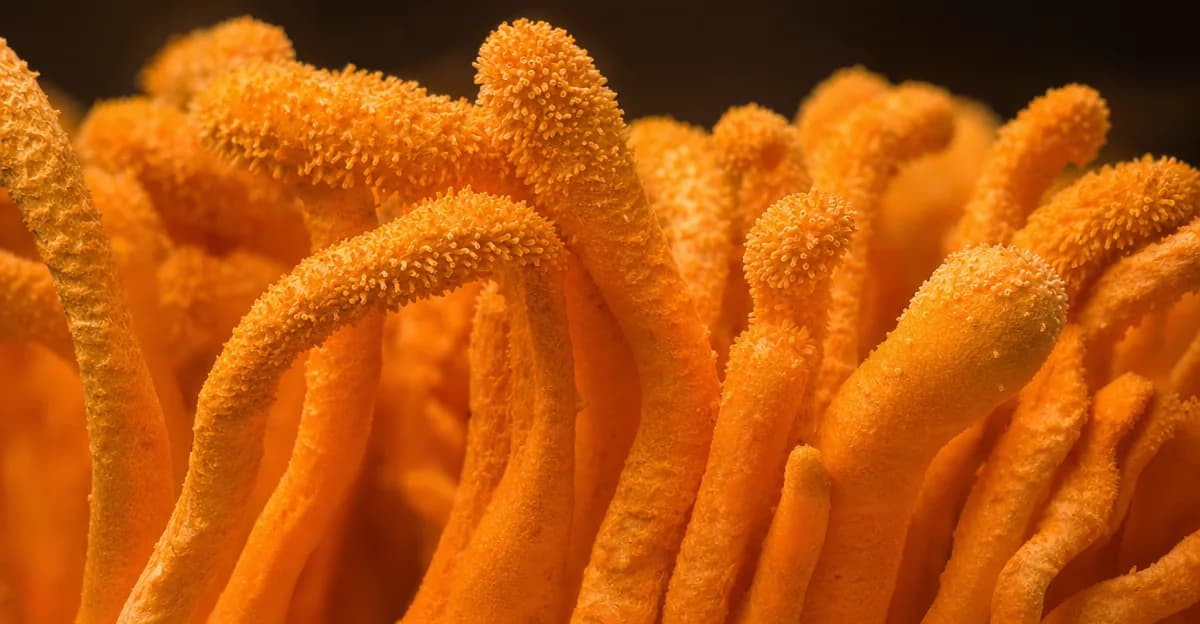
Walk into any supplement aisle or scroll any mushroom shop and you will see "cordyceps" sold with almost no distinction — as if it were one thing at different price points. It is not. Two genuinely different fungi hide under that one label, and they are not two grades of a single product. One is a bright-orange club fungus that growers cultivate indoors on sterile grain and that concentrates a compound called cordycepin. The other is a wild, endangered Himalayan "caterpillar fungus" that you essentially cannot grow, that lives by parasitizing an insect, and that now sits in a different fungal family altogether.
The confusion is baked into the names. For decades the wild species was called Cordyceps sinensis, so the two really did share a genus. That changed in 2007. This guide sorts them out: why they were split apart, what each one actually is, the real chemistry difference between them (and why it is a trade-off rather than a "wild is better" story), why one is a conservation emergency while the other is the sustainable choice, and — the practical question — what a jar labelled "cordyceps sinensis" usually contains and how to read the label. Every claim here traces to peer-reviewed research, listed at the end.
Are they even the same fungus? No — and not since 2007
Start with the single fact that resolves most of the confusion: the cultivated cordyceps and the wild cordyceps are not the same species, not the same genus, and — this is the surprising part — not even in the same family.
The cultivated one is Cordyceps militaris, in the family Cordycipitaceae. The wild one is Ophiocordyceps sinensis, in a separate family, Ophiocordycipitaceae. Until 2007 the wild species was classified as Cordyceps sinensis, which is why the old name is still everywhere in shops, packaging, and older articles. That year it was formally reclassified and moved out of Cordyceps into the genus Ophiocordyceps — a change flagged in the titles of the conservation and comparison literature to this day.
So the honest way to read a label is this: both are called "cordyceps," but only C. militaris still is one, botanically. The wild species keeps the trade name out of habit, not taxonomy. When you see the two side by side, you are not looking at a budget version and a premium version of one mushroom — you are looking at two different fungi that a naming accident lumped together. That distinction drives everything that follows.
What each one actually is
The two fungi don't just have different names — they live completely different lives, and that is why one is farmable and the other is not.
Cordyceps militaris is a club fungus you can grow in a jar. It fruits directly on a sterile grain substrate, producing the vivid orange, finger-like fruiting bodies most people picture when they think of cultivated cordyceps. It does not need a living host; a grower inoculates sterilized grain, controls the environment, and harvests in a matter of weeks. That is exactly why it is the cordyceps of home cultivators and commercial farms alike — reproducible, indoor, and fast. (If you want the how-to, see our guide to growing Cordyceps militaris at home.)
Ophiocordyceps sinensis is a fungus-plus-insect complex you find, not farm. In the wild it is entomopathogenic — it parasitizes the underground larvae of ghost moths (Thitarodes) in cold, high-altitude alpine soil, kills the caterpillar, and grows a single slender stalk up out of the dead insect's body. What harvesters collect on the Qinghai–Tibetan Plateau is that whole caterpillar-and-stalk object — known as yarsagumba or dōng chóng xià cǎo, "winter worm, summer grass." Because the fungus depends on the right host insect and specific high-altitude conditions, you cannot simply reproduce the true wild complex in a jar. This is not a marketing distinction; it is a biological one.
That single difference — grows on grain vs. grows on a caterpillar in the mountains — is the root of every practical contrast between them: which is available, which is affordable, which is endangered, and which you can actually produce yourself.
The chemistry: a trade-off, not a quality ladder
Here is where a lot of marketing goes wrong. "Wild" is sold as automatically better, and it is not that simple. The two fungi have different chemical fingerprints, each leaning toward different compounds — a trade-off, not a ranking.
C. militaris is the cordycepin fungus. Cordycepin (3′-deoxyadenosine) is the compound cultivated cordyceps is known for, and C. militaris is its principal producer; cultivation is, in large part, optimized to build it. If a product's selling point is cordycepin content, it is almost certainly C. militaris, because that is where the compound is abundant.
Wild O. sinensis leads on a different set of compounds. Rather than headline cordycepin, the wild fungus is characterized by adenosine and a broad range of other nucleosides, plus mannitol (also called cordycepic acid) and polysaccharides. A direct metabolomic comparison of wild O. sinensis against cultured C. militaris found the wild fungus running higher in several amino acids (such as glutamic acid, histidine, phenylalanine, and arginine), in unsaturated fatty acids, in peptides, and in adenosine-family nucleosides — the compositional basis of its long-standing reputation as a nutritional tonic. Independent analysis of O. sinensis likewise isolates a diverse set of nucleosides, including adenosine, corroborating that nucleoside-rich profile.
Two honest cautions belong here. First, this is a trade-off: C. militaris is higher in cordycepin, wild O. sinensis is higher in certain nucleosides and amino acids — so "which is better" depends entirely on what you are after, not on wild-versus-farmed. Second, the difference is qualitative in the literature — the wild fungus is characterized as low or variable in cordycepin, not devoid of it, and the reviewed sources do not offer a clean, agreed side-by-side number, so anyone quoting an exact "wild cordycepin" figure is going beyond the evidence. The genus as a whole is chemically rich — well over a hundred distinct metabolites have been catalogued across Cordyceps — which is part of why simple "one is stronger" claims rarely survive contact with the data.
The two faces of "cultivated sinensis": mycelium vs. fruiting body
There is a second layer of confusion most shoppers never hear about. When a product does say "cultivated Cordyceps sinensis," that phrase itself hides two very different things — and neither one fully matches the wild fungus.
Because the true wild complex can't be farmed, the industry cultivates O. sinensis in two other ways. The first is in vitro mycelial fermentation: growing the fungus's mycelium in liquid or on a substrate, with no caterpillar involved. This is scalable and standardized — you get a consistent, traceable product — but its chemical profile is documented as distinct from wild specimens, not identical to them. The second is in vivo cultivation, inoculating host larvae to mimic the natural life cycle; this lands chemically closer to wild material but is hampered by low infection rates, which is why it never became the cheap, mass-market route.
Metabolomic and transcriptomic work comparing wild against cultivated O. sinensis backs this up: the two diverge measurably, with cultivated material tending to carry more amino acids, carbohydrates, and phenolic acids, while wild material runs higher in nucleosides and nucleotides. The takeaway for a buyer: "cultivated sinensis" is a real category, but it is a fermented approximation of the wild fungus — most often the mycelial form — and it should not be read as identical to the wild caterpillar fungus, nor confused with cultivated C. militaris, which is a different species entirely.
Availability, cost, and the conservation problem
The reason cultivated C. militaris exists as a mass product at all is, largely, that wild O. sinensis is in trouble.
Wild O. sinensis is endangered and overharvested. It is endemic to the Qinghai–Tibetan Plateau, and its wild populations have declined sharply under the combined pressure of climate change and overexploitation. It is among the most valuable biological commodities in the world by weight, which fuels intense collection across Bhutan, Nepal, Tibet, and India — and that demand-driven harvest is precisely what threatens it. The conservation literature is blunt about the trajectory: heavy, price-driven wild collection of a slow-to-regenerate alpine fungus is not sustainable.
That is the entire case for cultivated C. militaris. With a broadly comparable compound profile and — critically — a fungus that grows quickly indoors on sterile grain with no host insect and no mountain required, C. militaris is positioned across the research as the sustainable, accessible stand-in that takes harvest pressure off the wild species. In practical terms this is also why it is the affordable, widely available one: you can farm it at scale, so it isn't gated by a shrinking wild supply or a Himalayan collection season. Wild O. sinensis, by contrast, is expensive and scarce almost by definition — and every gram of genuine wild material is a gram taken from a declining, protected resource.
So the sustainability answer is unusually clean for a "wild vs. cultivated" question: here, cultivated is the ethical and the practical default, and the whole point of cultivating C. militaris was to relieve the pressure on an endangered fungus.
The practical takeaway: which do you actually have — and can you grow it?
Bring it back to the two questions a real buyer or grower is asking.
What is a "cordyceps sinensis" supplement usually made of? Given that the wild complex can't be farmed and genuine wild material is scarce and costly, most consumer products labelled "cordyceps sinensis" are not the wild caterpillar fungus at all. They are a cultivated form — very commonly the mycelial (fermented) product discussed above — standing in for wild material. That is not necessarily a bad thing; it is often the sustainable choice. But it means the word "sinensis" on a label tells you the tradition being invoked, not that you are holding wild yarsagumba.
Can you grow either one yourself? You can realistically grow Cordyceps militaris — it is one of the more approachable medicinal mushrooms to cultivate indoors, fruiting on sterile grain in a matter of weeks. You essentially cannot produce the true wild O. sinensis complex, because it depends on parasitizing a specific host insect in high-altitude conditions that don't reduce to a jar on a shelf. So for a home grower, the choice makes itself: the cordyceps you can actually cultivate is C. militaris, and it happens to be the cordycepin-rich, sustainable one.
Reading a cordyceps label: what you're actually buying
Once you know the two fungi apart, a supplement label becomes readable. Here is what the common phrasings really signal.
- "Cordyceps militaris" or "cultivated cordyceps," bright orange. This is the farmed club fungus — the cordycepin-forward, reproducible, sustainable product. If a brand advertises a cordycepin figure, this is almost certainly the species behind it.
- "Cordyceps sinensis" or "cordyceps CS-4," often beige/brown powder. This invokes the wild Himalayan fungus, but in practice it is usually a cultivated form — most often mycelium grown by fermentation — because true wild material is scarce and expensive. Its profile is standardized and traceable, but documented as distinct from wild specimens.
- "Wild-harvested" or "yarsagumba" whole pieces. Only this points to the genuine wild caterpillar-and-stalk complex — and it is exactly the material under conservation pressure, so it carries an ethical cost and a high price.
- The tell to look for: species and form. A trustworthy label names the species (C. militaris vs. O. sinensis) and the form (fruiting body vs. mycelium). Vague "cordyceps extract" with neither is the one to question.
The reliable move mirrors the botanical one from earlier: don't buy on the trade name alone. Read for the species and whether it says fruiting body or mycelium. That two-word check tells you far more than "cordyceps" ever will.
The complete side-by-side: every trait that separates them
Everything above, consolidated into one reference. Every entry matches the sourced claims in the sections above.
| Trait | Cordyceps militaris (cultivated) | Ophiocordyceps sinensis (wild) |
|---|---|---|
| Family | Cordycipitaceae | Ophiocordycipitaceae — split out of Cordyceps in 2007 |
| Former / trade name | Cordyceps militaris (unchanged) | Formerly Cordyceps sinensis; Hirsutella sinensis is the mycelial form |
| What it is | Orange club fungus; fruiting body on grain | Fungus–caterpillar complex on a parasitized moth larva |
| Where it lives / how obtained | Farmed indoors on sterile grain | Wild-collected on the Qinghai–Tibetan Plateau |
| Signature chemistry | Cordycepin-rich; cultivation optimizes it | Nucleoside/adenosine- and mannitol-rich; higher in several amino acids |
| Cultivable? | Yes — home and commercial cultivation | True wild complex effectively not cultivable; only fermented/in vivo approximations |
| Conservation status | Not at risk — farmed at scale | Endangered; declining from climate change + overexploitation |
| Availability & cost | Widely available, affordable | Scarce and expensive; ethically flagged |
| What a supplement usually is | The actual fruiting body | Usually cultivated mycelium standing in for wild material |
One-line takeaway: if you want the cordycepin-rich cordyceps you can grow, buy, and feel good about sustainably, that is cultivated C. militaris; wild O. sinensis is a different, nucleoside-rich, endangered fungus you find in the Himalayas rather than farm — and most "sinensis" on a shelf is a cultivated approximation of it, not the wild article.
So which should you choose?
Match the fungus to what you actually want.
- Choose cultivated Cordyceps militaris if you want a cordycepin-rich product that is reproducible, traceable, affordable, widely available, and sustainable — and, uniquely, one you can grow yourself. For the overwhelming majority of buyers and every home grower, this is the sensible default.
- Choose Ophiocordyceps sinensis (as a cultivated "sinensis" product) if you are specifically after the traditional wild-fungus profile — the nucleoside- and adenosine-forward chemistry — and understand that what you can realistically buy is a cultivated, usually mycelial, approximation rather than the wild complex.
- Genuine wild yarsagumba is a different proposition entirely: rare, costly, and conservation-flagged. If sustainability matters to you, that is a reason to lean toward cultivated material — which is exactly the shift the conservation research is calling for.
The deciding questions, in order: Do I want cordycepin, or the traditional wild-tonic profile? (Cordycepin leans militaris.) Does it need to be affordable and available? (Strongly leans cultivated.) Do I want to grow it myself? (Only C. militaris is realistic.) On all three, the cultivated club fungus is the easy answer for most people — and if you'd like to produce your own, our Cordyceps militaris growing guide and the full Cordyceps militaris plant profile walk you through it. The first step in the store is the simplest one: read past the word "cordyceps" to the species and the form. That alone tells you which fungus you're really holding.