Why Won't My Cordyceps Fruit? Check Light First
If colonized Cordyceps militaris won't pin, check light first, then inspect culture, substrate, humidity, temperature, and air exchange.
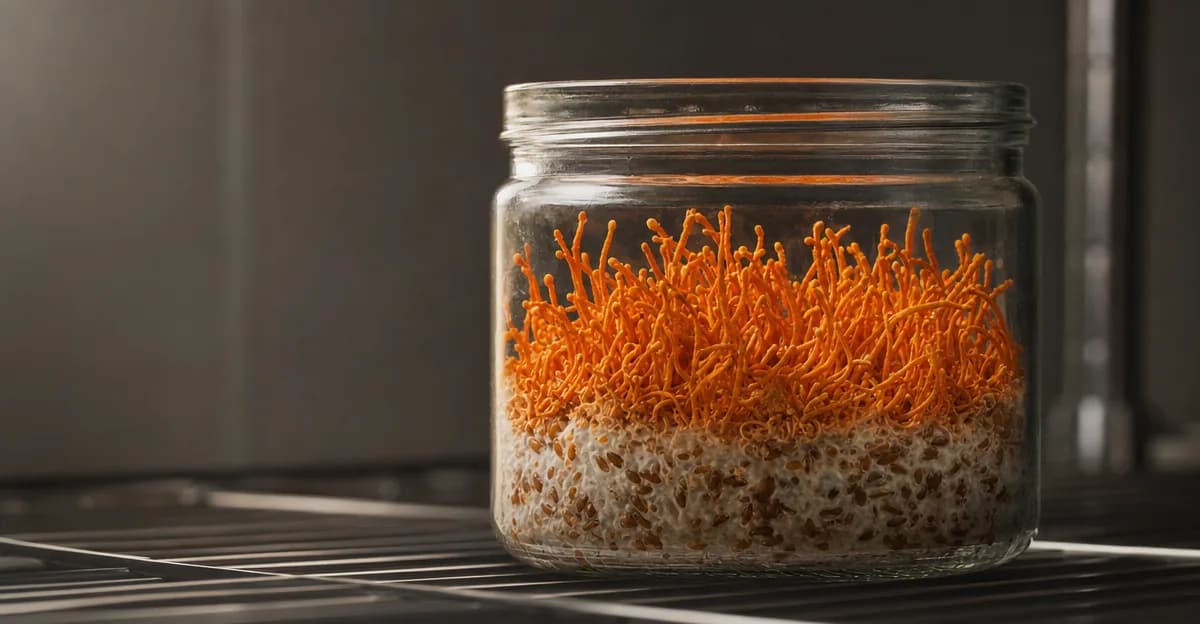
Key point: If your Cordyceps militaris jars appear colonized but have not pinned, check light first. Complete-text studies show that darkness can prevent primordia in a tested cultivation system and that the blue-light receptor CmWC-1 is involved in normal fruit-body development. If the culture already receives a regular light-dark cycle, inspect culture quality, substrate, humidity, temperature, and gas exchange rather than assuming that more light will solve the problem. For the full cultivation walkthrough, see our guide to growing Cordyceps militaris at home and the Cordyceps growing profile.
The symptom: fully colonized, but nothing happens
Here's the classic stuck grow. You inoculated your jars, the mycelium ran across the substrate, and the whole surface became a solid sheet of white. Then nothing visible changed: no orange bumps, pins, or primordia.
This looks different from an obvious contamination problem when there is no green mold, sour smell, or slime. A white surface alone cannot prove that a culture is clean or vigorous; it shows only that visible fruiting has not begun.
That transition is not automatic. In C. militaris, light is a documented environmental signal. Temperature, humidity, substrate, strain, and cultivation system can also affect the result, so a stalled jar needs a staged diagnosis rather than a single assumed cause.
Check #1: Is it sitting in the dark?
A well-supported and fixable reason cultivated Cordyceps may not fruit is lack of light.
C. militaris senses blue light through a photoreceptor called CmWC-1. In Yang and colleagues' gene-disruption study, wild-type strains formed fruit bodies in the tested cultivation system, while the two ΔCmwc-1 strains formed white aerial hyphae without fruit bodies. Crosses involving a knockout strain and a wild-type strain of the opposite mating type restored fruiting, while a cross between the two knockout strains produced no primordia or fruit bodies. The authors concluded that CmWC-1 regulates fruit-body development, alongside conidiation and secondary metabolism.
Hong and colleagues reached the same practical conclusion from a different system. Their inoculated silkworm pupae formed no primordia in darkness. Illuminated treatments did produce fruit bodies.
The fix: give it light.
- Use a regular light-dark cycle: Hong's fruiting experiment used 12 hours of light and 12 hours of darkness. This supports a 12/12 cycle as a study-used starting point, not as a proven universal optimum.
- Keep light intensity in context: Hong tested 100, 500, and 1,000 lux at 20 °C and relative humidity above 90% on inoculated silkworm pupae. All illuminated treatments produced fruit bodies. Those at 100 lux were generally short and thin, while those at 500 and 1,000 lux were longer and thicker.
- Do not turn one system into a threshold: The Hong experiment did not use home grain jars. Its results support avoiding continuous darkness, but they do not establish a universal minimum or optimum lux level for every strain, substrate, and container.
If colonized jars are still in darkness, moving them to controlled, indirect light on a timer is the clearest first change to test.
Check #2: If light is present, inspect the rest of the system
Light is necessary in the tested systems, but it is not a complete troubleshooting protocol. A recent review of C. militaris cultivation describes wide variation among solid-state methods and identifies the absence of standardized cultivation protocols as a research gap.
- Culture and strain: A white surface does not establish vigor, purity, or fruiting competence. If a lit culture remains vegetative, compare it with a fresh, verified culture.
- Substrate: Solid-state systems use different grains, insect materials, and mixed substrates. A setting that worked on inoculated pupae cannot be assumed to transfer to a rice jar.
- Humidity and gas exchange: Hong held its pupa system above 90% relative humidity. Park's review summarizes a broader 70-95% range across solid-state methods. These are reported conditions, not universal home-jar targets.
- Temperature: Temperature affects cultivation, but the complete-text evidence retained here does not establish one universal temperature-drop recipe for stalled jars. Follow a validated method for the specific strain, substrate, and container.
- Contamination: Green, black, or pink patches and sour odors are warning signs, but their absence does not prove that a culture is clean.
Change one condition at a time where practical. If several settings change together, you will not know which change affected the result.
What improvement looks like
When fruiting begins, small orange primordia appear on the mycelial surface and elongate into orange clubs. Timing varies with strain and cultivation system, so the retained complete-text sources do not support a universal response deadline.
If a dark-kept culture begins forming primordia after a light-dark cycle is introduced, keep the rest of the method stable and follow the validated fruiting instructions for that system. If nothing changes, move to culture, substrate, humidity, temperature, and gas-exchange checks.
Honest limits
The available studies do not measure which cause accounts for most failed home grows. They also do not justify a single temperature, humidity, light-intensity, or CO₂ target across all strains and systems.
The practical order is narrower: correct continuous darkness first. If light is already suitable, compare the entire setup with a validated method rather than chasing a single number from a different cultivation system.
Quick diagnosis table
| What you're seeing | What to check | Next step |
|---|---|---|
| White mycelium, no primordia, jars kept dark | Missing light signal | Introduce controlled indirect light on a timer; Hong used a 12/12 cycle |
| Jars already receive a light-dark cycle but do not pin | Culture, substrate, humidity, temperature, and gas exchange | Compare every condition with a validated method for that exact system |
| Fruiting at low light is short or thin | Light may be one factor | Hong observed longer, thicker fruit bodies at 500-1,000 lux than at 100 lux in pupae; do not assume the same optimum for grain jars |
| Green, black, or pink growth or sour odor | Likely contamination | Isolate or discard the container safely and review sterile technique |
| White jars remain stalled despite method-matched conditions | Culture vigor or an unseen system problem | Test a fresh verified culture and review the full cultivation process |
Key takeaways
- Light is required for normal fruit-body development in the tested systems. Hong observed no primordia in darkness, and Yang showed that disrupting Cmwc-1 impaired fruit-body formation.
- A 12 h light/12 h dark cycle is a complete-text, study-used regime, not a proven universal optimum.
- 500-1,000 lux is not a universal threshold. Hong obtained fruit bodies even at 100 lux in pupae, although they were shorter and thinner.
- If light is already suitable, inspect culture, substrate, humidity, temperature, and gas exchange together.
- No retained source supports a universal temperature-drop recipe for stalled home grain jars.
Explore further: How to grow Cordyceps militaris at home and the full Cordyceps growing profile.