How to Grow Garlic Chives: Care for Repeat Harvests
Learn how to grow garlic chives (Allium tuberosum) from seed or division, care for widening clumps, harvest repeat leaf crops, and limit self-seeding.
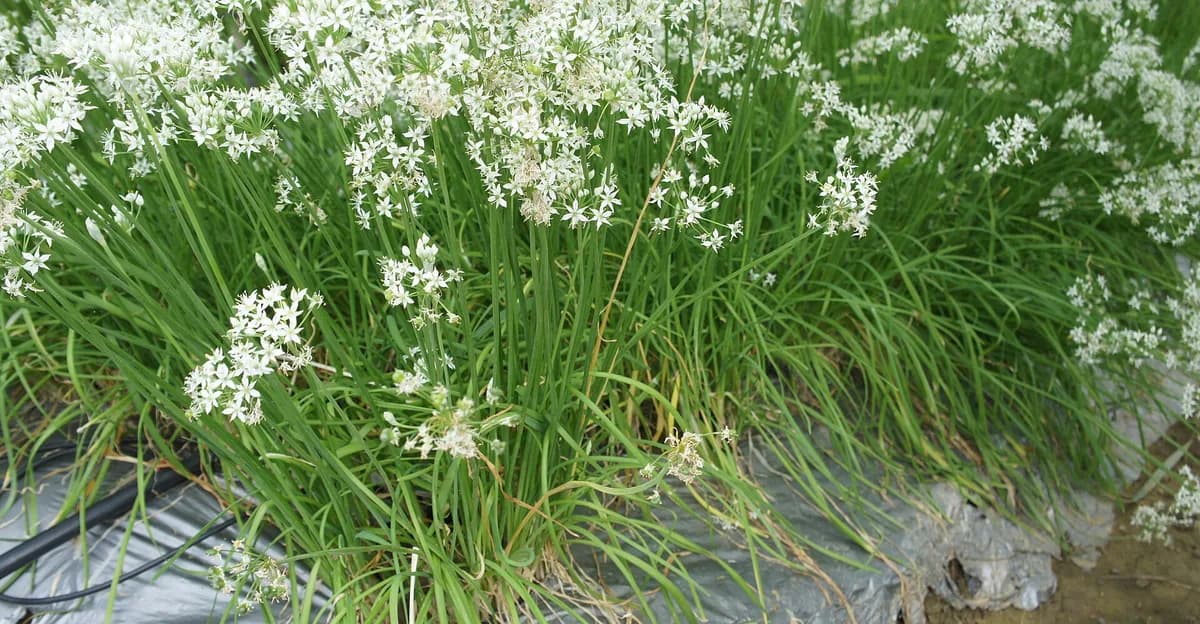
Key point: Garlic chives (Allium tuberosum) are perennial, clump-forming plants grown mainly for their flat leaves. Their white flowers and tender flower stalks are edible too. Give them full sun or light shade, keep the root zone moist but drained, and leave about 25–30 cm (10–12 in) between clumps.
You can start with seed or divide an established clump. Once the crown is established, it can replace cut foliage and provide repeat harvests during active growth. The main mistake to avoid is forcing a rigid calendar onto the plant. Germination, first harvest, winter dieback, and regrowth all shift with climate and growing method.
For a compact summary of the species, open the garlic chives plant profile.
Garlic chives at a glance
| Care point | Practical starting point |
|---|---|
| Light | Full sun for strongest growth; light shade is tolerated |
| Root zone | Moist, fertile soil or potting mix that drains freely |
| Spacing | About 25–30 cm (10–12 in) between clumps |
| Propagation | Seed or a rooted section from an established clump |
| Germination | Commonly about 7–14 days under suitable conditions |
| Harvest | Let young plants establish, then cut leaves near the base without damaging the crown |
| Flowers | Harvest open flowers if wanted, or deadhead before seed set to limit self-seeding |
| Containers | Suitable when the pot drains and gives the clump room to widen |
Choose a site with sun, moisture, and drainage
Full sun is the best default for a dense, productive clump. Garlic chives also tolerate light shade, which gives gardeners some room to work with balconies, small yards, and mixed beds.
The root zone needs a balance. Keep it moist during active growth, but use soil or potting mix that releases excess water. University extension guidance consistently pairs moisture with good drainage for this crop. That is more useful than copying a narrow soil pH range from one region, since the reviewed evidence does not establish one global optimum.
Garlic chives belong to the same plant family as bulb onions and garlic, but you grow them as a widening perennial clump for leaves and flowers. For the different timing and bulb-forming needs of those crops, use our separate guides to growing onions and growing garlic.
Start garlic chives from seed or division
Both routes work. Seed is useful when you want several new plants. Division starts with a rooted section from an established clump.
Starting from seed
Sow at the depth given on the seed packet, then keep the starting medium moist without leaving it waterlogged. Garlic chive seed commonly germinates in about 7–14 days under suitable conditions. The peer-reviewed germination study behind that range used controlled Petri-dish conditions, while University of New Hampshire Extension gives the same practical window. Weather and seed condition can still move the result.
Do not plan a heavy first harvest from the germination date alone. Research crops used for repeat cutting had a substantial establishment period, and seed-grown plants need time to build a crown before repeated leaf removal.
Starting from a divided clump
Separate a rooted section from a healthy established clump and replant it at the same site or in another bed or container. Field research has established new plots from separated rhizomes, and extension guidance also recommends division as a standard propagation method.
A fixed two- or three-year division schedule is optional rather than universal. Divide when the clump becomes crowded, the center loses vigor, or you want more plants.
Give each clump room to widen
Space plants about 25–30 cm (10–12 in) apart as a practical starting range. A field trial used 25 × 25 cm spacing, a greenhouse study used 28 cm between clumps, and University of New Hampshire Extension recommends 12 in. These are compatible reference points, not proof of one perfect distance for every cultivar or climate.
In a container, prioritize drainage and width. Garlic chives are well suited to pots and other small-space settings, but the sources reviewed here do not support a universal minimum pot volume. Choose a container that can hold the widening clump without trapping water around the crown.
Water steadily and feed modestly
Keep the root zone moist during active growth, especially while new leaves replace a harvest. Let excess water drain rather than leaving the crown in stagnant water.
Avoid increasing fertilizer by habit. Base any feeding on local soil, the product label, and the plant's response. In one deep-flow hydroponic nursery experiment, plant dry weight fell as total nitrogen increased across four concentrations under a fixed nitrate-to-ammonium formulation. A separate winter greenhouse soil trial found gains from a specific reduced slow-release fertilizer program compared with its local conventional treatment. Together, the studies support matching nutrient supply to the crop and setting. They do not provide a universal home-garden dose.
Note: These results address different systems and growth stages. The first study tested young plants in deep-flow hydroponics, while the second tested established plants in protected soil production. Neither result supplies a fertilizer recipe for a home pot or garden bed.
Commercial fertilizer rates from those experiments should not be copied into a pot or garden bed. A soil test, product label, and the plant's response are safer guides for local decisions.
Harvest leaves without damaging the crown
Let a young plant establish before the first hard cut. When the clump is ready, cut leaves near the base while leaving the crown intact. Established garlic chives can produce new foliage after cutting, a response documented in field, greenhouse-soil, and hydroponic studies as well as extension guidance.
Production studies often harvested on roughly monthly schedules, but one greenhouse experiment recorded regrowth periods of 50, 42, and 27 days after its first harvest. Those numbers belong to specific cultivars and controlled conditions. At home, wait for a strong new flush rather than cutting by a fixed number of days.
You can also harvest open flowers and tender flower stalks. If you do not want seedlings, remove flower stalks before they set seed. Garlic chives can self-seed readily, and deadheading is the extension-backed way to limit that spread.
Build your own repeat-harvest interval
Research harvest schedules are useful reference points, but they are poor timers for a home clump. Some production studies cut about monthly, while one greenhouse trial recorded regrowth periods of 50, 42, and 27 days after its first harvest. Cultivar, season, root volume, and growing system all changed between those studies.
A short harvest log gives you a better planning interval for your own plant:
| Record | What to write down | Why it helps |
|---|---|---|
| Before the cut | Date, growing location, and whether the clump has a full flush of upright leaves | Separates a planned harvest from a cut made while growth is still sparse |
| The cut | Whether you took the whole clump or only part of it | Makes later recovery times comparable |
| Root-zone condition | Moist, drying normally, or staying wet | Helps you read weak regrowth alongside the crop's need for moisture and drainage |
| First visible replacement growth | Date when new leaves are easy to see | Shows when recovery started |
| Strong new flush | Date when the clump again looks ready to harvest | Supplies the practical interval for that cycle |
| Flower stalks | None, harvested, or removed before seed set | Keeps leaf-harvest records separate from flowering and self-seeding decisions |
After three cuts, compare the recovery intervals. Use the middle value as a rough planning estimate, then check the plant before every harvest. If a later flush is thinner or slower, wait rather than cutting because the estimated date arrived. Keep separate records for pots, garden beds, and hydroponic plants because the published evidence does not support transferring one interval across those systems.
Adjust the calendar to your climate
Garlic chives are perennial, but the foliage does not behave the same way everywhere. In cold-winter climates, leaves may die back and return when active growth resumes. In warm climates, foliage can persist and the harvest season may be much longer.
Use seasonal cues instead of a Northern Hemisphere month list:
- Start seed or set divisions when local conditions support active root and leaf growth.
- Keep newly established plants moist but drained.
- Harvest after the crown is established and the plant has produced a strong flush of leaves.
- In cold climates, expect a pause after frost and new growth when conditions improve.
- In mild climates, keep judging harvest timing by regrowth rather than assuming the plant must follow a winter dormancy schedule.
Build a seasonal care plan from plant signals
A useful garlic-chive calendar starts with plant events rather than month names. The same clump may pause after winter frost in one garden and keep growing in a mild climate. Use the checkpoints below to build a plan that fits either pattern.
| Checkpoint | Action | Record before moving on |
|---|---|---|
| Seed is sown | Keep the starting medium moist without waterlogging it | Sowing date and first emergence; 7–14 days is a reference range, not a deadline |
| Division is replanted | Keep the root zone moist and let the section establish | Planting date and the first strong flush from the replanted crown |
| Crown is established | Begin the harvest log and cut without damaging the crown | Plant condition before the first substantial cut |
| Leaves are cut | Keep watering steady and wait for replacement foliage | Cut date, recovery start, and return of a strong flush |
| Flower stalks appear | Harvest open flowers or remove stalks before seed set | Whether the goal is flowers, seed, or tighter spread control |
| Growth slows with cold | Pause the repeat-harvest schedule and watch the crown | Dieback date and the first renewed growth when conditions improve |
| Clump becomes crowded | Divide if the center loses vigor or you want another plant | Where each rooted section is replanted |
Review the record when active growth resumes. Keep the actions that matched a strong flush and change the dates that came from assumptions about another climate. Do not use one unusually fast germination or regrowth cycle as the new rule; the reviewed studies show that timing changes with conditions and method.
Can garlic chives grow hydroponically?
Yes. Peer-reviewed studies have grown Allium tuberosum in deep-flow and other hydroponic systems, so soil-free cultivation is feasible. Mature hydroponic plants have also regrown after repeated leaf harvests.
The published setups should be read as research examples. The studies used nutrient-solution pH values of 5.5–6.5, 6.5, and 6.2, along with different cultivars, growth stages, nutrient formulas, and treatments. Those values show that near-6 to mid-6 conditions have worked in several experiments. They do not establish one universal pH, electrical conductivity, light level, or fertilizer recipe for every garlic chive system.
Do not copy the studies' salt treatments into a beginner setup. Those experiments tested plant quality and growth under tightly defined conditions, not a general home-growing recommendation. Start with a complete nutrient solution, watch the crop, and use the Nutrient Manager for product-specific mixing rather than hardcoding a research formula.
Compare published hydroponic conditions
The three hydroponic papers in this guide answer different questions. Reading them side by side helps separate a tested condition from a reusable recommendation.
| Study | Crop and system context | Nutrient-solution pH used | Research question | What you can carry into a home setup |
|---|---|---|---|---|
| Wu, Maruo, and Shinohara, 2008 | Seed-grown young plants in deep-flow culture | 5.5–6.5 | How initial growth and nutrient uptake changed across total-nitrogen concentrations under one fixed formulation | Deep-flow cultivation is feasible. The nitrogen result belongs to young plants and that formulation, so it is not a home dose. |
| Liu et al., 2022 | Established plants in deep-flow hydroponics with repeated leaf harvest | 6.5 | How defined salinity treatments affected growth and measured quality traits | Established hydroponic plants can replace cut foliage. The salt treatments are experimental conditions, not routine care. |
| Xie et al., 2023 | Hydroponic plants under a separate controlled salinity experiment | 6.2 | How moderate salinity treatments affected growth and measured quality traits | A second research group confirmed soil-free cultivation. It does not supply a universal salt or fertilizer recipe. |
Use the table as a boundary check when you plan a trial:
- Write down the crop stage, system type, nutrient product, pH, and harvest method you will use.
- Change one variable at a time so a response is easier to interpret.
- Keep pH and nutrient strength as separate records. The papers do not support deriving one from the other.
- Compare young plants with the Wu study and established, repeatedly cut plants with the Liu study. Do not merge their results into one schedule.
- Treat salt addition as outside the beginner protocol. Neither salinity paper establishes it as general home-growing care.
This comparison supports a cautious trial near the pH conditions used in published work, but it does not define an optimum. Cultivar, plant age, nutrient formula, equipment, and treatment all differed across the experiments.
Frequently asked questions
Are garlic chives perennial?
Yes. Allium tuberosum is a perennial that forms widening clumps. Foliage may die back in cold winters and return when active growth resumes.
Do garlic chives need full sun?
Full sun is the best default, but light shade is tolerated. Keep the soil moist and well drained in either setting.
How long do garlic chive seeds take to germinate?
About 7–14 days is a supported practical range under suitable conditions, but it is not a promise for every setup.
Can garlic chives grow in pots?
Yes. Extension sources support container growing for garlic chives. Use a draining container with enough width for the clump to expand; the evidence does not justify one universal minimum pot size.
Do garlic chives regrow after cutting?
Established crowns regrow after their foliage is cut. Wait for a strong new flush before harvesting again instead of following a fixed calendar.
How do I stop garlic chives from spreading?
Remove flower stalks before seeds mature, and divide clumps when they become crowded. Deadheading limits new seedlings, while division controls the size of the existing clump.