How to Grow Onions: The Day-Length Trick Most Guides Skip
A research-backed guide to growing onions in beds, containers, indoors, and hydroponically. Learn the one thing most guides skip — matching day-length type to your latitude — plus seeds vs sets vs transplants, watering, feeding, common problems, and how to harvest, cure, and store. Grounded in 17 peer-reviewed studies and university extension guidance.
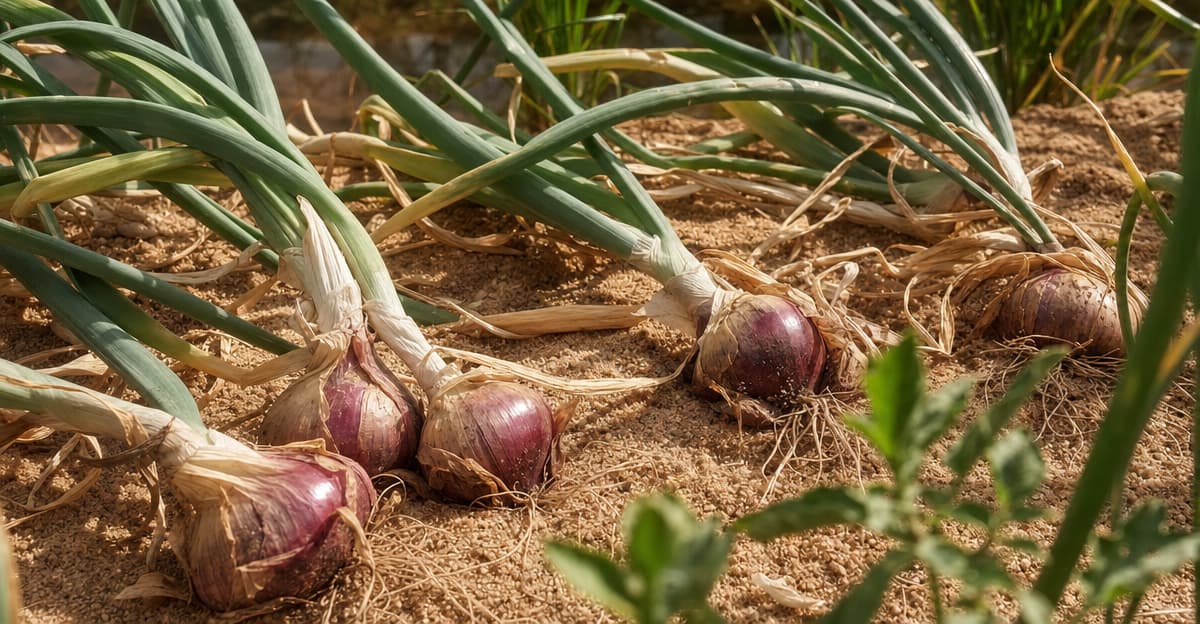
Onions (Allium cepa) look like a beginner's crop — drop a set in the ground, wait, pull up a bulb — and for many gardeners they are exactly that easy. But onions also fail more often than almost any other kitchen staple, and they nearly always fail for the same reason: the grower planted the wrong kind of onion for where they live. It is not a soil problem or a watering problem. It is a day-length problem, and it is the single most useful thing to understand before you plant anything.
This guide covers the whole crop — choosing the right type, starting from seeds, sets, or transplants, and growing onions across four environments (garden beds, containers, indoors under lights, and soilless/hydroponic systems) — with every recommendation tied to peer-reviewed research and university extension guidance, and honest notes wherever the evidence is thinner than the internet usually admits.
Onion Types and Their Relatives
"Onion" covers more than the storage bulb in your pantry. A quick map helps, because the type you want changes how you grow it:
- Bulb onion (Allium cepa) — the familiar globe onion grown for a dry, storable bulb. This is the main subject of this guide.
- Green / bunching / welsh onion (Allium fistulosum) — grown for tender green tops and slender white shanks rather than a bulb. Fast, forgiving, and the easiest allium to grow in a pot or indoors.
- Relatives worth knowing: leeks (Allium ampeloprasum), shallots, and chives all belong to the same family and share much of onion's culture.
If your goal is scallions rather than storage bulbs, the whole day-length question below mostly disappears — see the green-onion notes under each method, and our companion garlic guide for the other headline allium.
Choosing Your Onion: Day Length Is "the Trick"
Here is the mechanism most guides skip. A bulb onion spends its early life making leaves; at some point it switches from making leaves to swelling a bulb, and that switch is thrown by day length. When the daily hours of light cross a critical threshold, the plant stops adding leaves and starts storing energy in the bulb. A peer-reviewed review of allium bulb enlargement establishes this clearly: bulbing is initiated by a critical photoperiod, and the threshold is a fixed genetic trait of the cultivar.
That genetics is why onions are sold in day-length classes, and why the class must match your latitude:
- Short-day onions bulb when days reach about 10–12 hours — right for the southern US and other low-latitude regions, planted in fall or winter.
- Intermediate-day onions bulb around 12–14 hours — a broad middle-latitude fit.
- Long-day onions bulb only when days stretch to about 14–16 hours — right for the northern US and Canada, planted in spring.
Get this wrong and the plant never gets its cue. Multiple land-grant extensions describe the two classic failures: plant a long-day onion in the deep south and the days never grow long enough, so it makes leaves forever and never bulbs; plant a short-day onion in the far north and it bulbs almost immediately on small plants, giving you tiny onions. The most common reason onions "don't work" is a day-length class mismatched to latitude — fix that first, before you think about soil.
One point growers conflate: day-length class and daily sun are two different things. Day-length class is a genetic property of the seed you buy. Daily sun is a siting requirement — and here the extensions are unanimous: onions want full sun, at least 6 hours of direct light a day. More light hours through the season means more and larger leaves, and because each leaf feeds a ring of the bulb, better leaf growth means a bigger onion. Pick the right class and give it full sun.
Matching Day-Length Type to Your Latitude
Use this as a starting selector, then confirm against your regional extension office, which will often name specific cultivars proven locally:
- Roughly below 35°N (e.g., the US Gulf Coast, southern California, Florida): short-day types, planted in fall for a late-spring harvest.
- Roughly 32–38°N (the transition belt): intermediate ("day-neutral" in some catalogs) types offer the widest safety margin.
- Roughly above 38°N (the northern US, Canada, northern Europe): long-day types, started indoors in late winter and set out in spring.
Two honest caveats. First, these bands are approximations — the published thresholds themselves carry cultivar-to-cultivar variation, so treat the numbers as guidance, not a precise cutoff. Second, if you are growing green onions for their tops rather than bulbs, day-length class barely matters: you harvest before bulbing would ever begin, so grow whatever seed you can get.
Starting Onions: Seeds, Sets, or Transplants
Once you have the right class, you choose how to begin. Extension sources consistently frame three routes, each with a real trade-off:
- Sets (small dormant bulbs from last season) are the easiest and earliest — push them into the ground and go. The catch is a higher tendency to bolt (send up a premature flower stalk), especially the larger sets, and the narrowest cultivar choice.
- Seed gives the widest variety selection and the best bulbs, but needs the longest lead time — typically started indoors well before the season.
- Transplants (young seedlings, home-grown or bought) split the difference: more cultivar choice than sets, less lead time than starting your own seed.
For seed starters, extension and grower guidance converges on beginning indoors roughly 8–10 weeks before your intended transplant date, growing seedlings to about pencil-thickness before hardening off and planting out. Trim the tops back if seedlings get floppy, and plant transplants shallowly — onions bulb at the soil surface and don't want to be buried deep.
Germination temperature
Onion seed is not fussy about soil, but it does care about temperature. Three independent peer-reviewed studies of onion germination converge on an optimum in the range of about 20–25 °C (68–77 °F), where seeds sprout fastest and most completely. Below and above that band germination slows and thins out. The studies differ on the exact base and ceiling temperatures — because they used different cultivars and different modeling methods (thermal-time versus hydrothermal-time) — so treat the optimum as a reliable range and the outer edges as approximate. In practice, aim for warm soil to germinate, then grow the seedlings on cooler; you don't need to chase a single "perfect" number.
Four Ways to Grow Onions
Whatever method you choose, the day-length rule from above still governs whether a bulb forms. The environment changes how much attention you supply and, for indoor systems, whether bulbs are even the sensible goal.
Method 1: Garden beds (the primary, best-documented method)
Open ground is where onions are most reliably grown and best studied. Choose a sunny, well-drained site with loose, fertile soil, work in compost, and plant on the spacing your extension recommends — commonly around 8–10 cm (3–4 in) between plants for full bulbs, wider (10–15 cm / 4–6 in) for large sweet or Spanish types, and closer for green onions.
- Advantages: unlimited root run, natural soil biology, and a deep well of regional extension guidance.
- Limitations: you inherit your climate and your soil's drainage, and soilborne allium diseases (white rot, Fusarium basal rot, pink root) persist in ground where alliums have grown before — so rotate.
Method 2: Containers
Onions grow in pots, which suits balconies, poor native soil, or limited space. The honest framing matters here: dedicated peer-reviewed container-onion research is thin, so this guidance is transferred from bed culture by extension sources, not a distinct research finding. Within that limit, the consensus is practical and consistent:
- Green onions and shallow bulb types thrive in containers — they're shallow-rooted and quick.
- Large storage bulbs are harder in pots — they need depth, room, and a long steady season, so use a deep, wide container with excellent drainage and expect more watering attention than a bed needs.
Method 3: Indoors under grow lights
Indoors, light becomes the whole game. Because bulbing is a photoperiod response, you control day length directly with a timer — but you also have to supply enough light intensity over a long season, which is demanding for a full bulb. The science of spectrum is real: a peer-reviewed study of welsh onion under different LED wavelengths showed that light spectrum measurably shapes allium photosynthesis and growth, which is why grow-light choice isn't arbitrary. For most home growers the sensible indoor onion is a continuous supply of green onions on a sunny sill or under a modest light, harvested young — not a storage bulb.
Method 4: Hydroponic and soilless systems
Growing onions without soil is genuinely feasible, and the research says so. A peer-reviewed trial grew a Greek sweet-onion landrace hydroponically with competitive growth, yield, and nutrition versus soil — so a full hydroponic bulb onion is a real project, not a stunt. Soilless onion culture reaches into aeroponics too: a separate study optimized aeroponic production of fresh (green) onions by tuning root-misting intervals.
Be clear-eyed about the trade-off, because practitioner guides are unanimous on it: bulb onions are slow and space-hungry indoors, taking months and a lot of light, so most home hydroponic growers grow green onions instead — fast, compact, and endlessly cut-and-come-again. The one caution worth surfacing for any recirculating system is root-rot hygiene: waterborne pathogens like Pythium spread readily in shared nutrient solution, so clean systems and healthy roots matter more than in soil.
Hydroponic & Aeroponic Onions: System Choice and Honest Setpoints
System choice. The peer-reviewed feasibility work spans recirculating hydroponics for bulb onions and aeroponic (root-misting) culture for fresh/green onions; practitioner setups most often use deep-water culture or a simple net-cup system for green onions. A reliable low-effort starting point is regrowing green onions: set trimmed white bases in a net cup or a jar of nutrient solution under light and cut the tops repeatedly.
Seedling establishment. Getting onion seed cleanly into a soilless system is its own step; a peer-reviewed method using slant boards improves germination and seedling establishment for hydroponics and transfers well to alliums.
An honesty flag on nutrients, EC, and pH. You will find specific nutrient-strength (EC) and pH targets for hydroponic onions circulating online, but onion-specific setpoints are largely practitioner-derived rather than established by peer-reviewed trials. Treat any such numbers as starting points to calibrate against your own plants, not settled science. For the actual chemistry — how to mix and manage a solution, and how to read EC and pH — use our dedicated pillars: hydroponic nutrients for beginners and pH and EC management. We deliberately keep dosing there rather than printing an onion "recipe" here.
Watering Onions
Onions are more sensitive to drought than their tidy tops suggest, and the reason is anatomical: they have a shallow, sparse root system, so they can't chase water down the profile the way a deep-rooted crop can. A peer-reviewed review of onion and drought makes the consequence plain — water stress, especially during bulb development, directly reduces bulb size and yield.
Translating that into practice, extension guidance lands on a simple rule: aim for about 2.5 cm (1 inch) of water per week, delivered steadily rather than in feast-and-famine cycles, and keep moisture especially consistent while bulbs are swelling. Then reverse course near the end: stop watering once the tops begin to fall over, so the bulbs and necks dry down for harvest and storage rather than sitting wet. Consistent moisture through growth, a dry finish for the harvest — that rhythm matters more than any single figure.
Feeding Onions
Onion nutrition is where decades of peer-reviewed work say something more interesting than "add fertilizer," so it's worth understanding the why even though we won't print a dosing table.
Two nutrients tell the story. Nitrogen builds the leaf canopy — and since each leaf feeds a ring of the bulb, steady nitrogen through the leaf-growing phase sets up a big onion — the same uptake pattern reflected in commercial nutrient-management guidance. But more is not better: machine-learning analysis of onion nutrition confirms that balanced management, not maximal nitrogen, optimizes yield and quality, and classic work shows nitrogen's effects are tangled up with sulfur. On the form of nitrogen, research favors nitrate-dominant nutrition over high-ammonium feeding for onion growth.
The quieter, more surprising nutrient is sulfur — it is what makes an onion taste like an onion. Peer-reviewed work links sulfur availability directly to pungency and bulb quality: more sulfur, more of the sharp, storage-worthy flavor; less sulfur, a milder, sweeter bulb. This is the same lever that separates a sharp cooking onion from a sweet salad onion, and it's fully established science, not folklore.
The practical takeaway without any numbers: feed steadily while the leaves are growing, then ease off as the bulbs swell and mature, and don't neglect sulfur if flavor and keeping quality matter to you. Because precise rates depend on your variety, soil, and system, we keep the stage-by-stage nutrient targets on the onion plant page, where they live alongside the rest of onion's growing data, and we keep hydroponic dosing in the nutrient and pH/EC pillars.
Common Problems
Onions have a well-documented set of troubles. For most, the deeper diagnostic detail belongs in a dedicated troubleshooting guide; here is the short field version, with the top few worth recognizing on sight.
- Bolting (a flower stalk instead of a bulb): the plant was pushed into its reproductive phase early — often from planting oversized sets, or from a cold snap on well-grown transplants. A peer-reviewed review catalogs bolting among onion's key physiological disorders; the practical defenses are appropriately sized sets and a variety suited to your season.
- Onion thrips: the number-one insect pest of onions — tiny, silvery, tucked in the leaf axils, and a vector of Iris Yellow Spot Virus (IYSV). Multiple extension and IPM programs rank thrips as the pest to scout for first.
- Downy mildew, Botrytis neck rot, purple blotch: the main foliar and storage diseases, favored by wet, humid conditions and poor airflow; land-grant and IPM sources converge on spacing for airflow, rotation, and drying the crop before storage.
- White rot: a persistent soilborne fungus that survives for years in the ground — the strongest argument for rotating onions (and all alliums) out of infested beds.
For anything you can't identify, your regional extension or IPM program publishes onion-specific diagnostic guides — several are listed in the sources below.
Harvesting, Curing, and Storing
When to harvest
Onions tell you they're ready. When roughly half the plants have their tops fall over and the necks soften, bulbing is finished and it's time — stop watering, then lift the bulbs on a dry day. Ease them out rather than yanking by the tops, which can tear the neck.
Curing
Fresh-dug onions are not storage onions yet. Cure them in a warm, dry, well-ventilated, shaded spot for about two to four weeks, until the necks are fully dry and the outer skins are papery and rustle. Leaving the tops on during curing lets the plant pull the last of its energy and moisture down; trim them only once the neck is dry. This step is what lets an onion keep for months instead of weeks — don't rush it, and judge by the dryness of the neck, not the calendar. (Home-scale curing rests on well-established extension practice rather than controlled trials — treat the window as horticultural best practice.)
Storage — and the sweet-onion catch
Here the day-length and sulfur threads pay off in one satisfying rule: not all onions store, and it's predictable which ones won't. Pungent, firm-necked storage onions — typically long-day types — keep for months in cool, dry, airy conditions. Sweet, mild onions — often the short-day types prized for low pungency — do not keep, and the primary reason is physical: they carry high water content and low dry matter, so they lose mass and soften in storage markedly faster than firm, high-solids keepers. Their characteristic low sulfur (which makes them sweet rather than sharp) travels with that low dry matter, so mildness is a reliable signal that a bulb won't store — eat these fresh within weeks.
So match your storage plan to your onion: cure everything, store the sharp keepers cool and dry with good airflow, and put the sweet ones on the table first. Whatever the type, don't seal cured onions in plastic — trapped moisture invites the neck rots above.
The Short Version
Onions reward one decision made correctly up front: pick a day-length class that matches your latitude — short-day in the south, long-day in the north, intermediate in between — and give the plants full sun. Start from sets for ease, seed for choice, or transplants for balance; germinate seed warm around 20–25 °C. Water steadily (about an inch a week) through leaf growth, keep it consistent while bulbs swell, then dry them off as the tops fall. Feed for steady leaves and don't forget sulfur — it's what makes an onion taste like one. Watch for thrips, rotate away from white rot, harvest when the tops flop, cure for a few weeks, and store the sharp keepers cool while you eat the sweet ones fresh. Bed, pot, windowsill, or hydroponic system — that rhythm holds; the environment mostly decides how much attention you supply and whether a full bulb is even the goal.
For onion's full growing-condition data and nutrient targets, see the onion plant page.