How to Grow Spinach: Sowing, Feeding and Bolting
How to grow spinach: sow about 4 weeks before your last spring frost and 6 to 8 weeks before the first fall frost, and pick before long days bring bolting.
To grow spinach, sow about 4 weeks before your average last spring frost, our pick within Penn State Extension's four to eight weeks, and six to eight weeks before your average first fall frost. Lengthening days make spinach bolt, and University of Minnesota Extension says hot weather makes it respond faster.
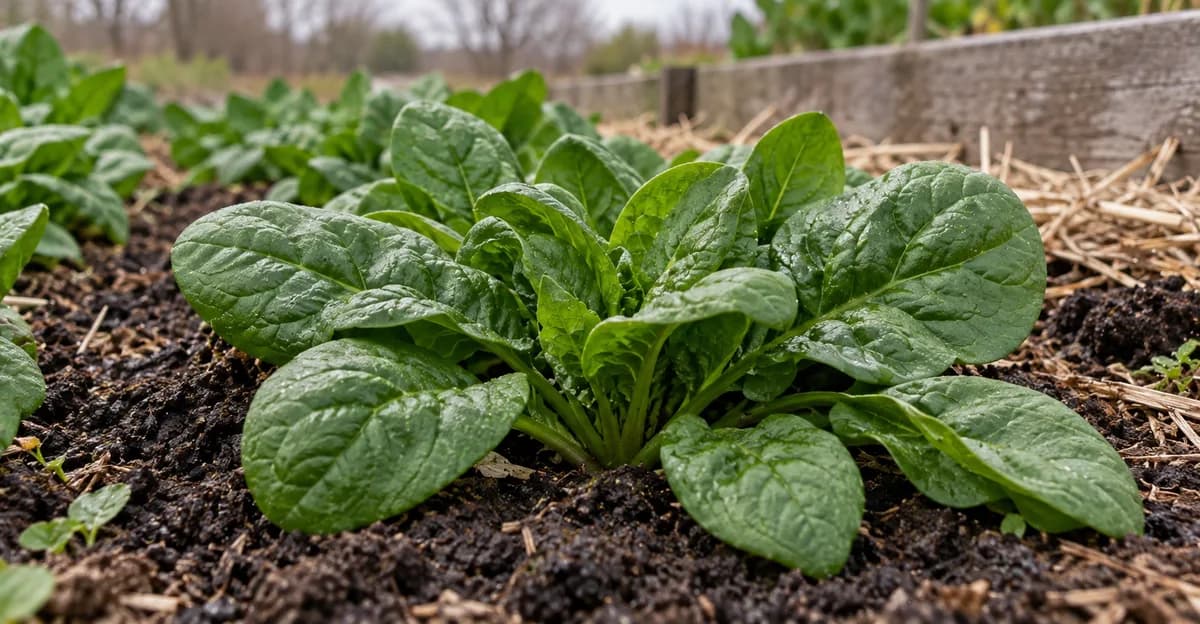
What Spinach Needs: Cool Weather, Sun and Steady Water
Spinach (Spinacia oleracea) is a cool-season leaf crop. Penn State Extension puts its best growing temperature at 50°F to 60°F and says young seedlings can tolerate cold as low as 15°F to 20°F. Utah State University Extension says spinach grows best below 75°F and that frost down to 32°F does not seriously damage young plants. It overwinters easily for an early-spring crop if plants have 4–5 true leaves by late in the year and are mulched heavily, with the mulch removed after the snow melts. Wisconsin Horticulture calls spinach a hardy annual with ideal weather of 50–60°F; in colder areas or severe winters, it says mulch may help plants survive, and hardier varieties such as 'Bloomsdale Longstanding' are more likely to make it through.
Spinach likes full sun and fertile, well-drained soil, but tolerates partial shade. Water garden spinach regularly, 1–2 inches a week depending on soil and temperature, Utah State says, because uneven moisture makes leaves tough, slows growth and causes off-flavors. In garden beds, loosen the soil 12 to 18 inches deep: mature spinach has a long taproot, while seedling roots are shallow, so thin carefully.
When to Sow Spinach for Your Frost Dates
How far before your frost dates to sow differs by extension service.
- About four to eight weeks before the average last frost date in spring and six to eight weeks before the average first frost date in fall, for two crops a year, says Penn State Extension. Many home gardeners fail because they start too late in spring.
- About 4 weeks before the average last frost date, with further sowings about 2 weeks apart, says Wisconsin Horticulture.
- 2–3 weeks before the last spring frost, or direct seed 3–4 weeks before transplants go out near the last frost-free date, says Utah State University Extension. For fall, it sows early-maturing cultivars 50–75 days before the expected maturity date, set about 1–2 weeks after the expected first fall frost.
- As soon as the soil can be worked in spring and again every one to two weeks until outdoor temperatures reach 80°F, and a fall crop two months before the average first frost date, says University of Minnesota Extension.
No source read gives sowing dates by USDA zone or a calendar for places without frost, so every rule here moves with your own frost dates. If you are unsure of your last frost date, Minnesota's spring rule needs none, because it sows as soon as the soil can be worked. Where there is no frost, our inference is to sow when the soil is in the germination ranges given for spinach seed, knowing that cool soil at sowing does not keep the crop from meeting heat or long days before harvest.
Fall sowing avoids the long days. In Minnesota, August sowings for fall grow under shortening days and will not bolt, University of Minnesota Extension says; it sows in early August from Duluth north and from mid-August elsewhere to avoid summer heat. Warm soil is the problem with a fall sowing. Penn State suggests shade cloth to keep the soil cool in the warm early days of fall, then plastic covers to stretch the harvest into late fall or, with luck, early winter.
Spinach Germination Temperature and Seed Choice
Sow into cool soil. Penn State Extension says spinach seed germinates best at soil temperatures between 45°F and 68°F, seedlings usually appear within 7 to 10 days, and fresh seed gives the best results because germination falls off quickly as seed ages. Utah State University Extension says you can sow once the soil reaches 40°F, that seed germinates best at 55–65°F and takes 7–10 days to emerge, and that temperatures above 80°F reduce germination.
In growth-chamber tests of nine spinach genotypes, seed germinated best between 15 and 20 °C; above 20 °C germination fell, and it dropped sharply at 35 °C.
Variety matters in warm conditions. In the same growth-chamber tests, 'Donkey', 'Marabu' and 'Raccoon' germinated over 70% at 30 and 32 °C ('Raccoon' 84% at 30 °C), while 'Tyee', sold as heat tolerant, had the lowest germination of the five commercial varieties at those temperatures. At 35 °C every genotype except 'Ozarka II' fell below 30%, and 'Ozarka II' still germinated 63%. The authors cite an earlier report that primed seed germinated better at 30 °C, but they judge choosing heat-tolerant varieties the more manageable practice. The sources read do not report on chilling seed before sowing.
How to Grow Spinach From Seed: Depth, Spacing and Thinning
Sow shallow; the extension services differ mainly on spacing. If you want one layout to start from, use Penn State's; the sources do not rank them, so the pick is ours.
- Sow ½ inch deep and two inches apart in rows 12 to 18 inches apart, Penn State Extension says, then thin when plants are two inches tall, leaving four to six inches for each plant, because crowded seedlings can be stunted and bolt early.
- Space plants 3 inches apart in rows 12 inches apart and thin when seedlings have 3–4 true leaves, Utah State University Extension says; dense plantings also reduce weed pressure.
- Sow seed 1–4 inches apart and about ½ inch deep, Wisconsin Horticulture says; at the closer spacing, thin when the leaves touch and eat the thinnings as salad greens.
- Sow one-fourth to one-half inch deep in rows 18 to 30 inches apart and thin to two to four inches apart, University of Minnesota Extension says.
You can also start spinach from transplants, which give an earlier harvest, Utah State says. Set them out once they have 4–6 mature leaves and a well-developed root system, which generally takes 5–6 weeks from sowing; seedlings pulled at thinning can be replanted if some roots are kept.
How to Feed Spinach in Soil and Containers
Start with a soil test. Spinach does best in soil with pH between 6.5 and 8, University of Minnesota Extension says, and phosphorus and potassium should follow the soil-test recommendations, with a low- or no-phosphorus fertilizer unless the report asks for more phosphorus. Let the soil test set potassium; no source read supports feeding spinach a fixed potassium-to-nitrogen ratio. If you want to understand what each nutrient does before you buy fertilizer, read how plant nutrients work.
Then side-dress. The two side-dress rates differ on phosphorus. Utah State University Extension places ¼ cup of a nitrogen fertilizer labelled 21-0-0 per 10 feet of row beside the plants, 4 weeks after transplanting or at thinning, and waters it in. Wisconsin Horticulture calls spinach a heavy feeder and fertilizes before planting and again at midseason, which matters more in spring when cold soil holds back nitrogen. It side-dresses about ¼ pound of 5-10-5 fertilizer per 10 feet of row when plants are about 2 inches tall, and adds nitrogen if the leaves start to yellow. The 5-10-5 carries phosphorus, which Minnesota adds only when the soil test asks for it. Our inference: without a test showing low phosphorus, the nitrogen-only 21-0-0 is the safer place to start.
Penn State Extension says spinach can be grown in a container if you choose varieties suited to containers, a container large enough for the plant and a nutrient-rich soilless potting mix; the page gives no container size. No source read gives a container feeding rate either, so our suggestion is to follow the potting mix or fertilizer label.
Why Spinach Bolts and How to Delay It
Bolting is the switch from leaves to a flower stalk. To stop spinach from bolting early, time the crop around day length and heat. A review of spinach bolting research describes spinach as a long-day plant: long days induce bolting, and managing day length and temperature while the crop grows can prevent it.
Heat and dry soil pull bolting forward. University of Minnesota Extension says spinach bolts in response to lengthening days, hot weather makes plants respond faster and drought can also speed bolting. In Minnesota, in the northern hemisphere, a hot or dry spell in May can end leaf production, and in June plants tend to bolt even in cool weather. It also notes that spinach can start to flower after several days above 75°F. Writing for the northern hemisphere too, a Penn State Extension article by a Butler County Master Gardener says spinach will want to bolt once the temperature reaches 80°F, and because it is also day-length sensitive it will bolt in June even if the weather stays cool; letting the soil dry out also makes it bolt. The bolting review also lists chilling, drought and strong light as stresses that induce bolting, and cites earlier work that bolting rises when growing plants are chilled and then meet warmer temperatures and long days.
No source read gives a measured day length at which bolting risk rises for home cultivars. One greenhouse study, citing earlier work, gives 14 hours of light a day as the photoperiod that induces flowering in spinach; its own plants grew under short natural days of 10.5 to 11.0 hours of light. The bolting review, citing transplant-production work by Chun and colleagues, reports that a shorter photoperiod during transplant production delayed bolting, with flower stalks at one sampling date after transplanting 15 mm long under the shorter photoperiods and 80 mm under 16 hours of light a day.
Variety buys some time. Wisconsin Horticulture names 'Indian Summer' and 'Olympia' as slow-bolting, 'Space' as bolt-resistant and 'Tyee' as very slow to bolt, and recommends such varieties for later plantings, but warns that even slow-bolting types do not stay leafy for long. 'Tyee' also germinated poorly in the warm growth-chamber tests, so our inference is to sow it while the soil is still cool, not into hot soil. Utah State University Extension says spinach bolts during the long, warm days of summer, and that long-standing or slow-bolting varieties suit late-spring plantings better. In a Texas screen reported by the bolting review, 'Fidalgo', 'Springfield' and 'Springer' were the late-bolting cultivars among 18 evaluated over 8 years in the Winter Garden region, and oriental cultivars generally bolted easily.
What to do depends on what you see in the bed:
- If plants are still leafy and no flower stalk has formed, keep picking until a flower stalk starts to rise.
- If one plant starts to bolt or a strong central stem is rising, cut every plant in the bed now, not only the bolting one: Minnesota says that once you notice one plant bolting, the rest will soon follow, so harvest them all, and Penn State Extension says a bolting plant sends up a strong central stem and becomes bitter and inedible.
Growing Spinach Indoors Under Lights
For spinach under lights, one indoor-growing paper's table of conditions suitable for spinach lists 12 h of light a day, 15–25 °C for growth and 7–23 °C for germination. Its authors state spinach production peaks at 75% relative humidity and between 14 and 18 °C under 12 h photoperiods; their own plants grew for 60 days in an enclosed indoor cabinet that averaged 25 °C, and they did not report bolting. Our inference from those figures is to keep the room at the cool end of the growth range. No source read gives a light intensity for spinach under lights.
Growing Spinach Hydroponically
Plan for root rot. Pythium root rot is the reason most hydroponic operations, anecdotally, avoid spinach: researchers describe hydroponic spinach as highly susceptible to Pythium root rot if proper sanitation and other cultural strategies are not implemented. This is our inference: for a first spinach crop, a garden bed or a container is the easier start, because the extension advice in this guide is written for gardens and hydroponic spinach needs that disease control from day one. If root rot has already set in, follow the hydroponic root rot rescue steps.
Keep the solution pH from drifting low. In growth-chamber deep-water culture, 'Corvair' spinach grew less as solution pH was lowered from pH 5.5, the highest pH tested. After 19 to 20 days, fresh shoot mass was 3.8 g per plant at pH 4.5 (52% of the 7.3 g at the highest pH) and 0.88 g at pH 4.0 (12%), where plants were stunted and roots severely inhibited. In the same study, raising solution strength (electrical conductivity, EC) from EC 1.4 to 3.4 dS/m at pH 5.5 did not significantly increase growth, which the authors read as nutrients not limiting at the standard strength; they note hydroponic solution pH is typically managed between 5.5 and 6.5.
In a floating-raft trial in an unheated greenhouse in Turkey, baby-leaf 'Aletta F1' spinach on a half-strength solution (EC 1.2–1.3 dS/m) gave 17.0% less total yield than on full strength (EC 1.6–1.8 dS/m), averaged over a winter and an early-spring crop; in each of the three harvests the authors place full and half strength in the same statistical group. Plain water cut yield by 74.8%. In that trial, leaf nitrate fell as the solution was diluted, but full and half strength did not differ significantly. Across both crops and all strengths, leaf nitrate stayed between 1177.2 and 1811.9 mg/kg, below the EU limit of 3500 mg/kg for spinach that the authors cite.
Do not leave potassium out of the solution. In a greenhouse deep-water-culture trial on baby-leaf 'Carmel' spinach, a nutrient solution with no potassium, applied for 14 days, cut tissue potassium by up to 91%, dry weight by 61% and fresh-weight yield by 76% compared with the control solution at 244 ppm (parts per million) K. Yet a quarter of the control potassium (58 ppm K) gave a fresh weight not significantly below the control, while 19 ppm K (10% of the control) gave a significantly smaller crop.
What the Hydroponic Spinach Trials Measured
This section is for hydroponic growers who want the conditions each trial ran under, and for any grower who wants the germination-chamber figures or a sand-culture potassium study.
The full-strength solution in the floating-raft trial was a winter-lettuce recipe with nitrogen and potassium at equal concentrations; the half dose cut the macronutrients by 50%. In that trial the growing period moved yield more than solution strength did: total yield was 34.2% higher in the early-spring crop than in the winter crop, against a 17.0% drop from full to half strength. The early-spring crop was warmer and sunnier: the nutrient solution averaged 20.0 °C (9.2–37.5 °C) against 10.7 °C (3.5–32.0 °C) in the winter crop, greenhouse air averaged 19.8 °C against 11.3 °C, and solar radiation was 10.64 against 5.55 MJ per m² a day. Regrowth cuts yielded less: 53.2% of the total came from the first cut, 21.1% from the second and 25.7% from the third.
The floating-raft authors report their hydroponic yields were higher than a soil-culture yield published by another group, and cite earlier work that hydroponic baby-leaf crops are usually ready 3–6 weeks earlier than open-field crops. The soil comparison is between studies, not within one trial.
Gillespie and colleagues grew the spinach for their deep-water-culture pH study in a growth chamber under 12 h of light a day from fluorescent lamps.
If you start seed in your own system, the germination study adds two sets of figures. In Chitwood and colleagues' growth-chamber tests, five genotypes ('Raccoon', F88-354, F88-310, 'Donkey' and 'Tyee') germinated 92% to 98% at 15 °C, and seven of the nine genotypes germinated 80% to 89% at 20 °C. Earlier experiments cited by Chitwood and colleagues found spinach seed germinating at soil temperatures from 5 to 30 °C, best at 20 °C and dropping abruptly between 25 and 30 °C; another cited report has germination ceasing entirely at 35 °C, which the newer tests found true for most genotypes but not for 'Ozarka II'. These earlier papers were not read.
In Ucgun and colleagues' greenhouse sand-culture study irrigated with salty water, 'Raccoon' and 'Gazelle' spinach kept growing at potassium doses far below standard advice, with shoot growth after 50 days generally unchanged by potassium dose and plants at the lowest dose (equivalent to 2.73 kg of K per hectare) keeping their N, P and K balance, and the authors conclude spinach needs much less potassium than the 63 to 138 kg per hectare previously recommended, and they credit the salty irrigation water with supporting growth at the lowest dose, in plants that already had 6–8 true leaves when salt irrigation began.
When to Harvest Spinach and How to Store It
How long until you can pick depends on the variety. Wisconsin Horticulture's cultivar list gives days to harvest from 30 days for 'Regal', a variety for dense baby-leaf plantings, to 48 days for 'Bloomsdale Longstanding'.
You can pick leaves any time before the flower stalk forms, Utah State University Extension says. Take older leaves first so the young ones keep growing, or cut all the leaves to within 2 inches of the soil as long as the growing point is not damaged. Wisconsin starts picking single leaves once plants have at least 6 true leaves, or cuts the whole plant at maturity, which it calls best in spring or as soon as a central stalk begins to appear. In fall, taking only the outer leaves keeps the plant producing.
In a floating-raft trial, baby leaves were cut when the outer, older leaves reached 10–15 cm long, cutting above the growing tip so the plants regrew. The first cut came 4 weeks after seeding in the early-spring crop but up to 8 weeks after seeding in the colder winter crop, and cutting stopped after the third harvest because leaf quality fell.
Start picking once leaves reach a usable size, Penn State Extension says, snipping outer leaves at the base and leaving the rosette to keep growing, since leaves left too long turn bitter. University of Minnesota Extension says spinach regrows after the first harvest, especially when single leaves are picked at the baby stage, so several harvests are possible. A fall crop can be picked leaf by leaf or cut at or just above the soil.
Storage advice depends on how cold you can keep it. Spinach keeps 1–2 weeks at 32°F and 95% relative humidity, Utah State says. In a home refrigerator, Minnesota says spinach lasts only a few days, or about a week if picked while plants are cool, rinsed in cold water and refrigerated right away.
Preventing Spinach Diseases and Pests
Where downy mildew is a problem, choose resistant varieties; water the soil rather than the leaves, since wet leaves encourage fungal disease, and give plants enough space. For spinach leafminer, Wisconsin Horticulture says to remove leaves with eggs or mines rather than spray, since sprays do not reach the larvae inside the leaf, and to cover plants with floating row cover after thinning.
Mark Your Spinach Sowing Weeks
Before you buy seed, find your average last spring frost and first fall frost dates with the frost date calculator, then count back to your spring and fall sowing weeks and mark them on your calendar.
Frequently Asked Questions
When should I plant spinach?
Penn State Extension says to sow four to eight weeks before the last spring frost and six to eight weeks before the first fall frost; Utah State University Extension says 2–3 weeks before the last spring frost, or direct seed 3–4 weeks before transplants go out near the last frost-free date. Our pick for a single week to mark is about 4 weeks before your last spring frost.
Why does my spinach bolt so quickly?
Spinach bolts in response to lengthening days, and University of Minnesota Extension notes it can start to flower after several days above 75°F. It says hot weather makes plants respond faster and drought can also speed bolting; in Minnesota, in the northern hemisphere, plants tend to bolt in June even in cool weather.
How deep and how far apart should I plant spinach seeds?
Sow ½ inch deep in rows 12 to 18 inches apart, then thin to four to six inches for each plant once plants are two inches tall, Penn State Extension advises. Utah State University Extension uses a closer layout: plants 3 inches apart in rows 12 inches apart, thinned when seedlings have 3–4 true leaves.
Will spinach seeds germinate in hot weather?
Fewer seeds germinate above 80°F, Utah State University Extension says; it puts the best soil temperature at 55–65°F, sows once the soil reaches 40°F and expects 7–10 days to emergence. Variety matters too. In growth-chamber tests, 'Donkey', 'Marabu' and 'Raccoon' germinated over 70% at 30 and 32 °C ('Raccoon' 84% at 30 °C), while at 35 °C every genotype except 'Ozarka II' (63%) fell below 30%.
Does spinach grow back after you cut it?
Yes, and Utah State University Extension says you can cut all the leaves to within 2 inches of the soil as long as the growing point is not damaged. University of Minnesota Extension adds that spinach regrows after the first harvest, especially when single leaves are picked at the baby stage, so several harvests are possible.
How long does fresh spinach keep in the fridge?
In a home refrigerator, spinach lasts only a few days, or about a week if you pick it while the plants are cool, rinse it in cold water and refrigerate it right away, University of Minnesota Extension says.