Stop Lettuce Bolting: It's a Switch, Not Old Age
Why does lettuce bolt and go to seed? Bolting is a programmed reproductive switch flipped by heat and long days, not old or diseased lettuce, and it is what turns the leaves bitter. Learn what triggers the switch and the levers that keep it from flipping, all traced to peer-reviewed and university research.
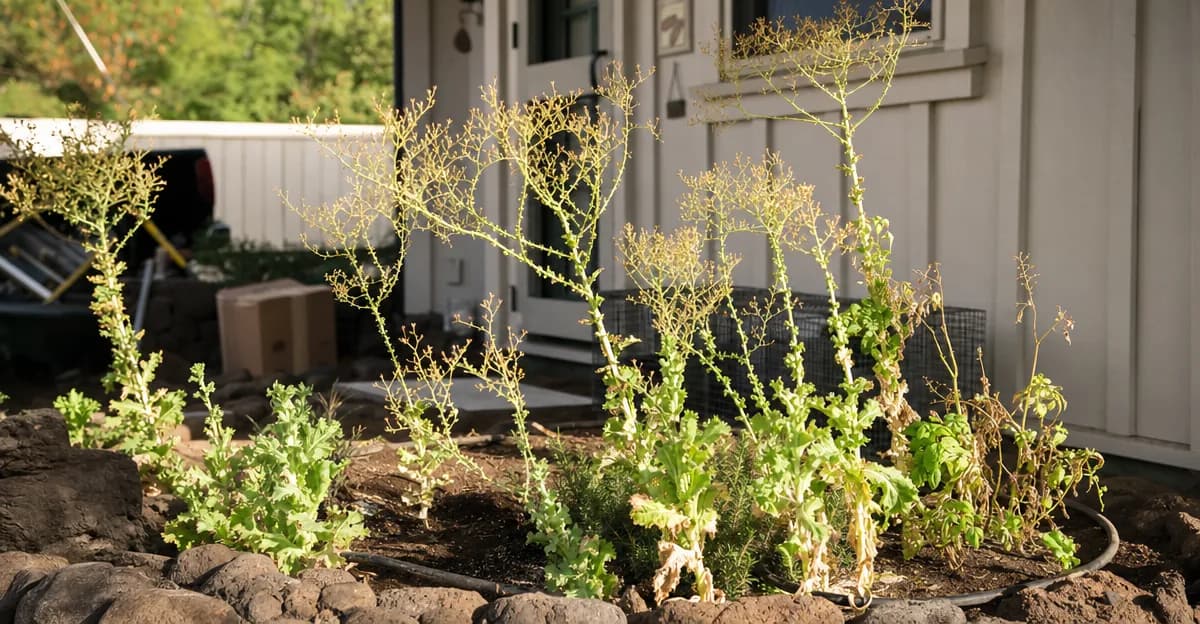
Key takeaway: When lettuce shoots up a tall central stalk, turns bitter, and stops making leaves, it has not gone "old" or caught a disease — it has flipped a programmed reproductive switch. Heat and long days turn on a florigen-and-gibberellin gene circuit at the growing tip, the plant abandons leaf production to flower and set seed, and the same switch is what makes the leaves bitter. Once that switch is thrown it cannot be reversed. So preventing bolting is not about rescuing a bolted head — it is about keeping the switch from flipping in the first place: stay cool, add shade, watch day length, choose slow-bolt varieties, and time the crop for cool windows.
Why does my lettuce bolt (go to seed)?
Bolting is the transition from vegetative growth to flowering. Instead of stacking new leaves into a compact head, the plant elongates a stem, sends up a flower stalk, and commits its energy to producing seed. University disorder references describe it the same way growers see it: a flower stalk shoots up and leaf quality collapses. The important reframe is that this is a developmental program the plant is designed to run, not a defect — the plant is doing exactly what an annual is built to do once its environment tells it the season is right.
That is why "my lettuce is just old" is the wrong diagnosis. Age is one input, but the switch is triggered by the environment, and it happens on the plant's reproductive schedule, not a fixed calendar of days. Bolting is also distinct from tipburn — the other heat-linked butterhead disorder, which is a calcium-transport problem in the inner leaves rather than a flowering transition. The two often get lumped together because both worsen in heat, but they are different mechanisms with different fixes; this guide stays strictly on bolting.
Because the physiology is shared across lettuce types, everything here applies whether you grow crisphead, romaine, loose-leaf, or butterhead lettuce — the crop most gardeners have in mind when a head suddenly stretches skyward and turns bitter.
Does heat or day length cause bolting?
Both do — and getting the relationship right is what separates good prevention from folk wisdom.
Heat is the dominant practical trigger. In the field and greenhouse, sustained high temperature is what pushes lettuce into flowering. The molecular work is unambiguous that the vegetative-to-reproductive transition is induced by high temperature, multi-omics analysis of heat-treated lettuce confirms the flowering program switching on under heat, and extension programs consistently name heat as the trigger growers actually run into. Oregon State's guidance puts a number on it: multiple days above roughly 75 °F (about 24 °C) can cause lettuce to flower.
Day length is an independent driver. Lettuce is a facultative (quantitative) long-day plant: longer photoperiods promote flowering on their own. This is where the popular "it's just the heat" story is incomplete. In Waycott's controlled-environment study across genetically diverse accessions, photoperiod was sufficient to induce bolting while high temperature alone was not, and genotypes varied widely in how strongly they responded to day length. Later QTL mapping identified dedicated photoperiod-sensitivity loci — orthologs of the classic CONSTANS flowering pathway — confirming day length is a genuine, heritable driver, not a side effect of warm summer days.
The honest reconciliation: heat is the accelerator most outdoor and greenhouse growers feel first, but day length is a real, separate lever — one that indoor and controlled-environment growers can actually control by managing their light schedule. Heat, day length, and plant age are not competing explanations; multi-omics analysis shows they funnel into the same floral program, with heat-responsive genes spanning the photoperiod, age, and gibberellin pathways at once. Do not treat heat as the only cause.
Inside the Bolting Switch: LsFT, LsSOC1, and the Gibberellin Trigger
The reason bolting behaves like a switch — sudden, decisive, irreversible — is that it runs through a small set of master genes at the shoot tip, and the science on how they connect is now quite specific.
The pivot point is LsFT, lettuce's version of florigen, the mobile "flower now" signal. High temperature promotes LsFT, and when researchers knocked LsFT down, they dramatically delayed bolting and abolished the high-temperature response entirely — strong evidence that this gene is the gateway heat has to pass through to trigger flowering. Just upstream sits LsSOC1, a flowering integrator that acts as an activator of heat-promoted bolting; knocking it down also delays bolting and makes plants insensitive to high temperature. The direct molecular link between sensing heat and throwing the switch is that heat-shock transcription factors — HsfA1e and HsfA4c — bind the LsSOC1 promoter, so the plant's heat-alarm machinery is wired straight into the flowering program.
Gibberellin (GA) enters as the executor of stem elongation, not the master decision. In a comparison of a bolting-resistant line against a bolting-sensitive one, applying exogenous GA promoted bolting in both, and flowering-promoting MADS-box genes were induced in the sensitive line. But the same work concluded it is the MADS-box gene differences — not GA alone — that distinguish resistant from sensitive plants, so GA is best understood as the hormone that physically drives the bolt within the flowering program rather than the sole cause of it. Multi-omics analysis places GA alongside the photoperiod and age pathways as one of three converging routes into flowering. Put together: heat (and long days) activate LsSOC1 and LsFT at the tip, the floral program engages, and GA elongates the stalk — a one-way sequence, which is exactly why you cannot un-bolt a plant.
Why does bolted lettuce taste bitter?
The bitterness is not a coincidence that happens to arrive with the flower stalk — it is part of the same reproductive shift. As lettuce bolts, it accumulates sesquiterpene lactones, chiefly lactucin and lactucopicrin, the compounds responsible for lettuce's bitter, milky sap. Direct measurement across cultivars shows these compounds rise sharply from the mature stage to the bolting stage: lactucopicrin, for example, was measured at roughly 10–345 µg/g dry weight at the mature stage versus about 169–3,888 µg/g at bolting, with lactucin similarly elevated. Extension and species references corroborate the sensory outcome — lettuce turns bitter as it bolts and goes to seed.
The practical consequence: bitterness tracks the developmental switch, not just the thermometer. That is why a bolting head tastes bitter even after a cool night, and why the only reliable way to keep lettuce sweet is to keep it vegetative in the first place.
How do I stop lettuce from bolting?
Because the switch is irreversible, every effective tactic is a prevention — you are keeping the plant from ever receiving the "flower now" signal. Six levers do the work.
1. Keep it cool. This is the single biggest lever outdoors. Hold the crop below roughly 24 °C / 75 °F; sustained temperatures above that threshold are what push lettuce into flowering. Cornell's controlled-environment guidance is built around keeping lettuce in cool, stable conditions so it stays vegetative through harvest, and warm-weather trials show that extreme heat — weeks reaching about 106–107 °F — will force bolting even in varieties chosen for tolerance. Cool nights and avoiding peak summer heat are the foundation everything else builds on.
2. Add shade. When you cannot control the air temperature, lower the plant's heat load directly. UC ANR's warm-weather guidance recommends shade cloth, or simply growing lettuce in the shadow of taller crops, to hold it through hotter weeks, and Michigan State likewise advises shade in summer to reduce bolting pressure.
3. Watch day length — especially indoors. Since long photoperiods independently promote bolting, avoid unnecessarily long light cycles under controlled environments. Cornell's CEA program keeps lettuce vegetative with disciplined environmental control rather than maximal day length. Outdoors you cannot change the sun, but this is the extra lever indoor and greenhouse growers hold: a shorter photoperiod lowers bolting pressure independent of temperature.
4. Time the crop and succession-plant. Plant into the cool shoulder seasons — spring and fall — rather than trying to hold lettuce through midsummer; UC IPM frames prevention as planting "when environmental conditions during development will not stimulate bolting". Land-grant hydroponic guidance treats lettuce as a cool-season crop grown on short cycles, harvested at roughly 30–40 days before heat and holding the crop too long trigger bolting. Succession planting — small, staggered sowings — keeps a steady supply of young, pre-bolt heads instead of one aging block that bolts all at once.
5. Keep water steady. Drought stress accelerates bolting and bitterness, so even, uninterrupted growth is itself a preventive. UC ANR's guidance is blunt: "don't skimp on water — keep lettuce growing fast to prevent premature bolting and bitterness", and Michigan State similarly stresses consistent moisture and minimizing stress swings.
6. Choose slow-bolt cultivars. Bolt resistance is a real, heritable trait — controlled comparisons of resistant versus sensitive lines trace the difference to specific flowering genes — so variety choice genuinely matters. Extension programs recommend selecting "slow-bolt" types, and both hydroponic and field trials have identified cultivars that hold longer under heat. The important caveat is in the next section: no single variety is bolt-proof everywhere.
Choosing Slow-Bolt Cultivars for Your System (and Why 'Jericho' Splits the Data)
Cultivar choice is worth taking seriously because bolt resistance is genetic, not luck. When researchers compared a bolting-resistant lettuce line against a sensitive one, the resistance traced to differences in flowering-gene expression that the plant inherits, and photoperiod-sensitivity QTL mapping found both daylength-independent and photoperiod-sensitive flowering loci segregating in lettuce populations. In other words, "slow-bolt" is a breedable property you can shop for — which is why extension programs specifically recommend choosing slow-bolt varieties.
The catch is that performance is environment- and system-specific, and the data make that vivid. In a deep water culture (hydroponic) heat trial of 18 cultivars, the more heat-tolerant group included 'Adriana', 'Aerostar', 'Monte Carlo', 'Nevada', 'Parris Island', 'Salvius', 'Skyphos', and 'Sparx', while 'Buttercrunch', 'Coastal Star', and 'Jericho' landed among the less tolerant. Yet a warm-weather field program in Sacramento lists 'Jericho' as a successful heat-tolerant variety, alongside 'Nevada', 'Red Cross', 'Paradai', 'Merlot', and 'Year Round Bronze Oak Leaf'. Same cultivar, opposite verdicts — because a DWC greenhouse and an open field are different environments.
The takeaway is not "the sources disagree so ignore them." It is that no single cultivar is universally bolt-proof, so you should select trialed slow-bolt types for your conditions and system rather than crowning one hero variety. 'Nevada' happens to appear on both the hydroponic and field lists, which makes it a reasonable starting point, but the durable strategy is to trial two or three recommended slow-bolt cultivars in your own setup and keep the ones that hold — cultivar is a strong lever, just not a substitute for the cool, shade, and timing levers above.
Can you reverse a bolting lettuce?
No. Once bolting is initiated it runs one direction — the plant has committed to flowering, the stem has elongated, and the leaves have turned bitter with sesquiterpene lactones that will not fall again. There is no cultural trick, no dose of cold, and no nutrient that walks a bolted head back to a sweet vegetative rosette. Extension programs across the board give the same practical advice: once lettuce starts to bolt, harvest it immediately for whatever usable leaves remain, or pull it and reseed a fresh, cool-window crop.
Treat this as reliable practical guidance rather than a hard physical law — it rests on consistent extension experience, and no peer-reviewed evidence points the other way. The real lesson is upstream: because a bolted plant cannot be saved, the entire game is prevention. Keep it cool, shade it, manage day length indoors, plant for cool windows and succession-sow, keep the water steady, and start with slow-bolt cultivars. Do those things and the switch never flips.
Quick reference: what triggers bolting and how to prevent it
| Lever | Why it matters | What to do |
|---|---|---|
| Temperature | Sustained heat above ~24 °C / 75 °F is the dominant trigger | Keep the crop cool; avoid peak summer heat, favor cool nights |
| Day length | Lettuce is a long-day plant; long photoperiods bolt it independently | Avoid unnecessarily long light cycles indoors |
| Timing | Heat during development flips the switch; holding the crop too long invites it | Plant spring/fall, harvest at ~30–40 days, succession-sow |
| Shade | Lowers the plant's heat load when you can't cool the air | Shade cloth or the shade of taller crops in summer |
| Water | Drought stress accelerates bolting and bitterness | Keep moisture steady; grow it fast and even |
| Cultivar | Bolt resistance is heritable, but environment-specific | Trial slow-bolt types for your system; no variety is bolt-proof everywhere |
Bolting is a switch, and the switch runs one way. You cannot un-bolt a head — but you can keep the plant from ever deciding it is time to flower.
Related Guides
- Butterhead Lettuce Growing Guide — the plant profile behind this troubleshooting guide
- Why Your Hydroponic pH Keeps Rising — the companion nutrient-management troubleshooting guide
- Top Kratky Method Mistakes — passive-hydroponic failures, including heat-driven bolting