How to Grow Passion Fruit That Actually Fruits (12 Studies)
Learn how to grow passion fruit from seed or cutting to harvest. Covers varieties, climate zones, soil preparation, trellising, hand pollination, NPK schedules, pruning, pest and disease management, and container growing — all backed by 12 studies and 8 extension sources.
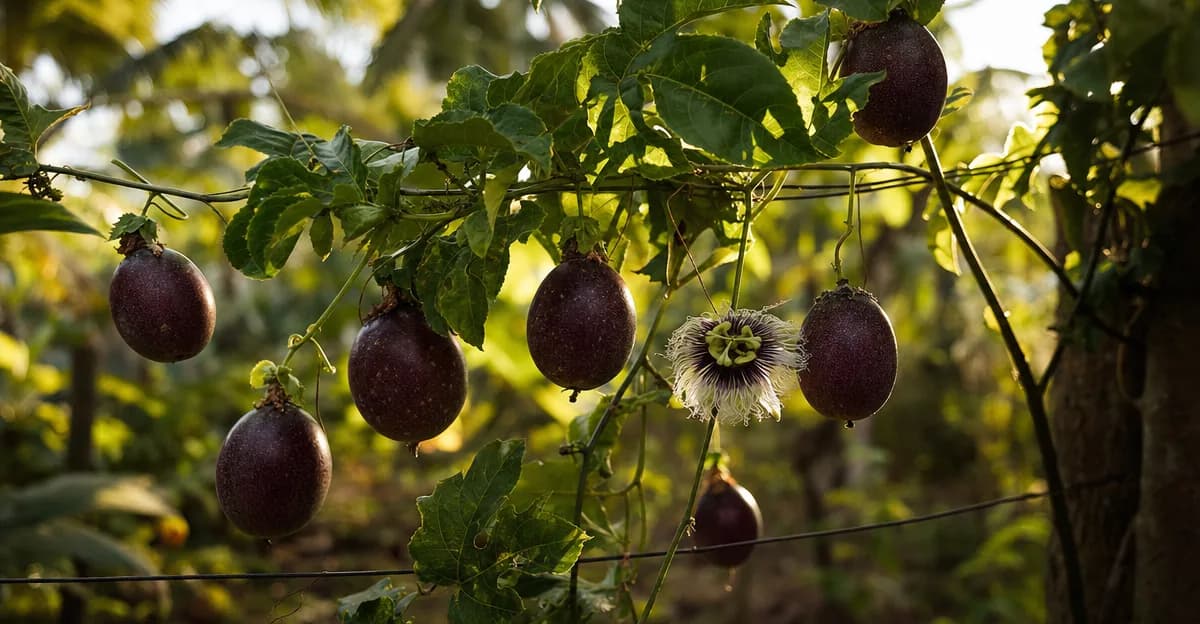
Key takeaway: Passion fruit (Passiflora edulis) is a vigorous tropical vine that goes from seed to first harvest in roughly 300 days. It needs full sun, well-drained soil at pH 5.5–6.5, and sturdy trellising — vines can grow up to 35 feet in a single year. The biggest yield lever is pollination: hand pollination increased fruit set from 23.3% to 69.8% in yellow passion fruit in controlled trials. This guide covers every stage of growing passion fruit, from variety selection through harvest, backed by 12 studies and 8 extension sources.
Is passion fruit hard to grow?
Passion fruit is not a plant-it-and-forget-it crop. It demands warmth, consistent moisture, and active pollination management. But it rewards growers generously: a single vine produces 2–7 kg of fruit per year, with 4.5 kg being typical.
The vine is a short-lived perennial with a productive lifespan of roughly 5–7 years. It thrives outdoors in USDA zones 9b–11 and can be grown in containers and moved indoors in cooler climates. Unlike many tropicals, passion fruit begins producing in its first year from transplant — though seed-grown plants take closer to 10 months.
Bottom line: Passion fruit is an intermediate-to-advanced crop. Success hinges on three things: correct temperature range, adequate pollination, and consistent nutrition. Get those right and the vine does the rest.
Choosing the right variety
The two main species in cultivation are purple passion fruit (Passiflora edulis) and yellow passion fruit (P. edulis f. flavicarpa). Your choice between them — and their many cultivars — determines flavor, pollination needs, and disease resistance.
| Variety | Fruit color | Self-compatible | Key traits |
|---|---|---|---|
| Purple (P. edulis) | Purple | Yes | Sweetest flavor; best for fresh eating; drought-tolerant |
| Yellow (P. flavicarpa) | Yellow | No | Most disease-resistant; 95% of Brazil's production; larger fruit |
| Ruby Star | Red | Partial | Tested in soilless culture; responds well to controlled NO3-N at 170 ppm |
| Possum Purple | Purple | Yes | Roots well from cuttings in perlite medium |
| Panama Red | Red | Partial | Australian commercial cultivar |
The self-compatibility distinction matters enormously. Purple types can set fruit from their own pollen, meaning a single vine can produce a crop. Yellow types are self-incompatible and require cross-pollination from a genetically different plant — you need at least two vines, ideally from different seed sources. Some purple hybrids are only partially self-compatible.
For home growers in subtropical climates, purple varieties are usually the best starting point. For commercial production or areas with Fusarium pressure, yellow types offer stronger disease resistance.
Climate and growing zones
Five independent sources agree: passion fruit grows best in a temperature range of 18–30°C (65–86°F).
Within that window, different growth stages have different optima. Utsunomiya (1992) found that purple passion fruit flowers optimally at 20–27°C, while fruit development peaks at a daily mean of 27–29°C. Menzel et al. (1987) demonstrated that low temperatures combined with low irradiance significantly reduce both flowering and nutrient uptake.
Temperature guidelines:
- Growth range: 18–30°C (65–86°F)
- Optimal for flowering: 20–27°C (68–81°F)
- Optimal for fruiting: 27–29°C daily mean
- Chilling injury: Prolonged exposure below 0°C (32°F) damages vines; fruit quality declines below 10°C (50°F)
- Germination: 25–30°C (77–86°F) is ideal
Growing zones: USDA zones 9b–11 support outdoor year-round cultivation. In zones 8 and below, container growing with winter protection is the best approach — see growing passion fruit in containers for details.
Light requirements
Passion fruit is a full-sun plant, and this is not optional. Menzel and Simpson (1988) showed that continuous shading reduces leaf area, dry weight, floral buds, and open flowers — severely impacting reproductive development. Four independent sources confirm that full sun is required for productive flowering.
For indoor or supplemental lighting, target a daily light integral (DLI) of 30 mol/m²/day, with a PPFD of 500–700 µmol/m²/s and a minimum photoperiod of 11–12 hours to trigger flowering (14 hours is optimal).
Soil preparation and pH
Passion fruit adapts to a range of soil types, provided drainage is excellent. Waterlogged soil promotes the root diseases that kill more passion fruit vines than any other factor.
Ideal soil profile:
- pH: 5.5–6.5 for in-ground growing — four sources agree on this range. Note that Nakayama and Matsuda (2022) found a lower optimum of pH 4–5 for the Ruby Star cultivar in soilless hydroponic culture, but this is cultivar- and system-specific.
- Texture: Sandy loam with good drainage. Amend clay soils with sand and compost.
- Preparation: NSW DPI recommends conducting a soil analysis 6 months before planting to correct pH and nutrient deficiencies.
- Mulch: Apply 2–4 inches (5–10 cm) of organic mulch around the vine base to conserve moisture and regulate soil temperature. Keep mulch away from the trunk to prevent collar rot.
Planting: seed, cutting, and transplant
You can start passion fruit from seed, from cuttings, or as a grafted transplant. Each method has trade-offs.
From seed
Seed propagation is the most accessible method, but germination can be slow and inconsistent.
- Extract seeds from ripe fruit, remove the pulp, and wash clean.
- Scarify the seed coat lightly (sandpaper or a nick with a blade) — this significantly improves germination rate.
- Soak seeds for 24 hours in room-temperature water.
- Plant 1 cm deep in moist, well-draining seed mix at 25–30°C.
- Expect germination in 2–3 weeks for fresh seed. Older or dry seed can take 1.5–3.5 months depending on seed coat thickness.
Castillo et al. (2020) found that cleaned, soaked seeds achieved approximately 80% germination at 26 days. The key variables are seed freshness and temperature — plant seeds soon after extraction for best results.
For a full propagation deep-dive — germination rates by seed source, scarification protocols, IBA rooting-hormone data, and how to grow from grocery-store fruit — see our dedicated guide to growing passion fruit from seed.
From cuttings
Cuttings produce true-to-type plants and can shorten the time to harvest. Ryals et al. (2020) found that plants grown from cuttings reached harvest 15 days earlier than seed-grown plants in one trial with the Possum Purple cultivar.
- Select semi-hardwood stems with 2–4 nodes.
- Remove lower leaves, keeping 1–2 reduced leaves at the top.
- Apply rooting hormone to the base.
- Plant in perlite or a well-draining propagation medium. Ryals et al. (2020) achieved successful rooting in perlite after approximately 4.5 months.
- Maintain high humidity (cover with a clear dome or bag) until roots establish.
Grafting
Grafting preserves desirable traits and shortens the juvenile phase. It also allows grafting desirable fruiting cultivars onto disease-resistant rootstock — particularly useful in areas with Fusarium wilt pressure. This is a more advanced technique best suited for experienced growers.
For all methods: Use disease-free propagation material. Four sources independently emphasize this as essential for preventing soilborne diseases.
Trellis and support structures
Passion fruit is a climbing vine that can grow up to 35 feet (10.7 m) in a single year. Without support, it sprawls across the ground, increasing disease pressure and reducing yields.
Research from Kenya found that vertical trellises produce more fruit and less disease than horizontal trellises. A standard two-wire trellis with posts at 5–6 m intervals and wires at 1.5 m and 2 m height works well for home gardens.
Trellis essentials:
- Build the trellis before planting — retrofit is difficult once vines establish.
- Use sturdy materials (treated timber, galvanized wire) — mature vines are heavy, especially when laden with fruit.
- Space plants 3 m (10 ft) apart along the trellis.
- For container growing, use a separate, sturdy trellis not attached to the pot — see container passion fruit guide for detailed setups.
Watering and irrigation
Passion fruit is a thirsty plant during active growth and fruiting. NSW DPI reports that mature vines can require up to 140 liters per vine per week at peak irrigation demand. UF/IFAS recommends daily watering during establishment.
Watering guidelines:
- Newly planted: Water daily for the first 2–4 weeks, then gradually reduce to every 2–3 days.
- Established vines: Deep watering 2–3 times per week in dry weather. Monitor soil moisture — passion fruit wilts visibly when drought-stressed.
- Fruiting period: Increase watering during fruit development. Inconsistent moisture causes fruit drop and poor juice content.
- Drainage caveat: Despite high water needs, passion fruit cannot tolerate waterlogged soil. The soil must drain freely between waterings.
Once established, purple passion fruit is moderately drought tolerant. However, "drought tolerant" does not mean "drought-loving" — prolonged dry stress reduces yield significantly.
Fertilizing: NPK by growth stage
Nutrition is where many growers underperform. Passion fruit is a heavy feeder, especially for nitrogen and potassium, but the balance changes across growth stages.
Cardenas-Pira et al. (2021) quantified the impact of nutrient omissions during vegetative growth: nitrogen deficiency caused a 60% reduction in vegetative biomass, phosphorus deficiency 39%, and potassium deficiency 7%. These figures reflect growth during the vegetative phase, not fruit yield, but they indicate the relative importance of each macronutrient. Potassium demand increases substantially during flowering and fruiting, where it is critical for fruit quality and sugar content.
In-ground fertilization
UF/IFAS recommends fertilizing 2–3 times per year with a slow-release balanced fertilizer such as 14-14-14. NSW DPI suggests monthly applications of 200 g per vine of 10-3-10 for bearing vines. The higher K ratio in the NSW recommendation reflects potassium's role during fruiting.
Watch for excess nitrogen. Three independent sources warn that too much nitrogen causes vigorous vegetative growth at the expense of flowering. If your vine is all leaf and no flower, cut back nitrogen.
Hydroponic and soilless nutrient targets
For growers using hydroponic or soilless systems, the following stage-specific targets provide a starting framework. They are based on nutrient formulations reported in Nakayama and Matsuda (2022) and Marques et al. (2019), supplemented by general tropical vine nutrition research:
| Growth stage | N (ppm) | P (ppm) | K (ppm) | Ca (ppm) | Mg (ppm) | EC (dS/m) | pH |
|---|---|---|---|---|---|---|---|
| Seedling | 80–120 | 25–40 | 110–170 | 80–120 | 20–35 | 1.0–1.5 | 5.5–6.5 |
| Vegetative | 125–170 | 35–55 | 175–260 | 120–160 | 30–50 | 1.6–2.2 | 5.0–6.5 |
| Flowering | 125–170 | 46–62 | 220–310 | 120–170 | 30–50 | 2.0–2.8 | 4.5–6.5 |
| Fruiting | 145–180 | 46–62 | 260–330 | 130–180 | 35–55 | 2.0–3.0 | 4.5–6.5 |
Note the sharp rise in potassium from seedling (110–170 ppm) through fruiting (260–330 ppm). Marques et al. (2019) achieved commercial-quality production with a Yellow Master cultivar at 169-62-311 ppm N-P-K and EC 2.72–2.95.
For a complete soilless build — system selection, reservoir setup, and disease prevention in a controlled environment — see our hydroponic passion fruit guide.
Use our nutrient manager for personalized NPK recommendations based on your system and growth stage.
Pollination: the biggest yield lever
Pollination is arguably the most critical factor separating disappointing yields from abundant harvests. Passion fruit flowers are structurally complex — the pollen is heavy and sticky, making wind pollination ineffective.
Self-compatibility recap
- Purple types (P. edulis): Self-compatible — a single vine can set fruit.
- Yellow types (P. flavicarpa): Self-incompatible — cross-pollination from a different plant is required.
- Some purple hybrids: Only partially self-compatible.
Even self-compatible purple varieties benefit significantly from cross-pollination for larger fruit and higher seed count.
Natural pollinators
Carpenter bees (Xylocopa spp.) are the most effective natural pollinators of passion fruit — three sources independently confirm this. Their large body size allows them to contact both the anthers and stigma in a single flower visit. Honey bees contribute, but are less efficient; BeeAware Australia reports 25% greater fruit set from honey bee pollination compared to no insect access in a Florida study. Commercial orchards use 2–3 hives per hectare.
Hand pollination
For home growers — especially those growing a single vine or growing indoors — hand pollination is the most reliable method. Ruggiero et al. (1976) demonstrated that hand pollination increased fruit set from 23.3% to 69.8% in yellow passion fruit.
How to hand-pollinate:
- Timing: Pollinate in the early afternoon when flowers are fully open. Passion fruit flowers typically open around midday and close by evening.
- Method: Use a small brush or your fingertip to collect pollen from the anthers (the five pollen-bearing structures). Transfer it to the three stigma lobes by gently dabbing.
- Cross-pollination for yellows: If growing yellow varieties, transfer pollen between different vines — same-plant pollen will not set fruit.
- Fruit count: A minimum of 100 ovules must develop into seeds for non-hollow fruit; well-pollinated fruit can contain up to 350 seeds.
Pruning and training
Pruning improves both yield and plant health, though the peer-reviewed evidence base is more limited than for other practices. Research from Kenya (ISHS) found that pruned vines were more productive than unpruned vines from the second year onward, producing more marketable fruits that were heavier with higher pulp and juice content.
Pruning guidelines:
- Timing: Prune at the end of the annual production cycle or in late winter/early spring before new growth begins.
- Approach: Selective, light pruning is preferred over heavy pruning. Remove dead wood, crossing branches, and spent fruiting laterals.
- Training: Guide the main leader to the top of the trellis, then allow side branches to cascade downward along the wires. This "curtain" training maximizes light exposure and air circulation.
- First year: Focus on establishing one or two strong leaders. Pinch out the growing tip when it reaches the top wire to encourage lateral branching.
Important caveat: The pruning research from Kenya is based primarily on conference proceedings with limited peer-reviewed replication. The principles are sound horticultural practice, but specific yield numbers should be treated as indicative rather than guaranteed.
Pest and disease management
Disease is the primary cause of vine death in passion fruit, with Fusarium wilt and collar rot being the most destructive soilborne pathogens.
Major diseases
Fusarium wilt (Fusarium oxysporum f. sp. passiflorae): Confirmed as a significant pathogen of passion fruit in North America. Symptoms include stunted vines, yellowing, one-sided wilt, and brown vascular streaks when you cut the stem. The pathogen persists in soil, making site history important. There is no effective chemical cure — prevention through disease-free planting material and resistant rootstock is essential.
Collar rot (Fusarium solani): Attacks the vine base at soil level. UF/IFAS reports the pathogen can persist in soil for up to 4 years. Avoid piling mulch against the trunk, ensure drainage, and plant on raised beds in areas with a history of collar rot.
Other fungal diseases: Zakaria (2022) identifies Phytophthora, Alternaria, and Colletotrichum as additional primary pathogens. A disease management hierarchy applies across all of these: prevention (disease-free material, site selection) > cultural control (drainage, sanitation, spacing) > chemical intervention as a last resort.
Major pests
Gulf fritillary caterpillar (Agraulis vanillae): The primary insect pest of passion fruit foliage. Larvae feed voraciously on leaves. Hand-pick small populations; use Bacillus thuringiensis (Bt) for heavier infestations.
Aphids: Beyond direct damage, aphids are vectors for passion fruit woodiness virus (PWV), which causes misshapen, woody fruit and reduced yields. Monitor regularly and control with insecticidal soap or neem oil.
Prevention checklist
- Start with disease-free seed or cuttings
- Plant in well-drained soil; use raised beds if drainage is poor
- Space vines adequately for air circulation (3 m apart)
- Keep mulch away from the vine trunk
- Remove and destroy infected plant material immediately
- Do not replant passion fruit in the same soil where Fusarium has occurred
- Consider grafting onto disease-resistant rootstock for high-risk areas
Harvesting and storage
Passion fruit signals its ripeness clearly: ripe fruit changes color (green to purple, yellow, or red depending on variety) and drops from the vine. Fruit ripens 70–80 days after pollination — three sources confirm this timeline.
Harvesting tips:
- Collect fallen fruit daily during the harvest season.
- Fruit that has turned color but not yet fallen can be picked, but it will have less developed flavor.
- A slightly wrinkled skin indicates peak ripeness and sweetest flavor — the wrinkling is not a sign of spoilage.
Storage (from UC Davis postharvest research):
- Partially ripe fruit: Store at 7–10°C (45–50°F) at 90–95% relative humidity.
- Fully ripe fruit: Store at 5–7°C (41–45°F) for approximately 1 week shelf life.
- Avoid prolonged cold: Chilling injury occurs below 5°C (41°F) with extended storage.
- Ethylene: Passion fruit produces moderate ethylene and is ethylene-sensitive — store separately from ethylene-producing fruits if you want to slow ripening.
Yield expectations
- Per vine: 2–7 kg per year, with 4.5 kg typical
- Commercial benchmarks: 2,500–4,900 kg per hectare (2,200–4,400 lb/acre)
- Plant density (commercial): ~890 plants per hectare (~360/acre)
For a detailed timeline of each growth stage from germination through harvest, see passion fruit growing stages.
Container and indoor growing
Passion fruit can be grown successfully in containers, making it accessible to growers outside tropical zones. Key parameters:
- Minimum pot size: 20 liters for young vines; 40+ liters preferred for mature plants
- Minimum depth: 45 cm to accommodate the root system
- Growing medium: Well-draining mix (coco coir, perlite, compost). Drip irrigation via Dutch buckets or coco coir bags works well.
- Trellis: Must be sturdy and independent of the container — a top-heavy vine in a pot is a tipping hazard.
- Spacing: 150 cm between container plants
- Pollination: Hand pollination is essentially required for indoor container growing, since natural pollinators are absent.
Deep-water culture (DWC), NFT, Kratky, and aeroponics are not suitable for passion fruit — the vine's root system and size make these systems impractical.
For soilless container culture, Nakayama and Matsuda (2022) demonstrated successful production of the Ruby Star cultivar at 170 ppm NO3-N, EC 2.0 dS/m, and pH 4–5. Marques et al. (2019) achieved commercial yields with semi-hydroponic slab culture at EC 2.72–2.95 and pH 6.5. These two studies used different cultivars and pH ranges, so match your nutrient solution to your chosen variety.
For a detailed container-specific guide including overwintering strategies, see growing passion fruit in containers.
Frequently asked questions
Is passion fruit easy to grow?
It is intermediate to advanced. It demands consistent warmth (18–30°C), full sun, active pollination management, and disease vigilance. But the vine is vigorous once established, growing up to 35 feet per year, and it begins producing fruit within its first year from transplant.
Does passion fruit come back every year?
Yes. Passion fruit is a perennial vine with a productive lifespan of roughly 5–7 years. It does not die back in winter in frost-free zones. In areas with light frost, top growth may die back but regrow from the base if roots survive. Hard freezes kill the vine entirely.
How long does it take passion fruit to grow fruit?
From seed to first harvest takes approximately 300 days (about 10 months). The major phases are roughly 20 days for germination, 60 days of seedling establishment, 180 days of vegetative growth, and 70–80 days from flowering to ripe fruit. These phases overlap — flowering begins while the vine is still in active vegetative growth — so the total elapsed time is shorter than the sum of individual phases. Plants from cuttings may reach harvest slightly earlier — one study found a 15-day advantage with the Possum Purple cultivar.
Do you need two passion fruit plants to get fruit?
It depends on the species. Purple passion fruit (P. edulis) is self-compatible and a single vine can set fruit. Yellow passion fruit (P. flavicarpa) is self-incompatible and requires cross-pollination from a genetically different plant. If growing yellow varieties, plant at least two vines from different seed sources.
Quick-reference growing card
| Parameter | Value |
|---|---|
| Botanical name | Passiflora edulis |
| USDA zones | 9b–11 (outdoor); containers elsewhere |
| Temperature | 18–30°C (65–86°F) |
| Light | Full sun (6+ hours direct) |
| Soil pH | 5.5–6.5 (in-ground) |
| Spacing | 3 m (10 ft) apart |
| Water | Up to 140 L/vine/week at peak |
| Seed to harvest | ~300 days |
| Fruit ripening | 70–80 days after pollination |
| Yield | 2–7 kg/vine/year |
| Lifespan | 5–7 years productive |
| Pollination | Hand pollination recommended; carpenter bees ideal |
For personalized nutrient recommendations, try our nutrient manager. To identify nutrient problems, see our plant nutrient deficiency chart.