Can You Grow Hydroponic Asparagus? Yes — 5 Steps to Spears
Yes, you can grow asparagus hydroponically. This science-backed guide covers crown selection, nutrient ratios, patience timelines, and your first spear harvest.
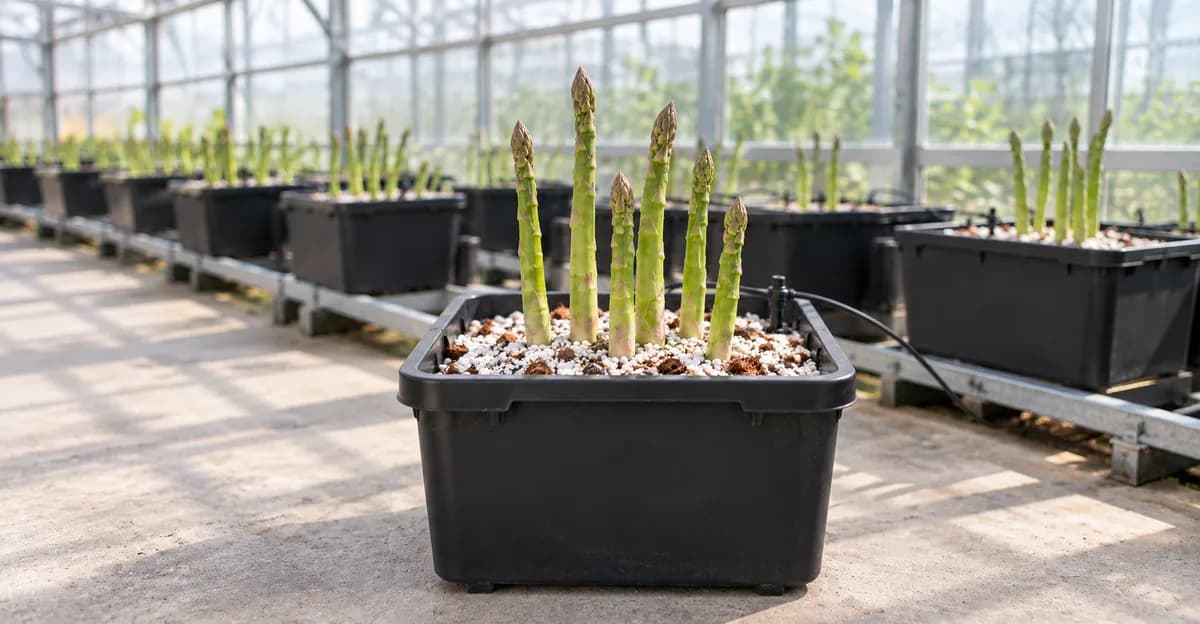
Key takeaway: Asparagus (Asparagus officinalis) is one of the few perennial vegetables that actually benefits more from hydroponic cultivation than most annual crops do. The reason is biological: asparagus releases autotoxic compounds — including trans-cinnamic acid and coumaric acid — that poison its own roots over time, a phenomenon called asparagus decline syndrome. In soil, this makes replanting impossible for 4–5 years. In hydroponics, you flush the problem away. A 2008 study in the Journal of Agricultural and Food Chemistry demonstrated that treating recirculating nutrient solution with TiO₂ photocatalysis produced 1.6× greater spear yields by neutralizing these root-exuded toxins (Sunada et al., 2008). This guide covers everything from crown selection to harvest, grounded in peer-reviewed research and university extension data.
Why Grow Asparagus Hydroponically?
Asparagus is a long-lived perennial. A well-managed bed produces spears for 15–20 years (University of Minnesota Extension). That longevity is its greatest asset — and also its greatest vulnerability in soil. Here is why soilless cultivation makes particular sense for this crop.
The Asparagus Decline Problem
Every asparagus plant poisons the ground it grows in. Researchers at Kagawa University identified the mechanism: asparagus rhizomes release allelopathic compounds — primarily trans-cinnamic acid, p-coumaric acid, caffeic acid, ferulic acid, and iso-agatharesinol — into the surrounding soil. At concentrations above 10 µM, trans-cinnamic acid alone inhibits asparagus seedling growth. Over a 10–15 year production cycle, these compounds accumulate until yields become unprofitable, a syndrome formally called asparagus decline.
The economic consequences are severe. Once a field declines, growers must abandon the plot entirely and wait 4–5 years before replanting asparagus — and even then, yields in replanted fields rarely exceed half of normal production. Fusarium crown rot (F. oxysporum, F. proliferatum, F. redolens), the other major component of decline syndrome, compounds the problem in soil where these autotoxic compounds weaken root defenses.
How Hydroponics Solves This
In a hydroponic system, you have three defenses that soil growers lack:
- Continuous nutrient solution replacement. Regular reservoir changes flush autotoxic compounds before they accumulate to damaging concentrations. A nutrient flush every 7–10 days is standard practice.
- Photocatalytic detoxification. Sunada et al. (2008) at The University of Tokyo demonstrated that TiO₂ powder under UV irradiation breaks down the phytotoxic substances released by asparagus roots — specifically 3,4-dihydroxyphenylacetic acid in their study. Their recirculating system with photocatalytic treatment produced 1.6-fold greater spear yield than untreated controls — while also eliminating disease-causing microorganisms in the solution.
Note: Research groups differ on which autotoxic compound is primary. Kato-Noguchi et al. at Kagawa University identified trans-cinnamic acid as the key autotoxin in soil studies, while Sunada et al. at The University of Tokyo identified 3,4-dihydroxyphenylacetic acid in hydroponic recirculation. Multiple allelopathic compounds likely contribute to the syndrome simultaneously.
- Sterile starting conditions. Unlike field replanting, a hydroponic system starts pathogen-free. No Fusarium chlamydospores persist in clean growing media, removing the primary biotic driver of decline syndrome.
Additional Advantages
- Out-of-season production. Nicola, Hoeberechts, and Fontana (2004) demonstrated in their Acta Horticulturae study that soilless asparagus culture in greenhouses enables year-round spear production — including harvests in the first year of growth. Out-of-season asparagus commands premium market prices.
- Precise nutrient control. Asparagus nutrient requirements shift significantly between growth phases. Hydroponics lets you adjust nitrogen, phosphorus, and potassium concentrations in real time rather than relying on slow-release soil amendments.
- Space efficiency. Without field spacing constraints and the ability to grow vertically with Dutch bucket systems, you can produce more spears per square meter.
Nutritional Profile: What Makes Asparagus Worth Growing
Before covering the how, it is worth understanding the why. A comprehensive 2024 review in Foods by Olas documented the nutritional and bioactive profile of A. officinalis:
Nutritional content per 100 g of raw asparagus (USDA FoodData Central):
| Nutrient | Amount | % Daily Value |
|---|---|---|
| Calories | 20 kcal | — |
| Protein | 2.2 g | 4% |
| Dietary fiber | 2.1 g | 8% |
| Folate (B9) | 52 µg | 13% |
| Vitamin K | 41.6 µg | 35% |
| Vitamin C | 5.6 mg | 6% |
| Iron | 2.14 mg | 12% |
| Potassium | 202 mg | 4% |
| Phosphorus | 52 mg | 4% |
Ten cooked asparagus spears provide approximately 225 µg of folate — over 50% of the daily requirement (400 µg DFE). This makes asparagus one of the richest vegetable sources of folate, a nutrient critical for cell division and neural tube development during pregnancy.
Beyond standard vitamins and minerals, asparagus contains notable bioactive compounds. Rutin accounts for 60–80% of total phenolic content in green and purple varieties (1.51–7.29 mg/g dry weight). The plant also produces asparagusic acid (a unique sulfur compound), quercetin, kaempferol, isorhamnetin, and the prebiotic fiber inulin — which supports gut microbiome health.
Choosing Your Hydroponic System
Asparagus has a large, spreading root system (the crown) that stores energy for spear production. This root structure is the single biggest factor in system selection.
Dutch Bucket System (Recommended)
The Dutch bucket (bato bucket) system is the best match for hydroponic asparagus. Here is why:
- Deep root accommodation. Standard 3–5 gallon bato buckets provide enough depth for crown development. Asparagus crowns need a minimum of 15–20 cm (6–8 inches) of growing media depth.
- Individual plant management. One crown per bucket lets you monitor each plant independently and remove any that show disease symptoms without affecting the rest.
- Scalable. Add buckets as your asparagus bed expands — no system redesign needed.
- Excellent drainage. Asparagus roots are susceptible to rot in waterlogged conditions. The drain-to-waste or recirculating design of Dutch buckets keeps the root zone oxygenated.
Recommended media: A 60:40 perlite-to-vermiculite mix, or the 60% peat and 40% perlite blend used successfully by Nicola et al. (2004) in their soilless asparagus trials. Expanded clay pebbles (LECA) also work well and offer indefinite reuse.
Deep Water Culture (DWC)
DWC can work for asparagus, but with caveats:
- Roots sit permanently in nutrient solution, maximizing nutrient uptake.
- Requires vigorous aeration — asparagus roots need dissolved oxygen levels above 5 mg/L.
- The autotoxicity issue becomes more critical in DWC because root exudates concentrate in the shared reservoir. Frequent solution changes (every 5–7 days) are non-negotiable.
- Best suited for smaller operations where you can closely monitor solution chemistry.
Nutrient Film Technique (NFT)
NFT is the least suitable option for asparagus. The shallow channels cannot accommodate mature crowns, and the thin nutrient film provides insufficient contact time for the heavy feeding this plant requires during spear production. Avoid NFT for asparagus.
Crown Selection and Preparation
You can start asparagus from seed or from crowns (bare-root transplants). For hydroponic growers, crowns are strongly recommended.
Why Crowns Beat Seeds
- Time savings. Seeds require 14–21 days to germinate (at 22–26°C / 71–79°F) and then 12–18 months of fern growth before any spear harvest. Crowns skip this entire juvenile phase.
- Sex selection. Male asparagus plants produce more spears and do not waste energy on berry production. One-year-old all-male hybrid crowns (Jersey Giant, Jersey Knight, Jersey Supreme, Millennium) give you the highest yield potential from day one.
- Proven genetics. Named cultivars are bred for disease resistance, spear quality, and productivity. UC157, while high-yielding, shows greater autotoxic and allelopathic activity than European varieties like Gijnlim in replanting studies — a factor worth considering when choosing cultivars for recirculating systems.
Preparing Crowns for Hydroponics
- Source certified disease-free crowns. Field-grown crowns can carry Fusarium spores and soil-borne pathogens into your clean hydroponic system. Purchase from reputable nurseries that certify disease-free stock.
- Rehydrate before planting. Soak crowns in tepid water (20–22°C) for 20–24 hours. This rehydrates the root system from dormancy and stimulates immediate growth upon planting.
- Inspect and trim. Remove any broken, mushy, or discolored roots. Healthy roots are firm, tan to light brown, and have visible root tips.
- Plant at the right depth. Position the crown so the bud cluster sits 10–15 cm (4–6 inches) below the media surface in your Dutch bucket. Spread the roots evenly over a mound of media, then cover gradually.
Nutrient Solution Management
Asparagus nutrient requirements shift dramatically between its two main growth phases: fern growth (vegetative) and spear production (harvest). Getting this transition right is the key to high yields.
Phase 1: Fern Growth and Crown Establishment
During vegetative growth, the plant builds its fern canopy and stores carbohydrates in the crown for future spear production. This phase demands:
| Parameter | Target Range |
|---|---|
| pH | 6.0–6.5 |
| EC | 1.4–1.8 mS/cm |
| Nitrogen (N) | High — primary driver of fern mass |
| Phosphorus (P) | Elevated — critical for root system development |
| Potassium (K) | Moderate |
Asparagus is a nitrogen-hungry crop during fern establishment — prioritize nitrogen availability to maximize fern mass and crown energy storage. Phosphorus is particularly important during establishment because the crown is actively building its storage root network. A deficiency at this stage stunts the entire plant permanently.
Recommended base solution: A standard vegetative hydroponic formula (such as a 3-1-2 NPK ratio) works well. Supplement with calcium (150–200 ppm) and magnesium (50–75 ppm) for structural integrity.
Phase 2: Spear Production
When you transition the plant to harvesting mode, nutrient demands change:
| Parameter | Target Range |
|---|---|
| pH | 6.0–6.8 |
| EC | 2.4–3.0 mS/cm |
| Nitrogen (N) | Reduced — excessive N produces loose, feathery spear tips |
| Phosphorus (P) | Moderate |
| Potassium (K) | Increased — supports spear firmness and quality |
The shift from high-nitrogen to balanced nutrition is critical. Excess nitrogen during harvest produces spears with open, fern-like tips rather than tight, compact heads — a key quality indicator in asparagus grading.
Micronutrient Requirements
Asparagus requires adequate iron and copper in its nutrient solution for enzyme function and chlorophyll synthesis. Maintain these trace elements:
| Micronutrient | Target (ppm) |
|---|---|
| Iron (Fe-DTPA or Fe-EDDHA) | 3–5 |
| Manganese (Mn) | 0.5–1.0 |
| Zinc (Zn) | 0.3–0.5 |
| Copper (Cu) | 0.1–0.3 |
| Boron (B) | 0.3–0.5 |
| Molybdenum (Mo) | 0.05 |
Solution Maintenance Protocol
- Monitor pH and EC daily. Asparagus does not tolerate extremely acidic conditions (University of Minnesota Extension). If pH drops below 5.5, root function degrades quickly.
- Full reservoir change every 7–10 days. This is more frequent than many hydroponic crops require, but it is essential for flushing autotoxic root exudates.
- Top off with half-strength solution between changes to compensate for water uptake without spiking EC.
- Clean reservoirs and lines during changes to prevent biofilm buildup, which can harbor Fusarium spores.
For more on managing pH and EC in hydroponic systems, see our complete guide: /insights/ph-ec-management-hydroponics.
Environmental Conditions
Temperature
Asparagus is a cool-to-moderate climate crop with distinct temperature needs across growth stages:
| Growth Stage | Day Temperature | Night Temperature |
|---|---|---|
| Seed germination | 22–26°C (71–79°F) | — |
| Fern growth | 24–30°C (75–86°F) | 16–20°C (60–68°F) |
| Spear production | 18–24°C (65–75°F) | 12–16°C (54–61°F) |
| Dormancy induction | Below 10°C (50°F) | Below 5°C (41°F) |
The dormancy question. In traditional cultivation, asparagus requires a cold dormancy period (vernalization) to trigger the next season's spear production. Nicola et al. (2004) managed this in their soilless system by storing rhizomes at −1°C from February to July, then at 0°C from August to September, before bringing them into the greenhouse in October. For year-round hydroponic production, you can simulate dormancy by moving crowns to cold storage (0–2°C) for 8–12 weeks between production cycles.
Light
Provide 12–14 hours of strong light daily during fern growth. Asparagus ferns are the plant's solar panels — they capture the energy stored in the crown for spear production. Insufficient light during the vegetative phase directly reduces next season's yield.
- Full sun equivalent: 400+ µmol/m²/s PPFD for greenhouse growing.
- LED supplementation: If growing indoors, full-spectrum LED panels work well. See our guide on /insights/led-grow-light-spectrum-science for recommended setups.
Humidity and Airflow
Maintain relative humidity between 60–70%. Good air circulation is critical — asparagus ferns are dense, and stagnant humid air promotes fungal diseases, particularly Stemphylium leaf spot and Cercospora needle blight. Use oscillating fans to keep air moving through the canopy.
The Complete Growing Timeline
Here is a realistic timeline for hydroponic asparagus from crown planting to full production:
Year 1: Establishment (No Harvest)
- Month 1–2: Plant crowns in Dutch buckets. Maintain establishment nutrient solution (EC 1.4–1.8). First fern shoots appear within 2–4 weeks.
- Month 3–6: Fern canopy develops fully. The plant is photosynthesizing and storing carbohydrates in the crown. Do not cut any growth.
- Month 7–8: Allow ferns to yellow naturally as the plant enters dormancy. Reduce watering and nutrient delivery gradually.
- Month 9–10: Dormancy period. Move crowns to cold storage (0–2°C) for 8–12 weeks, or — in a greenhouse — allow natural winter temperatures to trigger dormancy.
Critical rule: Do not harvest any spears in year one. Every spear you cut removes stored energy the crown needs to establish. Patience here pays dividends for years to come.
Year 2: First Limited Harvest
- Early spring (post-dormancy): Return crowns to growing system. Switch to spear production nutrient solution (EC 2.4–3.0).
- Spears emerge: Harvest spears when they reach 15–20 cm (6–8 inches) tall, with tight, compact tips.
- Harvest window: 2 weeks only. University of Minnesota Extension recommends limiting the first harvest to just 2 weeks to avoid depleting the crown.
- After harvest: Allow all subsequent spears to develop into ferns. Return to vegetative nutrient solution. Build the crown for next year.
Year 3+: Full Production
- Harvest window extends to 6–8 weeks (typically ending by early summer in seasonal cycles).
- Yield: A mature, healthy asparagus crown produces 8–12 spears per harvest cycle. In hydroponic systems with optimized nutrition, yields can exceed field averages by up to 30%.
- Spear quality: Hydroponically grown spears tend to be more uniform in diameter and color, with tighter tip closure — the key external quality indicator.
Harvesting Techniques
When to Cut
- Harvest when spears are 15–20 cm (6–8 inches) tall with tight, unopened tips.
- If the tip begins to open or "fern out," the spear has passed its prime — let it grow into a full fern to feed the crown.
- Check daily during active production. Asparagus spears grow fast — up to 7–10 cm (3–4 inches) per day in warm conditions.
How to Cut
Use a sharp, clean knife to cut spears at the media surface level. In soil cultivation, spears are typically snapped or cut below ground, but in hydroponics, cutting at media level avoids disturbing the crown and growing media.
Post-Harvest Handling
Asparagus loses quality rapidly after cutting. The spears continue to respire and toughen. For the freshest product:
- Stand spears upright in 2–3 cm of cool water immediately after cutting.
- Refrigerate at 2–4°C (35–39°F) within 30 minutes of harvest.
- Consume or process within 3–5 days for peak flavor and nutrition.
Common Problems and Solutions
| Problem | Symptoms | Cause | Solution |
|---|---|---|---|
| Loose, feathery spear tips | Tips open before spears reach harvest height | Excess nitrogen or temperatures above 27°C during spear production | Reduce N in nutrient solution; lower temperature to 18–24°C range |
| Thin, pencil-width spears | Spear diameter decreasing over time | Crown energy depletion from over-harvesting | Shorten harvest window; allow more ferns to grow; check EC levels |
| Yellowing ferns (off-season) | Ferns yellow prematurely during vegetative growth | Iron deficiency, pH too high, or root rot | Check Fe levels (target 3–5 ppm); verify pH 6.0–6.5; inspect roots |
| Brown, mushy crown | Crown tissue soft and discolored | Fusarium crown rot or waterlogged media | Remove affected plant; disinfect bucket; improve drainage; ensure pathogen-free crowns |
| Declining yields after 3–4 cycles | Progressively fewer and thinner spears | Autotoxin accumulation in recirculating system | Increase solution change frequency; consider UV sterilization or TiO₂ treatment per Sunada et al. (2008) |
| Needle blight | Brown lesions on fern needles | Cercospora or Stemphylium fungal infection | Improve airflow; reduce humidity below 70%; remove affected fronds |
For more on identifying and treating nutrient-related issues, see: /insights/nutrient-burn-hydroponics.
Quick-Reference Growing Parameters
| Parameter | Establishment Phase | Spear Production Phase |
|---|---|---|
| pH | 6.0–6.5 | 6.0–6.8 |
| EC (mS/cm) | 1.4–1.8 | 2.4–3.0 |
| Day temperature | 24–30°C (75–86°F) | 18–24°C (65–75°F) |
| Night temperature | 16–20°C (60–68°F) | 12–16°C (54–61°F) |
| Light hours | 12–14 h | 12–14 h |
| Humidity | 60–70% | 60–70% |
| Reservoir change | Every 10–14 days | Every 7–10 days |
| Best system | Dutch bucket | Dutch bucket |
| Media | Perlite/vermiculite 60:40 or peat/perlite 60:40 | Same |
From Unusual Crop to Year-Round Harvest
Asparagus is not the first crop most growers think of when they consider hydroponics. But the science makes a compelling case: this is a plant that actively suffers in soil over time — and soilless culture directly addresses its most destructive biological limitation.
The Nicola et al. (2004) study demonstrated first-year spear production in soilless culture, something impossible in traditional field growing where you must wait two full seasons. The Sunada et al. (2008) research proved that the autotoxicity problem — the fundamental reason asparagus fields decline — is solvable with photocatalytic treatment in recirculating systems. And university extension data consistently shows that controlled-environment asparagus commands premium prices, particularly for out-of-season production.
If you are already growing hydroponic vegetables and want to diversify into a high-value perennial crop that produces for 15+ years, asparagus deserves serious consideration. Start with certified disease-free all-male crowns, give the plant a full establishment year without harvesting, and maintain disciplined nutrient solution management. The reward is a reliable supply of fresh, tender spears — grown without the biological time bomb ticking beneath every soil-grown asparagus bed.
Explore asparagus varieties in our plant database: /plants.