7 Kratky Method Mistakes That Kill Plants (Refilling Is #1)
Why do Kratky plants wilt and die? The number-one killer is not what most growers think — it is refilling the reservoir. Learn the 7 Kratky method mistakes that drown, starve, and rot plants, with the fix for each, all traced to university research.
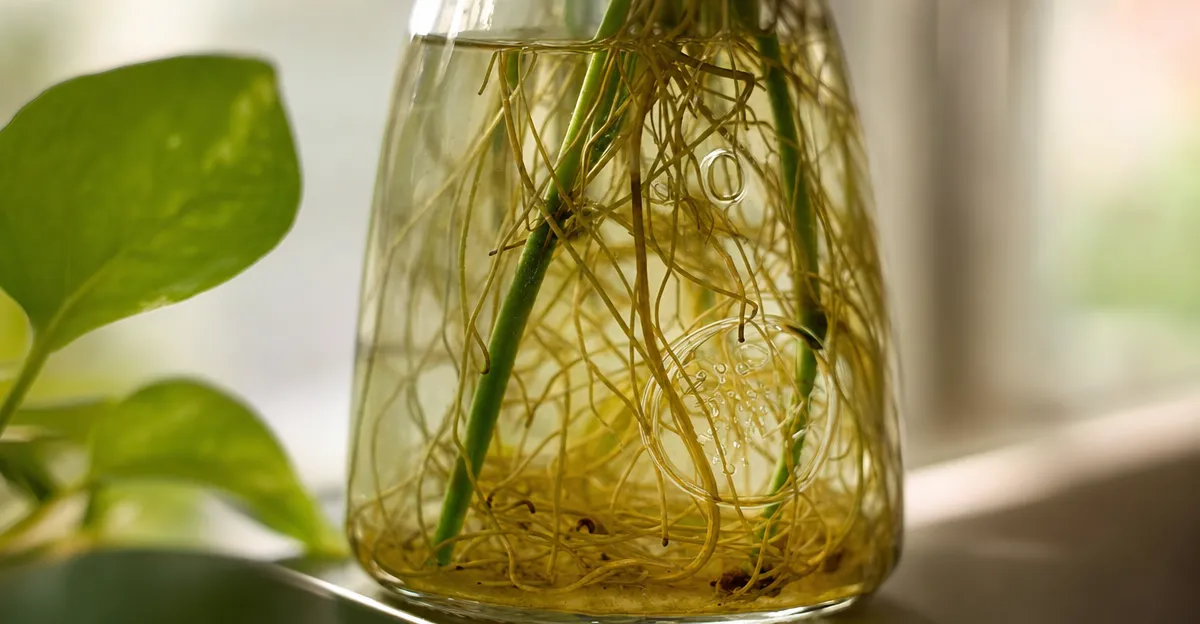
Key takeaway: Most Kratky plants that die are not killed by neglect — they are killed by help. The single most common lethal mistake is topping the reservoir back up, which drowns the very roots that keep the plant breathing. The Kratky method has no pump; the shrinking air gap between the lid and the falling water is the aeration system. Almost every failure below comes back to one idea: this is a set-it-and-leave-it method, and the moves that feel like good gardening — refilling, chasing an EC number, using a clear jar on a sunny sill — are the ones that break it.
Why do Kratky plants die when the method is supposed to be "hands-off"?
The Kratky method is a non-circulating, pumpless hydroponic technique developed by B.A. Kratky at the University of Hawaiʻi. You fill a reservoir once, suspend the plant in a net pot at the top, and harvest weeks later without ever adding water or electricity. It works because of a mechanism most beginners never learn: as the plant drinks and the solution level falls, the roots left behind in the widening air gap turn into air-breathing "oxygen roots" that pull oxygen directly from the humid space above the water. The lower roots stay in solution and take up water and nutrients; the upper roots breathe. That division of labor is the entire life-support system.
So when a Kratky plant dies, it is almost always because a well-meant intervention broke that mechanism — or because the reservoir, crop, or environment was mismatched from day one. Here are the seven mistakes that actually kill plants, ranked from most lethal, each with the mechanism and the fix. None of them is "how to build the system" — for setup, see the Kratky method beginner's guide. This is what goes wrong.
Mistake 1: Topping off the reservoir (the #1 killer)
The mistake: You check your jar, see the water level has dropped well below the net pot, panic, and pour more solution back in to "top it off." Within a day or two the plant wilts and collapses.
Why it kills: This is the failure Kratky himself warns about in his own grower bulletin. As the level falls, the roots suspended in the humid gap become oxygen roots that breathe air. When you raise the liquid level again, those roots "become submerged and starved for oxygen. Plants initially wilt and may suffer physiological damage or even 'drown' and die". The air gap is not a design flaw to be corrected — it is the aeration system, and re-flooding it suffocates the plant from the roots up. Root respiration depends directly on dissolved oxygen, so submerged, deoxygenated roots simply stop functioning. This is not a cosmetic setback: raising root-zone oxygen from roughly 6.8–7.8 to 8.1–9.0 mg/L has been shown to increase lettuce fresh mass by as much as 110% — which is the scale of growth a collapsed air gap forfeits.
The fix: Let the level fall. A dropping reservoir is the method working correctly, not failing. At transplant only the bottom ~½ inch of the net pot should touch the solution; within a few weeks the level drops below the pot entirely and the oxygen roots have already formed to compensate. Do not refill. Size the reservoir once so it lasts to harvest (see Mistake 2), and if a crop genuinely needs more than one charge, harvest it before the solution runs out rather than topping up mid-cycle.
Mistake 2: Putting the wrong crop in too small a reservoir
The mistake: Growing a tomato, cucumber, or other large fruiting plant in a mason jar or shallow tote — then watching it stall, yellow, and give almost nothing. It is easy to read this as "Kratky only works for lettuce," but that is not quite right.
Why it fails: The real constraint is water volume, not species. Kratky's method is intended only for crops that need less than 2 gallons of water per plant for the entire growing season — leafy, romaine, and semi-head lettuces, cilantro, green onions, pak choi, and watercress. A big fruiting crop drinks far more than that, so a small jar runs dry long before harvest. The proof that it is a reservoir problem, not a crop ban, comes from Kratky's own tomato work: non-circulating tomatoes matched soil-bed yield (3.5 vs 3.1 kg/plant) — but only when given a correspondingly large solution reservoir. Undersize the tank and you get the honest field result other researchers report from simplified passive systems: slow, inconsistent growth.
The fix: Match the reservoir to the crop's season-long thirst, not the other way around. For loose-leaf, romaine, or butterhead lettuce, cilantro, and green onions, a jar or small tote is fine. Commercial Kratky setups budget roughly 1.5–2 gallons of nutrient solution per plant. If you want a tomato or another fruiting crop, either give it a large tote sized to its full-season demand or accept that a passive single-charge system is the wrong tool — a recirculating method suits it better. Don't put a tomato in a mason jar.
Sizing the Reservoir: The Volume Math and the Oxygen-Root Window
The free fix — "match the tank to the crop's thirst" — has arithmetic behind it. Kratky's commercial guidance budgets roughly 1.5–2 gallons of nutrient solution per plant across the whole season and caps the method at crops needing under 2 gallons per plant start to finish. Work backward from that number instead of guessing: a four-head lettuce tote wants 6–8 gallons of usable solution below the net pots, not merely whatever fits under the lid. Undersize it and the level drops past the roots before the heads mature; oversize it and you have only wasted solution, which is the cheap mistake to make.
The geometry at transplant matters as much as the volume. Set the net pots so only the bottom ~½ inch sits in solution at fill. That thin contact is deliberate: it wets the lower roots while leaving most of the root ball in air, so the plant begins building oxygen roots on day one rather than waiting for the level to crash. From then on the upper roots breathe the humid gap while the lower roots feed, and because root respiration tracks dissolved oxygen almost directly, the widening air gap is doing the job an air pump does in an active system. That is why lifting root-zone oxygen from about 6.8–7.8 to 8.1–9.0 mg/L can more than double lettuce fresh mass: the falling reservoir is your aeration, and sizing it correctly is what lets it fall on schedule.
One caveat volume alone won't fix: a bigger tank does not make the solution stable. Because you never top up, evaporation slowly concentrates what remains, so EC drifts upward over the cycle even as the plant draws specific nutrients down — and the seasonal EC target itself moves, from roughly 2.3–2.6 mS·cm⁻¹ in winter to 2.8–3.3 in summer for Kratky lettuce. Size for the full season, mix to the season's EC, and plan to harvest before the charge is spent rather than nursing a depleting reservoir.
Mistake 3: Letting the reservoir get warm and sun-baked
The mistake: Standing a clear or thin-walled container in a warm, sunny spot so the solution heats up through the day. The plant grows slowly, then roots turn brown and slimy.
Why it kills: Warm water is a double hit. First, root-zone temperature has a sharp optimum: in controlled trials, 25 °C maximized lettuce shoot and root dry weight, while 35 °C decreased growth. Chilling the water back toward the low-20s °C measurably changed growth and nutrient uptake across multiple lettuce cultivars, confirming water temperature is a controllable variable, not background noise. Second, warm, stagnant, low-oxygen water is exactly what root-rot pathogens want. Pythium root-rot severity is governed by temperature, and Pythium is a documented cause of "severe yield losses" in hydroponic lettuce specifically — the very crop most Kratky growers use. A sun-warmed passive reservoir suppresses growth and invites rot at the same time.
The fix: Keep the reservoir cool and dark. Use an opaque, light-blocking container (which also solves Mistake 6), insulate it, and keep it out of direct afternoon sun. Aim to hold the root zone in the low-to-mid 20s °C rather than letting it drift toward the mid-30s where growth falls and Pythium accelerates.
Mistake 4: Guessing the nutrient strength (ignoring EC)
The mistake: Mixing nutrients "by eye" or to a single fixed recipe year-round, with no EC (electrical conductivity) meter, and assuming one strength works in every season.
Why it costs you: Kratky lettuce has measured, season-dependent EC optima. Research on lettuce grown specifically in the Kratky method found ideal EC of about 2.3–2.6 mS·cm⁻¹ in winter and 2.8–3.3 mS·cm⁻¹ in summer — wrong EC and season-blind EC both cost yield. There is an added twist unique to a non-circulating reservoir: because you never top up, evaporation slowly concentrates the remaining solution, so a strength that was right at fill can climb over the cycle. Guessing leaves you blind to both the seasonal target and the drift.
The fix: Buy an EC meter and mix to a season-appropriate target — roughly the mid-2s mS·cm⁻¹ in cool months and closer to 3 in warm months for lettuce. Check EC when you set the reservoir up, and understand that in a passive system it will tend to concentrate, not dilute, as the water evaporates. For the full method of reading and correcting EC across systems, see the pH and EC management pillar.
Mistake 5: Trusting the EC pen — and topping back to a target number
The mistake: Using EC as a "fuel gauge": the pen reads a normal number, so you assume the nutrients are fine — or worse, you top the reservoir back up to hit a target EC, unknowingly committing Mistake 1 in the process.
Why it misleads: A stable EC reading is a false comfort. EC measures total dissolved salts, not which salts. In a controlled trial, a recycled solution held at target EC still lost nitrogen, phosphorus, potassium, and iron while sodium and copper accumulated — and that hidden depletion cut lettuce shoot fresh weight by 22–36% versus fresh solution, even though the EC pen looked fine the whole time. So in a passive Kratky reservoir the pen genuinely cannot tell you what is happening: evaporation pushes EC up while the plant quietly draws specific nutrients down. The number stays plausible; the balance does not.
The fix: Don't chase an EC number, and above all don't top up to one — that re-floods the oxygen roots. Kratky's design answers this by intent: don't recycle or replenish, size the reservoir right, and harvest before the solution is exhausted. Treat EC as a setup check and a rough trend, not a live readout of nutrient health in a single-charge system.
Mistake 6: Leaving the reservoir clear so light grows algae
The mistake: Using a clear jar, bottle, or uncovered tote so light reaches the nutrient solution. Within days the water turns green and the roots get slimy.
Why it's a problem: Light plus nutrient-rich water grows algae fast. In an empirical study, light-exposed nutrient solution grew algae within days, and the authors note algae growth "leads to depleted oxygen and nutrient levels and root rot" — algae competes with your plant for the same oxygen and nutrients and fouls the root zone. This is a well-known practitioner problem with a clear fix, though the strongest single measurement of its harm comes from a lower-tier venue, so treat the mechanism as solid and the exact magnitude as approximate rather than a precise established figure.
The fix: Block the light. Use an opaque container, or wrap/paint a clear one, so no light reaches the solution — the standard practice in both Kratky's own bulletin and extension guidance for passive lettuce systems. This is the same move that keeps the reservoir cool (Mistake 3), so one opaque, shaded container solves two failure modes at once.
Mistake 7: Growing a heat-sensitive crop in the wrong season or climate
The mistake: Running lettuce or another cool-season leafy crop through the peak of summer and blaming the hydroponics when it grows poorly, turns bitter, or bolts (shoots up to seed) — even though the reservoir, EC, and air gap were all correct.
Why it happens: Some failures are not hydroponic at all; they are climate mismatches. Lettuce grows best at roughly 60–70 °F (about 16–21 °C) air temperature, and high temperatures cause poor growth and bolting regardless of how good your setup is. This dovetails with the root-zone data — growth falls off as temperature climbs toward the mid-30s °C — so a hot environment penalizes the crop above and below the waterline at once. University extension programs frame passive "set it and forget it" lettuce as a cool-season, beginner-friendly system for exactly this reason.
The fix: Match the crop to the season and place it accordingly. Grow cool-season greens in spring, autumn, or a temperature-controlled indoor space, and move Kratky jars out of hot direct sun. If you must grow through summer heat, choose more heat-tolerant leafy crops and keep both the air and the reservoir as cool as you can. This is crop selection, not a hydroponic defect — and it is the failure most often misdiagnosed as "the method doesn't work."
Recovery Triage: What To Do After You've Already Made the Mistake
Prevention is the whole point of this guide, but growers usually arrive after something has gone wrong. Here is the honest recovery outlook for the lethal mistakes — some are reversible, several are not.
- You refilled and the plant wilted (Mistake 1). This is the hardest to undo. Once the oxygen roots are re-submerged they are "starved for oxygen," and Kratky's own bulletin warns the plant "may suffer physiological damage or even 'drown' and die". If you catch it within hours, stop adding water and let the level fall again so a fresh air gap re-exposes any surviving upper roots — but because respiration collapses as dissolved oxygen falls, badly suffocated roots do not come back. Treat a drowned Kratky plant as a likely loss and a lesson, not a rescue.
- The roots are brown and slimy in warm water (Mistake 3). Once Pythium has taken hold in a sun-warmed reservoir you are past prevention. Its severity is temperature-driven and it is a documented cause of severe losses in hydroponic lettuce specifically, so cooling the reservoir slows further spread but does not reverse rotted tissue. Move the container out of the sun, shade and insulate it, and if the crop is still young, restart clean rather than nursing infected roots.
- The water turned green (Mistake 6). This one is recoverable if caught early. Algae depletes oxygen and nutrients and fouls the root zone, so block the light immediately — wrap or re-house the container — to starve it. A light film cleared quickly is survivable; a heavily fouled, low-oxygen reservoir behaves like the warm-water case above.
- Growth stalled but the EC pen reads normal (Mistake 5). The pen is the trap. A solution held at target EC can still lose nitrogen, phosphorus, potassium, and iron while sodium accumulates, cutting lettuce shoot fresh weight 22–36%. You cannot fix this by adding more of the same mix, and topping up only re-floods the roots. In a single-charge reservoir the clean move is to harvest what you have before the balance degrades further and size the next charge to carry the crop to the end.
The pattern across all four: passive hydroponics leaves very little room to intervene after the fact. The reservoir is charged once, and most failures are decided at setup — which is why every fix in this guide is a prevention, not a repair.
Quick reference: the 7 mistakes
| # | Mistake | What it does | The fix |
|---|---|---|---|
| 1 | Topping off the reservoir | Drowns the air-breathing oxygen roots | Let the level fall; never refill |
| 2 | Wrong crop / undersized reservoir | Runs dry before harvest | Match tank to season-long thirst (~1.5–2 gal/plant) |
| 3 | Warm, sun-baked reservoir | Suppresses growth, invites root rot | Opaque, insulated, shaded; keep the root zone in the low-20s °C |
| 4 | Guessing the EC | Wrong/season-blind nutrient strength | Use an EC meter; seasonal target (~2.3–3.3 mS·cm⁻¹ for lettuce) |
| 5 | Trusting the EC pen | Stable EC hides falling nutrients; tempts a refill | Don't chase EC or top up; size right and harvest before exhaustion |
| 6 | Clear reservoir | Light grows algae that steals oxygen/nutrients | Block all light with an opaque container |
| 7 | Heat-sensitive crop, wrong season | Poor growth and bolting | Grow cool-season greens in cool conditions |
Notice how many of these trace back to a single instinct: doing something. The Kratky method rewards restraint. Fill it once, keep it cool and dark, match the crop to the reservoir, and let the water fall on its own. The most dangerous tool in passive hydroponics is a watering can.
Related Guides
- Kratky Method for Beginners — how to build and start a system correctly
- Kratky Method Mason Jar Setup — the smallest-scale passive build
- Passive Hydroponics: 4 Proven Methods — Kratky, wick, semi-hydro, and hempy compared
- Why Your Hydroponic pH Keeps Rising — the companion pH/EC troubleshooting guide