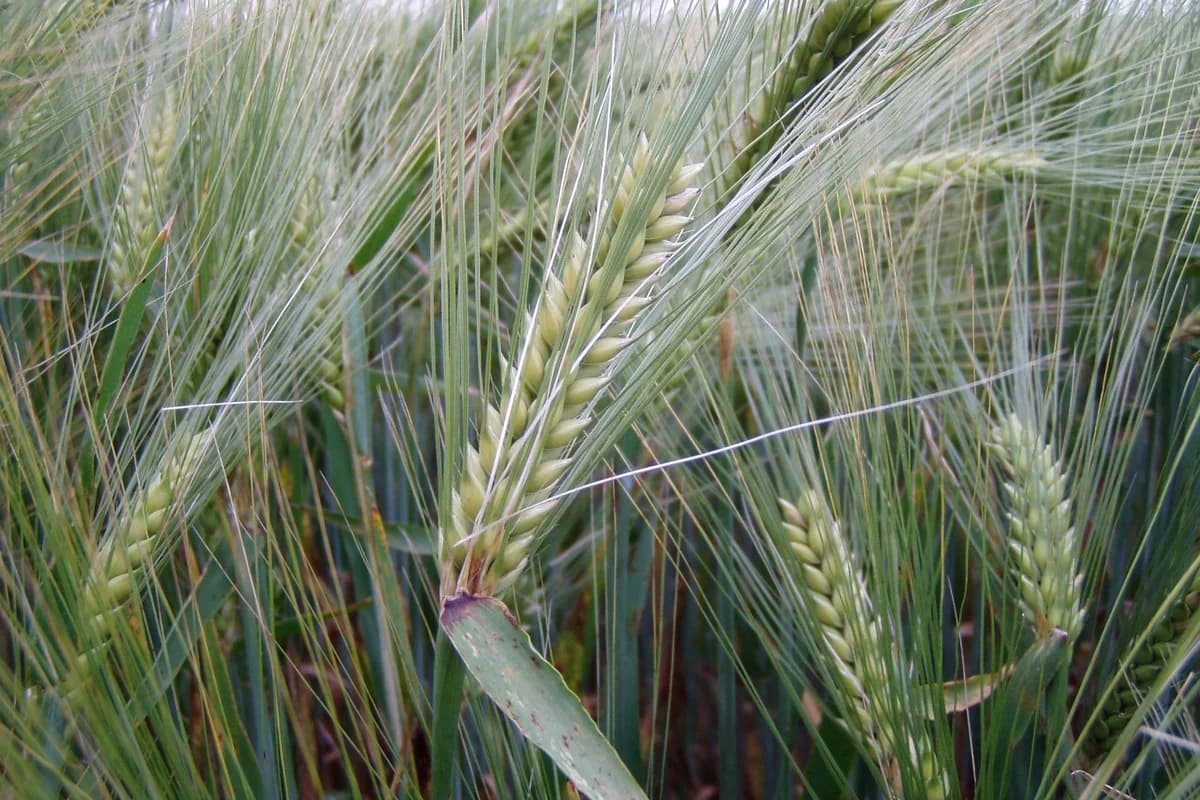
About This Plant
Barley (Hordeum vulgare) is a cool-season cereal grain in the Poaceae family, cultivated worldwide for feed, food, and malting. One of the oldest domesticated crops, it matures in 60-90 days for spring types and adapts to climates from subarctic to subtropical. Barley tolerates poor soils and alkaline conditions better than wheat but requires adequate manganese and is sensitive to waterlogging. Both hydroponic fodder production (7-10 day sprout cycles) and full grain production are viable, with ebb-and-flow and drip systems best suited for longer cycles. Peak nutrient demand occurs during stem elongation at 3 kg N/ha/day. Spring and winter types exist, with winter barley requiring vernalization at 0-5C for 4-8 weeks.
How to Grow Barley
Learn how to grow Barley from seed to harvest in 83 days. Intermediate difficulty. Complete nutrient guide, pH/EC requirements, and growing conditions for soil & container.
Sources cited: 33.
Nutrient Requirements by Growth Stage
Barley follows a determinate cereal nutrient uptake pattern with peak demand during stem elongation (GS30-39) at 3.0-3.1 kg N/ha/day. Nitrogen peaks in the vegetative stage (170-235 ppm optimal 200) and must be reduced during grain fill to control protein for malting…
Sign in to view nutrient requirements
A free account unlocks NPK targets for all four growth stages, micronutrient levels, a per-stage nutrient calculator, and the full nutrition guide. Signing up takes one click. Truleaf is a free, non-profit project, and every new account helps it grow. No spam, ever.
Growing Environments
Outdoor production is ideal — barley is a temperate field crop grown globally in full sun, cool climates (USDA zones 3-8), with a 60-120 day growing season. Greenhouse growing is suitable for year-round production and breeding programs; speed breeding achieves 6 generations per year…
Temperature
Barley is a cool-season C3 cereal with an optimal growth temperature of 15C and a growth range of 5-30C. Germination minimum is 3-4C with optimum at 15-20C; emergence occurs in 5-8 days at optimal temperatures, extending to 10-14 days at near-minimum temperatures. Heat stress above 25C during flowering reduces kernel set and accelerates maturation. During grain fill, cooler temperatures (15-18C) produce higher test weight. Winter barley requires vernalization (0-5C for 4-8 weeks) to transition from vegetative to reproductive growth. Speed breeding protocols use 22C day/17C night for rapid generation advance. A moderate day-night differential of 5-8C promotes strong stem development.
Humidity
Barley prefers cool, dry conditions with 40-70% relative humidity (optimal 55%). High humidity above 70% during heading and flowering significantly increases Fusarium head blight risk and promotes leaf rust…
Light
Barley is a quantitative long-day plant requiring more than 14h photoperiod for timely heading in photoperiod-sensitive varieties. Spring types are less sensitive…
Airflow
Good air circulation at 0.3-1.5 m/s prevents fungal disease (powdery mildew, net blotch, Ramularia) in humid conditions. Moderate wind exposure (0.5-1.0 m/s) strengthens stems and reduces lodging risk through mechanical stress adaptation…
Sign in to view environmental requirements
A free account unlocks exact temperature, humidity, light and airflow targets, including germination and growth ranges, DLI, photoperiod and PPFD, plus the full environment guide. Signing up takes one click. Truleaf is a free, non-profit project, and every new account helps it grow. No spam, ever.
Hydroponic System Compatibility
Barley is compatible with ebb-and-flow, drip, and NFT systems. Ebb-and-flow (flood/drain) is the proven commercial system for hydroponic barley, supporting dense planting with good root oxygenation…
Growing Media
Barley thrives in well-drained loamy soil with pH 6.0-7.0 and tolerates slightly alkaline conditions up to pH 8.5 better than most cereals. Good drainage is the critical requirement — barley is more sensitive to waterlogging than wheat or oats…
Container Specs
Use containers at least 20 cm deep to accommodate barley's fibrous root system. Minimum width of 30 cm allows planting multiple stems at 5-8 cm spacing…
Training & Support
Barley does not require trellising, caging, or structural support under normal conditions. However, lodging (stem collapse) is a significant concern in taller varieties (70-120 cm) during grain fill when heads become heavy…
Sign in to view system compatibility
A free account unlocks why each of the six systems fits or fails, plus growing media, container sizes, training methods, companion plants, and the full systems guide. Signing up takes one click. Truleaf is a free, non-profit project, and every new account helps it grow. No spam, ever.
Propagation
Barley is propagated exclusively by seed with easy difficulty. Sow seeds directly at 2.5-5 cm depth, targeting 20-25 seeds per square foot for adequate stand density…
Harvesting
Barley is an annual grain that does not regrow after harvest. Harvest when grain reaches 13.5-14% moisture for direct bin storage, or begin combining at 18-20% moisture if artificial drying is available…
Planting Calendar
Barley follows two planting calendars depending on type. Spring barley is sown as soon as soil is workable in March-April (soil temperature minimum 3C) and matures in 60-70 days for harvest in July-August…
Common Issues
The most critical diseases for grain barley are net blotch (Pyrenophora teres), rhynchosporium scald (up to 40% yield loss), and Fusarium head blight (DON mycotoxin risk). Barley yellow dwarf virus, transmitted by cereal aphids, causes yield losses up to 50% when infection occurs before tillering…
Get the full science-backed guide
By signing up, you help keep Truleaf free and support the growth of our nonprofit project. Your account unlocks full details for every plant issue—including symptoms, causes, step-by-step solutions, and prevention—plus the month-by-month planting calendar, the complete guide, and all research sources. It only takes one click. No spam, ever.