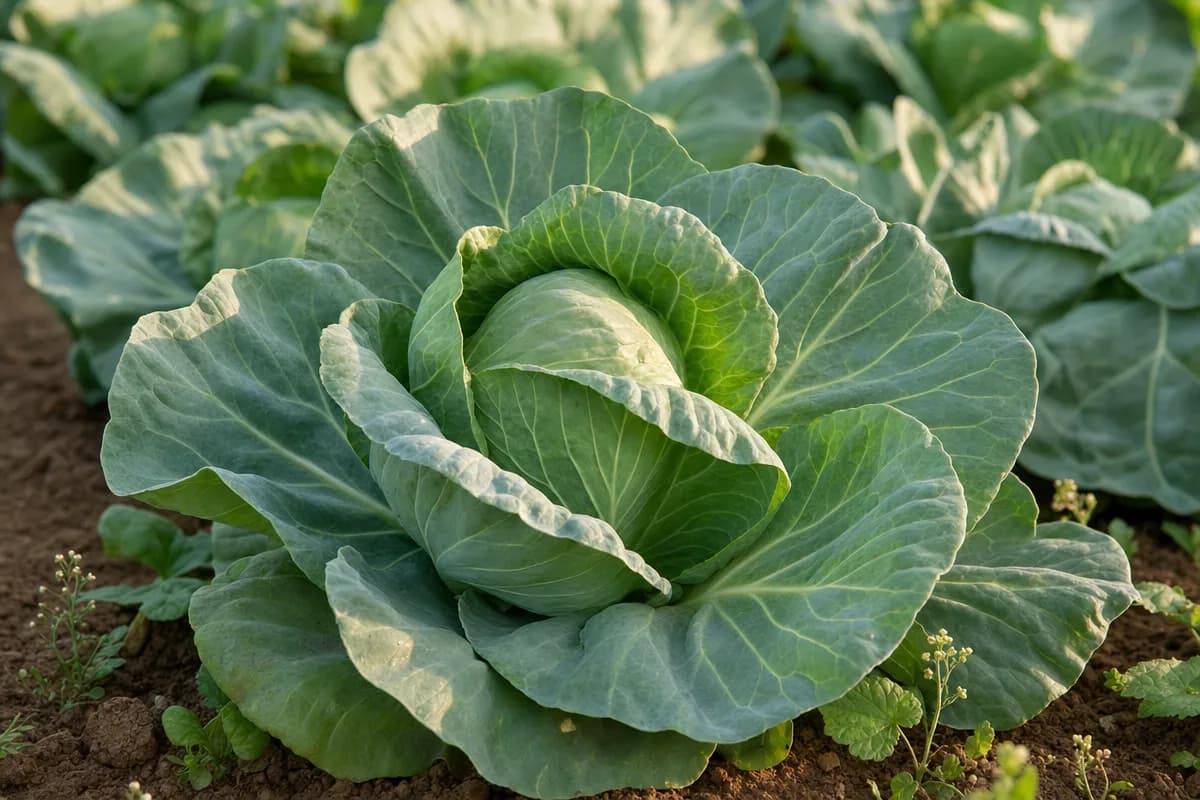
About This Plant
Cabbage is a cool-season cole crop producing dense, spherical heads of tightly layered leaves harvested as entirely vegetative tissue. A heavy feeder with high nitrogen and potassium demands, it requires progressive nutrient ramping through its 91-105 day seed-to-harvest cycle. Sulfur is uniquely critical for brassica quality — research demonstrates 13% yield increases and improved nitrogen use efficiency from optimized S supplementation. After primary head harvest, stumps produce 2-4 smaller secondary heads from axillary buds over 4-6 weeks.
How to Grow Cabbage
Learn how to grow Cabbage from seed to harvest in 105 days. Beginner difficulty. Complete nutrient guide, pH/EC requirements, and growing conditions for hydroponics, soil & greenhouse.
Sources cited: 25.
Nutrient Requirements by Growth Stage
Cabbage is among the heaviest feeders in the Brassicaceae family with a distinctive staged nutrition profile. During seedling establishment (EC 0.8-1.2), maintain N at 95-125 ppm with elevated P at 25-38 ppm for root development…
Sign in to view nutrient requirements
A free account unlocks NPK targets for all four growth stages, micronutrient levels, a per-stage nutrient calculator, and the full nutrition guide. Signing up takes one click. Truleaf is a free, non-profit project, and every new account helps it grow. No spam, ever.
Growing Environments
Cabbage adapts to indoor, outdoor, greenhouse, and container environments. Indoor controlled-environment production is advantageous for maintaining the 15-22C temperature regime year-round and enabling CO2 enrichment…
Temperature
Cabbage is a cool-season crop requiring temperatures of 15-22C for optimal growth. Seeds germinate across 10-24C, with fastest emergence at 18-24C in 4-7 days. After sprouting, maintain seedlings at 15-18C to prevent leggy growth. Vegetative growth and head formation proceed optimally at 15-22C with 18C as the target. Head quality depends on sustained cool conditions — temperatures above 27C trigger bolting while sustained heat above 32C causes tissue damage. A moderate day-night differential of 3-5C (18C day / 14C night) during heading promotes dense, compact formation. In controlled environments, maintain nutrient solution temperature below 20C to prevent root-zone heat stress and preserve dissolved oxygen.
Humidity
Cabbage performs best at 50-70% relative humidity with 65% as the optimal target. Seedlings benefit from higher humidity (70-80%) to prevent leaf margin desiccation during establishment…
Light
Cabbage requires 14-16 hours of light daily to support robust vegetative growth and head development. Target a Daily Light Integral (DLI) of 12-18 mol/m2/day with 15 as the optimal…
Airflow
Adequate airflow is essential for cabbage in controlled environments, particularly during heading when the dense head structure traps moisture between developing inner leaves. Maintain air velocity of 0.3-0.8 m/s at canopy level with target VPD of 0.8-1.2 kPa…
Sign in to view environmental requirements
A free account unlocks exact temperature, humidity, light and airflow targets, including germination and growth ranges, DLI, photoperiod and PPFD, plus the full environment guide. Signing up takes one click. Truleaf is a free, non-profit project, and every new account helps it grow. No spam, ever.
Hydroponic System Compatibility
Cabbage grows successfully in most hydroponic systems except NFT. DWC is the top choice — constant nutrient access supports the heavy feeding demand with one plant per 19+ L bucket and strong aeration…
Growing Media
Cabbage requires a medium balancing moisture retention, aeration, and structural support over 91-105 days. A 70/30 coco coir/perlite blend is preferred for drip systems — it provides excellent water retention while maintaining root oxygen…
Container Specs
Cabbage needs substantial container volume to support its dense root mass and 91-105 day growth cycle. Use a minimum 5-gallon (19 L) container per plant with at least 30 cm depth and 30 cm width…
Training & Support
Cabbage requires no training, staking, or support structures. The plant develops a short (15-25 cm), thick central stem that is entirely self-supporting even with heads weighing 1-3 kg…
Sign in to view system compatibility
A free account unlocks why each of the six systems fits or fails, plus growing media, container sizes, training methods, companion plants, and the full systems guide. Signing up takes one click. Truleaf is a free, non-profit project, and every new account helps it grow. No spam, ever.
Propagation
Cabbage is propagated exclusively by seed — the only commercially viable method for the capitata group. Sow seeds 6 mm deep in sterile soilless mix or rockwool cubes at 18-24C…
Harvesting
Harvest when heads feel firm and solid under gentle squeeze pressure, typically at 15-20 cm diameter for standard varieties (1-2 kg). For mid-season varieties, this is 60-80 days after transplant…
Planting Calendar
Cabbage follows a dual-season spring and fall planting pattern typical of cool-season brassicas. Spring crop: sow indoors January-March, transplant 4-6 weeks before last frost (March-May), harvest May-July…
Common Issues
Cabbage faces pest and disease pressure from both specialist insects and pathogens common to all Brassicaceae. Head splitting and tip burn are the primary physiological disorders — splitting from inconsistent moisture or over-maturity, tip burn from calcium deficiency in rapidly growing inner leaves…
Get the full science-backed guide
By signing up, you help keep Truleaf free and support the growth of our nonprofit project. Your account unlocks full details for every plant issue—including symptoms, causes, step-by-step solutions, and prevention—plus the month-by-month planting calendar, the complete guide, and all research sources. It only takes one click. No spam, ever.