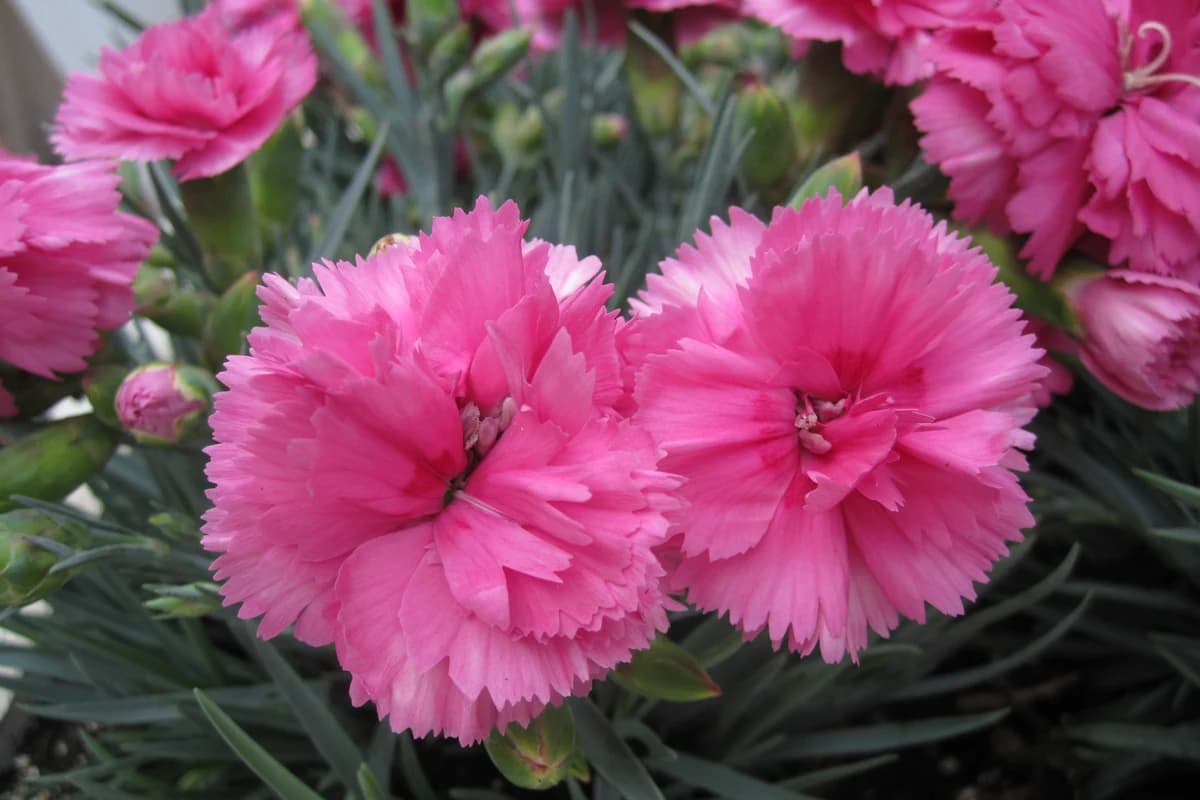
About This Plant
Carnation is a cool-growing ornamental flower grown for long-lasting cut stems, fragrant blooms, and compact pot forms. Reliable production depends on bright long days, cool nights, free-draining media, careful drip fertigation, pinching, support netting, and strict sanitation against Fusarium wilt, Botrytis gray mold, and rust.
How to Grow Carnation
Learn how to grow Carnation from seed to harvest in 140 days. Intermediate difficulty. Complete nutrient guide, pH/EC requirements, and growing conditions for soil & container.
Sources cited: 18.
Nutrient Requirements by Growth Stage
For substrate-grown cut carnation, the strongest fertigation anchor is a greenhouse study on cv. Don Pedro using 200 ppm N in vegetative growth and 160 ppm N in the productive phase, with P near 30 ppm, K near 150 ppm, Ca near 120 ppm, Mg near 40 ppm, EC 1.5-2.5 dS/m, and pH 5.5-6.0[ref-1]…
Sign in to view nutrient requirements
A free account unlocks NPK targets for all four growth stages, micronutrient levels, a per-stage nutrient calculator, and the full nutrition guide. Signing up takes one click. Truleaf is a free, non-profit project, and every new account helps it grow. No spam, ever.
Growing Environments
Carnations can be grown outdoors, in high tunnels, greenhouses, and containers, but the best environment is cool, bright, and well ventilated[ref-5][ref-6]. Greenhouse and polyhouse systems give the strongest control over day-night temperature, long-day lighting, humidity, fertigation, and disease sanitation[ref-5]…
Temperature
Carnation is a cool-growing cut flower rather than a warm leafy crop. Greenhouse and polyhouse guidance supports about 18-24C by day or 20-25C in intensive systems, with cooler 10-15C nights improving flower development and stem quality[ref-5][ref-6][ref-12]. Seeds germinate around 7-14 days, with government biology data reporting 7-10 days near 21C, so a zero-day germination value is incorrect[ref-7]. Keep root and air temperatures stable during bud development because wide swings can aggravate quality defects such as split calyx[ref-9][ref-13].
Humidity
Use moderate humidity for established carnations, not persistently wet air. TNAU production guidance lists about 60-65% relative humidity during full growth and flowering, with higher 80-85% humidity only during early vegetative establishment[ref-5]…
Light
Carnation behaves as a quantitative long-day plant. TNAU reports a critical photoperiod near 13 hours, so the existing 14-hour value is above the flowering threshold, and USU notes that days longer than 12 hours, ideally 16-18 hours, can hasten flowering in miniature carnation production[ref-5][ref-6]…
Airflow
Airflow is primarily a disease and postharvest-quality control for carnation. Botrytis gray mold and rust both increase when foliage, buds, or flowers remain wet, and extension guidance emphasizes sanitation, dry canopies, and ventilation rather than wet overhead irrigation[ref-9][ref-10][ref-11]…
Sign in to view environmental requirements
A free account unlocks exact temperature, humidity, light and airflow targets, including germination and growth ranges, DLI, photoperiod and PPFD, plus the full environment guide. Signing up takes one click. Truleaf is a free, non-profit project, and every new account helps it grow. No spam, ever.
Hydroponic System Compatibility
Drip fertigation in soil, raised beds, grow bags, or substrate is the best-supported controlled system for carnation[ref-5]. TNAU production guidance describes drip irrigation and fertigation, while nutrient studies used substrate or pot culture with controlled nutrient solution rather than passive water…
Growing Media
Use a free-draining, aerated medium rather than waterlogged organic mix. TNAU guidance recommends well-drained red loam or sandy loam with pH 5.5-6.5 for carnation, and commercial production commonly combines beds or grow bags with drip fertigation[ref-5]…
Container Specs
Container production should use compact pot carnation cultivars unless the grower can provide cut-flower depth and support. Pot-carnation research reported single plants in 9 cm pots or three plants in 15 cm pots, with flowering about 12 weeks from pinch under the study conditions[ref-17]…
Training & Support
Training is required for quality cut stems. USU recommends pinching plants about 3-4 weeks after transplanting and supporting stems with taut 6 by 6 inch mesh to keep them straight[ref-6]…
Sign in to view system compatibility
A free account unlocks why each of the six systems fits or fails, plus growing media, container sizes, training methods, companion plants, and the full systems guide. Signing up takes one click. Truleaf is a free, non-profit project, and every new account helps it grow. No spam, ever.
Propagation
Use rooted stem cuttings as the primary method when cultivar identity matters. The Australian government biology review states that cultivated carnations are commonly propagated vegetatively because seed does not preserve true-to-type horticultural traits[ref-7]…
Harvesting
Harvest stage depends on market use. UC Davis postharvest guidance says standard carnations ship and store best when cut or purchased in bud stage, while mini carnations should have at least one open flower per stem[ref-11]…
Planting Calendar
For temperate Northern Hemisphere field or tunnel production, sow seed indoors 6-8 weeks before transplant or use rooted cuttings for uniform florist crops[ref-6][ref-7]. USU high-tunnel trials transplanted miniature carnations 6-8 weeks before the last freeze under protection, about 4 weeks before the last freeze…
Common Issues
The main verified carnation problems are Fusarium wilt, Botrytis gray mold, rust, insect pests, and abiotic quality defects such as split calyx[ref-9][ref-10][ref-18]. Fusarium wilt causes one-sided yellowing and brown vascular tissue, Botrytis attacks moist flowers with gray mold, and rust forms brown pustules on…
Get the full science-backed guide
By signing up, you help keep Truleaf free and support the growth of our nonprofit project. Your account unlocks full details for every plant issue—including symptoms, causes, step-by-step solutions, and prevention—plus the month-by-month planting calendar, the complete guide, and all research sources. It only takes one click. No spam, ever.