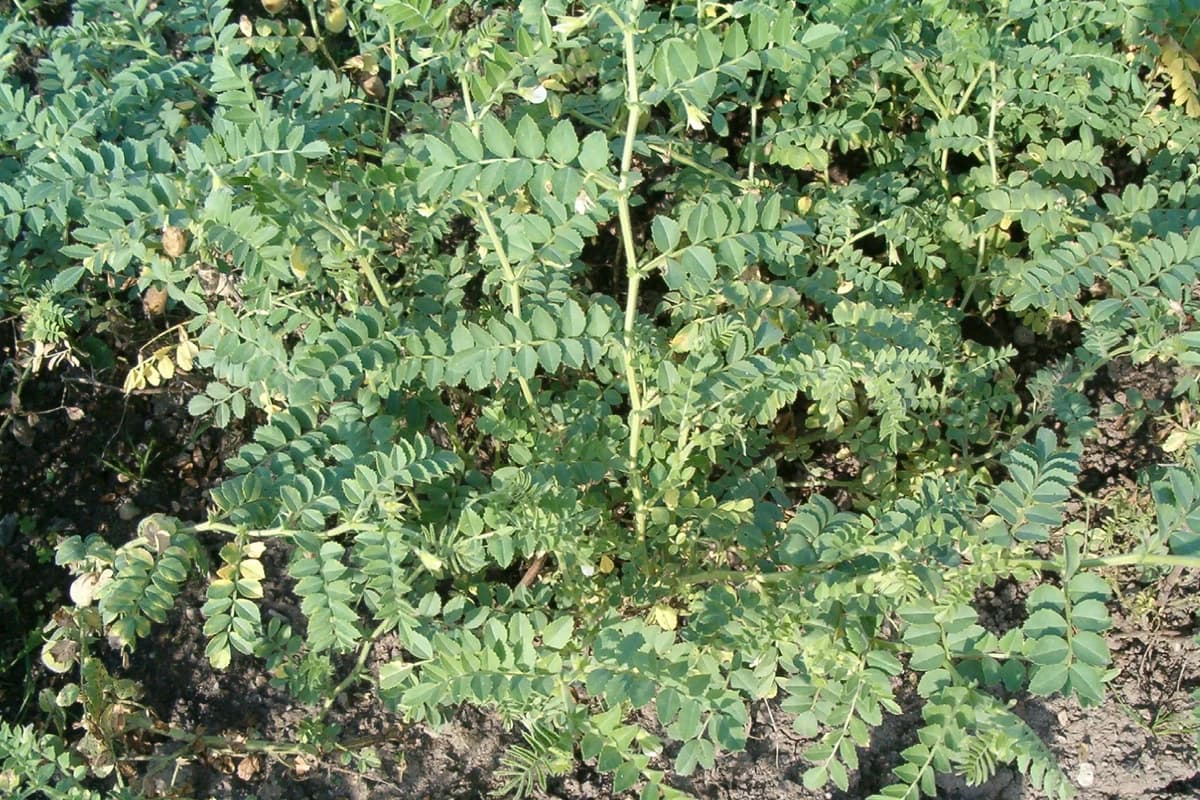
About This Plant
Chickpea, also called garbanzo bean, is a cool-season annual pulse grown for protein-rich dry seeds. It performs best in well-drained neutral soil or deep containers, depends on Mesorhizobium nodulation for most nitrogen after establishment, and is most limited by heat during flowering, waterlogging, and Ascochyta blight.
How to Grow Chickpea
Learn how to grow Chickpea from seed to harvest in 115 days. Intermediate difficulty. Complete nutrient guide, pH/EC requirements, and growing conditions for soil & container.
Sources cited: 8.
Nutrient Requirements by Growth Stage
Treat chickpea as a nodulating legume, not a heavy nitrogen feeder. MSU reports about 70% or more of plant nitrogen normally comes from biological fixation and warns that high soil N can reduce nodulation and delay flowering…
Sign in to view nutrient requirements
A free account unlocks NPK targets for all four growth stages, micronutrient levels, a per-stage nutrient calculator, and the full nutrition guide. Signing up takes one click. Truleaf is a free, non-profit project, and every new account helps it grow. No spam, ever.
Growing Environments
Outdoor field culture is the evidence-backed standard for chickpea, but greenhouse or container production is practical if root depth, drainage, and strong light are provided. The crop is drought tolerant compared with pea and lentil, yet it is sensitive to waterlogging and salinity…
Temperature
Chickpea is a cool-season pulse, but its best vegetative and reproductive performance sits in mild warmth rather than cold. Montana State reports best growth at 70-84 F daytime and 64-70 F nights, while the OGTR biology review notes flowering and podding are sensitive to heat at about 35/22 C or higher. Keep growth near 18-29 C and avoid prolonged heat during early bloom and pod set.
Humidity
Moderate, dry-canopy conditions are safest for chickpea. The crop tolerates semi-arid production, but Ascochyta blight and Botrytis increase sharply when humidity, rain splash, and leaf wetness persist…
Light
Grow chickpea in full sun or high-intensity greenhouse light. Growth-chamber research used 370 umol m-2 s-1 and showed chickpea is generally long-day responsive, with 16-hour days hastening flowering in sensitive accessions compared with 10-hour short days…
Airflow
Air movement is a disease-control requirement rather than a yield target. Ascochyta, Botrytis, and Sclerotinia are all favored by wet canopies, dense growth, or humid conditions…
Sign in to view environmental requirements
A free account unlocks exact temperature, humidity, light and airflow targets, including germination and growth ranges, DLI, photoperiod and PPFD, plus the full environment guide. Signing up takes one click. Truleaf is a free, non-profit project, and every new account helps it grow. No spam, ever.
Hydroponic System Compatibility
Use deep soil, coco-based media, or drip-irrigated containers as the primary controlled-environment approach. Chickpea has a taproot and lateral roots that can reach about 30 inches, is sensitive to waterlogged roots, and depends on healthy nodulation for nitrogen supply…
Growing Media
Choose a deep, well-drained, low-salt medium. MSU recommends well-drained neutral soils and warns that chickpea is not adapted to saline or wet soils…
Container Specs
Containers must be deeper than typical leafy-green pots because chickpea develops a taproot and lateral roots to about 30 inches in field conditions. Use at least 30 cm depth for small plants and larger 12-20 L containers for meaningful dry seed yield…
Training & Support
Chickpea normally needs no trellis, stake, topping, or pruning. NDSU describes chickpea as erect and bush-like, with primary and secondary branching and low pods typically high enough for direct harvest…
Sign in to view system compatibility
A free account unlocks why each of the six systems fits or fails, plus growing media, container sizes, training methods, companion plants, and the full systems guide. Signing up takes one click. Truleaf is a free, non-profit project, and every new account helps it grow. No spam, ever.
Propagation
Propagate chickpea from seed. Use disease-free, high-vigor seed, plant shallowly into warm well-drained soil or media, and inoculate with Mesorhizobium ciceri or M…
Harvesting
Harvest dry chickpea when pods and seed have matured, not while plants are still actively flowering. MSU notes kabuli types usually mature in 110-120 days and that pods should be mature, seeds changed color, and seeds detached inside pods before desiccation or threshing…
Planting Calendar
In temperate spring-sown systems, direct sow around the local spring wheat planting window so flowering occurs before the hottest part of summer. NDSU reports flowering occurs around 50 days after emergence, near the 13th or 14th node, and reproductive stages progress from early bloom through full seed and…
Common Issues
The main disease risk is Ascochyta blight, which causes target-like lesions with dark pycnidia and can severely reduce yield and seed quality. Prevention is integrated: disease-free seed, resistant cultivars, seed treatment, three-year pulse rotation, sanitation, scouting, and timely fungicide decisions…
Get the full science-backed guide
By signing up, you help keep Truleaf free and support the growth of our nonprofit project. Your account unlocks full details for every plant issue—including symptoms, causes, step-by-step solutions, and prevention—plus the month-by-month planting calendar, the complete guide, and all research sources. It only takes one click. No spam, ever.