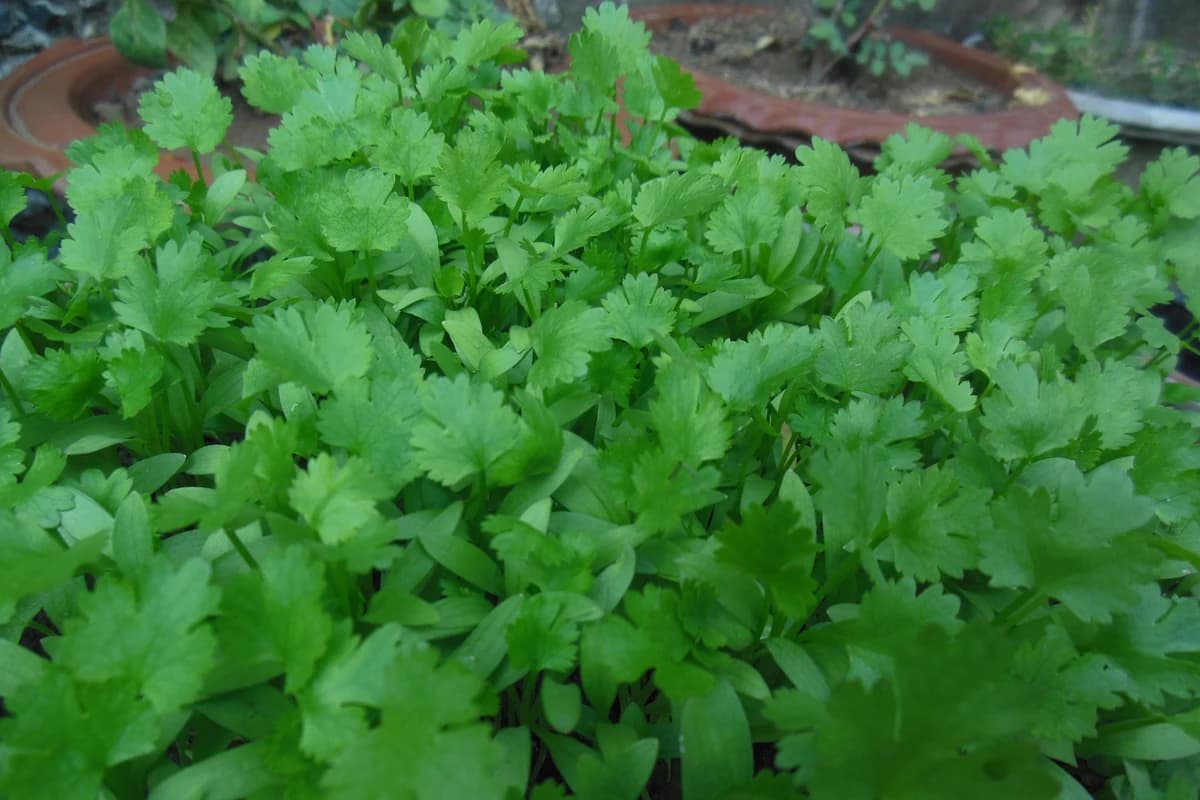
About This Plant
Cilantro microgreens are slow-growing, aromatic coriander seedlings harvested at the cotyledon to first true leaf stage. They perform best in clean shallow trays, cool indoor conditions, moderate light, gentle airflow, and a dilute nutrient program after germination.
How to Grow Cilantro Microgreens
Learn how to grow Cilantro Microgreens from seed to harvest in 25 days. Intermediate difficulty. Complete nutrient guide, pH/EC requirements, and growing conditions for soil & container.
Backed by 16 peer-reviewed citations.
Nutrient Requirements by Growth Stage
Manage cilantro microgreens as a short-cycle seedling crop, not mature cilantro. Direct coriander microgreen trials support dilute nutrition: 1/4 to 1/2 modified Hoagland improved covered-tray yield on coconut substrate, and another coriander study used quarter-strength modified Hoagland at EC 0.35 dS m-1 and pH 6.0…
Sign in to view nutrient requirements
A free account unlocks NPK targets for all four growth stages, micronutrient levels, a per-stage nutrient calculator, and the full nutrition guide. Signing up takes one click. Truleaf is a free, non-profit project, and every new account helps it grow. No spam, ever.
Growing Environments
Indoor tray production has the strongest evidence because direct cilantro microgreen trials used controlled rooms with fixed temperature, humidity, light, and hydroponic or soilless tray media. Greenhouse or protected container production is possible when sanitation, airflow, and irrigation are controlled…
Temperature
Keep cilantro microgreens in a cool indoor range. Direct cilantro microgreen work used about 19.7/18.7C day/night, and extension microgreen guides place germination and growth near 21-23C with slightly cooler nights. The current 18-24C germination range and 18-22C growth range are therefore retained, with 21C as a practical target. Avoid hot rooms because coriander is a cool-season species and heat weakens quality before harvest.
Humidity
Target moderate humidity around 55-60%, with 50-70% acceptable when covers are vented and airflow is running. Humidity covers are useful only during early germination; after emergence they should be removed or vented because dense cilantro trays trap moisture around seed coats and stems…
Light
The existing 16 hour photoperiod near 208 PPFD is well supported. Cilantro microgreens were grown successfully at 210 PPFD under a 16/8 light cycle, which gives about 12 mol m-2 d-1…
Airflow
Gentle continuous airflow is required after germination because cilantro microgreens are dense, slow trays that hold moisture around stems. Use shelf-level fans or horizontal air movement strong enough to prevent stagnant humid pockets but not strong enough to bend or desiccate seedlings…
Sign in to view environmental requirements
A free account unlocks exact temperature, humidity, light and airflow targets, including germination and growth ranges, DLI, photoperiod and PPFD, plus the full environment guide. Signing up takes one click. Truleaf is a free, non-profit project, and every new account helps it grow. No spam, ever.
Hydroponic System Compatibility
The best-supported system is shallow tray culture with soilless media or hydroponic fiber mats kept moist but not saturated. Bottom watering or tray sub-irrigation is a good fit because it keeps the canopy drier than overhead watering…
Growing Media
Use clean shallow soilless media or hydroponic mats. Cilantro microgreens were grown successfully on Biostrate felt mats with half-strength Hoagland, while coriander trials used coconut coir and vermiculite at 5:1 with substrate covering…
Container Specs
Use shallow food-safe trays with drainage and a solid bottom tray for watering. USU recommends the standard 10 x 20 microgreen tray format and cilantro seeding around 28 g per tray…
Training & Support
No structural support or training is needed. Cilantro microgreens are harvested as immature seedlings with cotyledons and emerging true leaves, so there is no staking, trellising, pruning, topping, or transplant support…
Sign in to view system compatibility
A free account unlocks why each of the six systems fits or fails, plus growing media, container sizes, training methods, companion plants, and the full systems guide. Signing up takes one click. Truleaf is a free, non-profit project, and every new account helps it grow. No spam, ever.
Propagation
Propagate only from seed. Sow cilantro densely into a clean shallow tray, press for good seed-to-media contact, and keep covered or weighted during early establishment…
Harvesting
Cilantro is slower than many microgreens. Harvest when cotyledons are expanded and first true leaves are visible, commonly 21-28 days under extension guidance…
Planting Calendar
Treat cilantro microgreens as a year-round protected tray crop. Sow indoors or in a greenhouse in any month, then schedule harvest about three to four weeks later for typical cilantro trays…
Common Issues
The primary problems are damping-off, mold, weak seedlings, and food-safety contamination. Watch for patchy emergence, collapsed or pinched stems, fuzzy growth, wet canopy patches, and leggy pale stems…
Get the full science-backed guide
By signing up, you help keep Truleaf free and support the growth of our nonprofit project. Your account unlocks full details for every plant issue—including symptoms, causes, step-by-step solutions, and prevention—plus the month-by-month planting calendar, the complete guide, and all research sources. It only takes one click. No spam, ever.