About This Plant
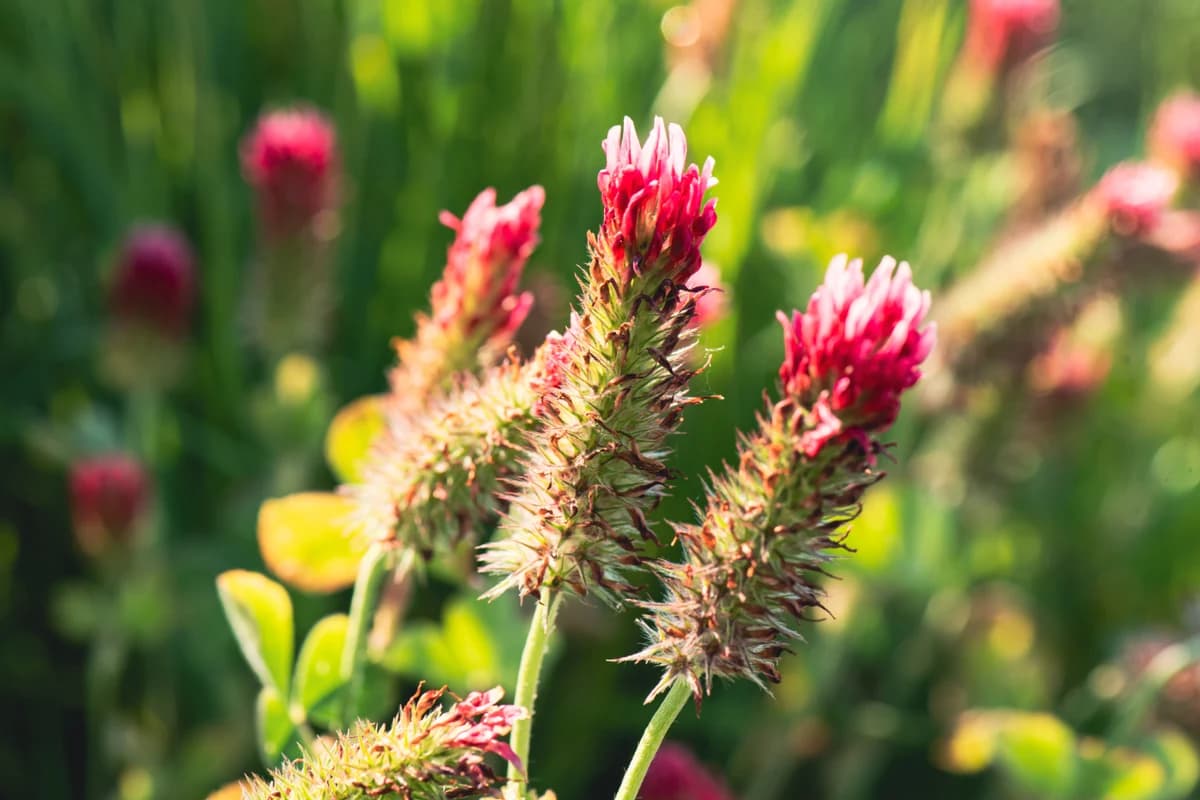
Crimson clover is a cool-season annual legume grown as a cover crop, forage, green manure, pollinator resource, and seed crop. It fixes nitrogen when properly inoculated, protects soil through winter, and produces bright crimson flower spikes before spring termination or seed harvest.
How to Grow Crimson Clover
Learn how to grow Crimson Clover from seed to harvest in 210 days. Beginner difficulty. Complete nutrient guide, pH/EC requirements, and growing conditions for soil & container.
Sources cited: 15.
Nutrient Requirements by Growth Stage
For pure crimson clover, peer-reviewed and extension evidence does not support fixed hydroponic NPK ppm targets. Properly inoculated stands normally receive no fertilizer nitrogen; fertilizer N can suppress nodulation, while phosphorus, potassium, sulfur, lime, and boron are managed from soil tests…
Sign in to view nutrient requirements
A free account unlocks NPK targets for all four growth stages, micronutrient levels, a per-stage nutrient calculator, and the full nutrition guide. Signing up takes one click. Truleaf is a free, non-profit project, and every new account helps it grow. No spam, ever.
Growing Environments
Crimson clover is strongly suited to outdoor field, pasture, orchard, vineyard, vegetable-rotation, and raised-bed cover-crop use. Greenhouse or indoor use is possible for trials or small containers, but the accepted sources do not document it as a standard production crop…
Temperature
Crimson clover is a cool-season annual, not a warm greenhouse crop. Seed tests on Dixie crimson clover showed rapid germination at 20C, delayed germination at 10C, and poor germination at 30C, while USDA guidance places field emergence near 7 days when moisture is adequate. Treat 10-24C as the practical controlled-environment range, with roughly 18-20C best for establishment and cooler field growth after emergence. Prolonged heat above the mid-20s C reduces establishment reliability and pushes the crop out of its preferred cool, moist season.
Humidity
No complete source found a crimson-clover relative-humidity optimum. The verified management factor is moisture balance: the crop establishes best in cool, moist conditions but performs poorly on poorly drained, waterlogged, soggy, or strongly disease-favorable sites…
Light
Crimson clover is best managed as a full-sun cover crop or forage. USDA and extension sources describe it as a winter or summer annual used in open field rotations, orchards, pastures, and cover-crop mixtures…
Airflow
No source provides an airflow rate for crimson clover. The verified principle is canopy drying and stand-density control: thick growth before cool wet months raises crown and stem rot pressure, while mowing or grazing can remove excess foliage and improve stand health…
Sign in to view environmental requirements
A free account unlocks exact temperature, humidity, light and airflow targets, including germination and growth ranges, DLI, photoperiod and PPFD, plus the full environment guide. Signing up takes one click. Truleaf is a free, non-profit project, and every new account helps it grow. No spam, ever.
Hydroponic System Compatibility
The current hydroponic system claims are not species-verified. Crimson clover has been used in experimental nutrient and nodulation research, but no complete source validated DWC, NFT, ebb-flow, Kratky, drip hydroponics, or aeroponics as production systems for this crop…
Growing Media
Use well-drained fertile loam or sandy loam where possible. USDA and SARE note that crimson clover performs poorly on heavy clay, waterlogged, extremely acidic, highly alkaline, calcareous, soggy, or salty soils…
Container Specs
Authoritative sources do not give pot-size specifications for crimson clover. The defensible small-space guidance is to use a broad, well-drained raised bed or container deep enough for an annual legume root system and to sow directly rather than transplanting…
Training & Support
Crimson clover does not require trellising, staking, topping, or formal training. It is an upright to semi-erect annual legume grown as a stand or mixture, commonly reaching around 30-60 cm depending on cultivar, fertility, and climate…
Sign in to view system compatibility
A free account unlocks why each of the six systems fits or fails, plus growing media, container sizes, training methods, companion plants, and the full systems guide. Signing up takes one click. Truleaf is a free, non-profit project, and every new account helps it grow. No spam, ever.
Propagation
Propagate crimson clover by direct seeding. USDA and extension sources recommend a firm, weed-free seedbed, shallow placement, and good seed-to-soil contact; common field depths are about 0.25-0.5 inch, with slightly deeper placement only in sandy soils…
Harvesting
Harvest timing depends on use. For forage or hay, cut at or before mid-bloom to balance yield and quality; USDA reports good stands can yield about 1-2.5 tons dry matter per acre…
Planting Calendar
Use climate-based scheduling rather than universal day counts. For winter-annual use, sow 6-8 weeks before the average first frost; in the Southeast this is commonly late summer to fall, while northern areas need earlier sowing or may use crimson clover as a summer annual after frost risk has passed…
Common Issues
The verified crimson-clover issues differ from the current generic hydroponic list. Crown and stem rot caused by Sclerotinia trifoliorum is one of the most serious diseases and is favored by cool, wet, dense stands…
Get the full science-backed guide
By signing up, you help keep Truleaf free and support the growth of our nonprofit project. Your account unlocks full details for every plant issue—including symptoms, causes, step-by-step solutions, and prevention—plus the month-by-month planting calendar, the complete guide, and all research sources. It only takes one click. No spam, ever.