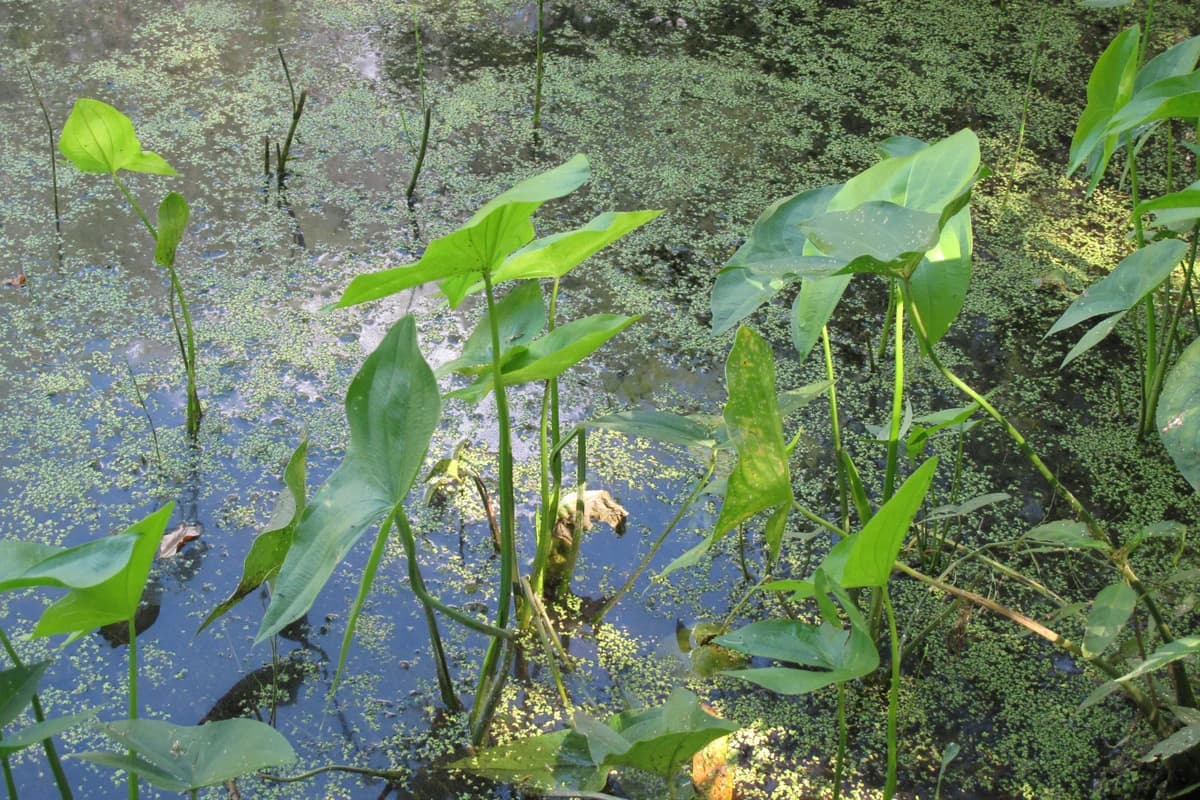
About This Plant
Duckweed (Lemna minor) is a tiny floating aquatic plant grown as fast-turnover biomass for aquaponics, animal feed research, wastewater nutrient recovery, and contained edible-green experiments. It propagates mainly by vegetative budding rather than seed, doubles quickly under warm nutrient-rich water, and is harvested by skimming the surface mat. Best results come from shallow still or gently recirculating water, moderate light, neutral pH, regular biomass removal, and strict containment because it can overgrow ponds.
How to Grow Duckweed
Learn how to grow Duckweed from seed to harvest in 5 days. Beginner difficulty. Complete nutrient guide, pH/EC requirements, and growing conditions for hydroponics, soil & greenhouse.
Backed by 20 peer-reviewed citations.
Nutrient Requirements by Growth Stage
Duckweed is a vegetative aquatic crop; do not use flowering or fruiting nutrient stages. Maintain a modest but continuous nutrient supply around N 15-30 ppm, P 5-10 ppm, and K 20-40 ppm, with a practical target near 16-7-22 ppm for contained culture…
Sign in to view nutrient requirements
A free account unlocks NPK targets for all four growth stages, micronutrient levels, a per-stage nutrient calculator, and the full nutrition guide. Signing up takes one click. Truleaf is a free, non-profit project, and every new account helps it grow. No spam, ever.
Growing Environments
Duckweed is compatible with indoor, greenhouse, outdoor, and container culture when water is contained and nutrient chemistry is monitored. Indoor culture works in shallow trays, tubs, aquaria, and stacked recirculating systems under moderate light…
Temperature
Duckweed is managed as a vegetative aquatic biomass crop, so use water temperature rather than air temperature as the control point. Laboratory Lemna growth tests standardize cultures at 24 +/- 2C, and controlled-environment studies commonly use 20-25C for reproducible growth. Outdoor mass-production work found production slowed strongly below 18.5C, while warm pond temperatures around 30-31C supported high output when water depth and nutrients were stable. The practical range for production is 18-31C, with 22-25C as the safer indoor target and 27-30C acceptable outdoors if heat spikes are buffered. Growth can persist outside this range, but cold water slows multiplication and mid-30C water risks culture collapse.
Humidity
Relative humidity is not a primary control variable for normal duckweed culture because the plant floats directly on water and keeps its fronds hydrated from below. For open-water trays, DWC tubs, ponds, and raceways, manage water level, temperature, and surface wetness instead of chasing a canopy humidity set point…
Light
Start indoor duckweed at 100-150 umol/m2/s PAR for 14-16 hours, with 16:8 light:dark as the default production schedule. OECD Lemna test conditions use 85-135 umol/m2/s for reproducible short assays, while indoor production trials show that 50-150 umol/m2/s can work depending on clone, medium, and density…
Airflow
Duckweed does not need canopy airflow in the way leafy terrestrial crops do; it needs still to gently moving water that keeps fronds spread in a thin surface layer. Excessive water velocity is harmful because fronds overlap, roots tangle, and surface mats lose even light exposure…
Sign in to view environmental requirements
A free account unlocks exact temperature, humidity, light and airflow targets, including germination and growth ranges, DLI, photoperiod and PPFD, plus the full environment guide. Signing up takes one click. Truleaf is a free, non-profit project, and every new account helps it grow. No spam, ever.
Hydroponic System Compatibility
Deep-water culture, open tubs, ponds, and shallow raceway trays are the natural systems for Lemna minor because the crop floats and absorbs nutrients directly from water. Passive Kratky-style tubs also work for small contained cultures if nutrients are replenished and biomass is skimmed often…
Growing Media
Duckweed needs no solid growing medium. The correct medium is water: clean freshwater, aquaponic water, diluted nutrient-rich effluent, or a balanced hydroponic solution, depending on use case and food-safety requirements…
Container Specs
Use watertight opaque containers with enough surface area for a thin floating mat. OECD test guidance sets a laboratory minimum of 20 mm water depth and 100 mL volume, but production studies show better stability with more water: 50 mm depth outperformed 25 mm in recirculating trays, outdoor tanks used about 30 cm,…
Training & Support
Duckweed requires no training, trellis, cage, stake, pruning, topping, or structural support. Management is entirely surface-density management: keep the mat thin enough for each frond to receive light and nutrients, skim biomass before multilayering, and redistribute clumps if water movement pushes plants into piles…
Sign in to view system compatibility
A free account unlocks why each of the six systems fits or fails, plus growing media, container sizes, training methods, companion plants, and the full systems guide. Signing up takes one click. Truleaf is a free, non-profit project, and every new account helps it grow. No spam, ever.
Propagation
Propagate Lemna minor by division of active frond colonies, not by seed. USDA describes duckweed reproduction as predominantly asexual, with vegetative buds forming new connected fronds that later separate…
Harvesting
Harvest duckweed by skimming the floating mat with a fine net, screen, or perforated scoop. Research and pilot systems commonly reset density by removing excess biomass and leaving an active mat for regrowth…
Planting Calendar
Duckweed has no normal sowing, transplanting, flowering, or fruiting calendar; the production calendar is a water-temperature and harvest-density schedule. Indoors or in a greenhouse, cultures can be started and harvested year-round under 20-25C water, 100-150 umol/m2/s PAR, and a 16:8 photoperiod…
Common Issues
The main duckweed production problems are chemical imbalance, overcrowding, algae, temperature stress, and uncontrolled pond expansion. High pH combined with ammonium shifts nitrogen toward un-ionized ammonia, causing chlorosis, sinking fronds, and rapid growth loss…
Get the full science-backed guide
By signing up, you help keep Truleaf free and support the growth of our nonprofit project. Your account unlocks full details for every plant issue—including symptoms, causes, step-by-step solutions, and prevention—plus the month-by-month planting calendar, the complete guide, and all research sources. It only takes one click. No spam, ever.