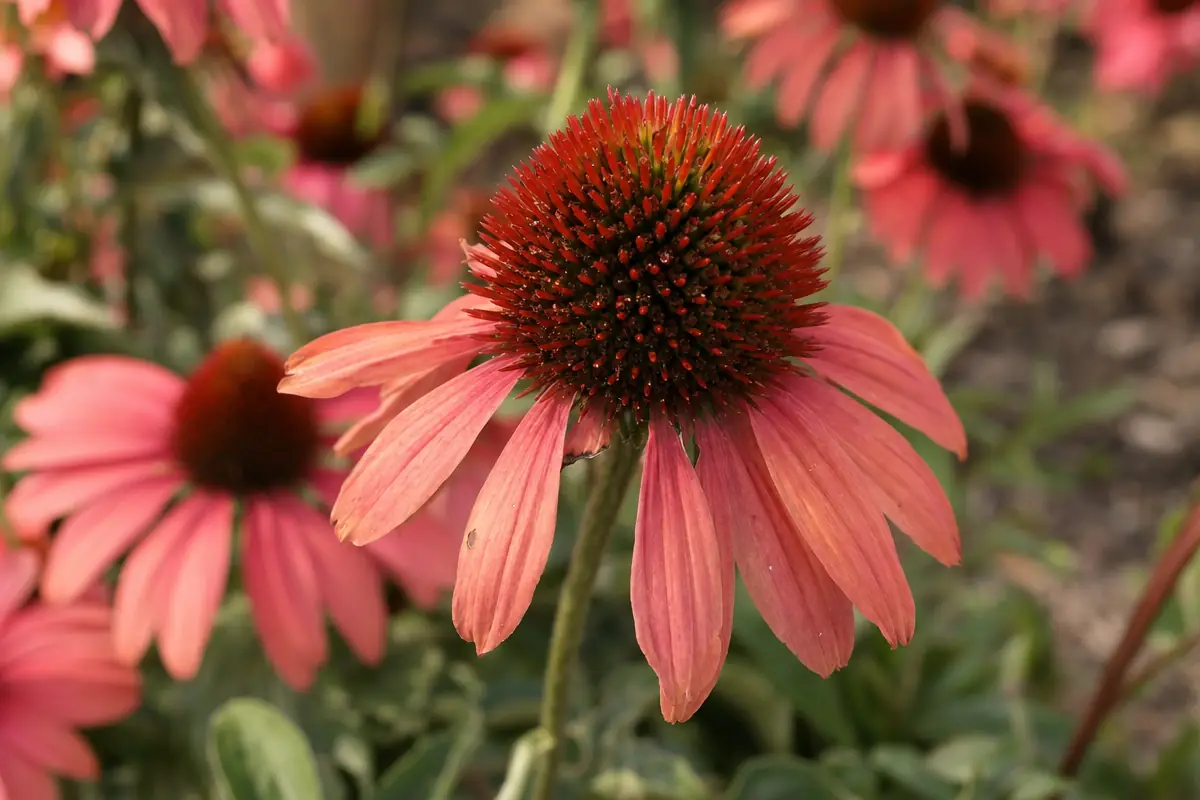
About This Plant
Echinacea purpurea, or purple coneflower, is a hardy North American perennial grown for pollinator-friendly flowers and medicinal aerial parts and roots. It can be managed outdoors, in containers, or in greenhouse soilless systems, but high-quality production depends on full sun, well-drained media, cautious fertility, and strict disease sanitation.
How to Grow Echinacea
Learn how to grow Echinacea from seed to harvest in 240 days. Intermediate difficulty. Complete nutrient guide, pH/EC requirements, and growing conditions for hydroponics, soil & greenhouse.
Sources cited: 13.
Nutrient Requirements by Growth Stage
After seedlings reach transplant size, the strongest E. purpurea hydroponic evidence supports a nitrate-dominant solution near N 210 ppm, P 31 ppm, K 235 ppm, Ca 160 ppm, Mg 49 ppm, and S 64 ppm, held at pH 5.7-6.2 and EC 1.0-1.5 dS/m…
Sign in to view nutrient requirements
A free account unlocks NPK targets for all four growth stages, micronutrient levels, a per-stage nutrient calculator, and the full nutrition guide. Signing up takes one click. Truleaf is a free, non-profit project, and every new account helps it grow. No spam, ever.
Growing Environments
Echinacea is suitable outdoors, in greenhouses, and in containers, and it can be grown indoors if light is strong enough. Outdoors it prefers full sun to part shade and well-drained, evenly moist soil, becoming drought tolerant after establishment…
Temperature
Use Echinacea as a cool-to-moderate greenhouse perennial rather than a hot crop. Controlled hydroponic studies used about 22/18C day/night, and extension sowing guidance places indoor germination near 18-21C with emergence in 10-20 days. For production, the current 18-22C growth range is retained because it matches the greenhouse trials; outdoor plants tolerate heat once established, but medicinal quality trials should avoid chronic heat and water stress unless intentionally testing stress effects.
Humidity
A greenhouse target near 70-75% RH is supported, with up to 80% acceptable only when air movement and spacing keep foliage from staying wet. Clemson emphasizes well-drained conditions, dry foliage, and proper spacing to reduce disease pressure…
Light
Give outdoor plants full sun to part shade and greenhouse crops bright light. The prior 650 PPFD value is supported in a hydroponic greenhouse study, but that study used a 10-hour light period; 650 PPFD for 16 hours produces a much higher 37.4 mol/m2/day DLI that was not directly verified…
Airflow
Maintain gentle continuous airflow in protected culture. Echinacea disease guides repeatedly point to spacing, dry leaves, and sanitation for powdery mildew, rots, and leaf spots…
Sign in to view environmental requirements
A free account unlocks exact temperature, humidity, light and airflow targets, including germination and growth ranges, DLI, photoperiod and PPFD, plus the full environment guide. Signing up takes one click. Truleaf is a free, non-profit project, and every new account helps it grow. No spam, ever.
Hydroponic System Compatibility
Drip fertigation or ebb-flow in peat-perlite media is the most conservative soilless fit because the key hydroponic trials used substrate pots and controlled fertigation. Deep-flow, NFT, and other closed hydroponic systems have research support for Echinacea, but they require root support, aeration, and sanitation…
Growing Media
Use well-drained media that still holds steady moisture. In hydroponic greenhouse trials, 50:50 peat moss and very fine perlite gave the best growth and medicinal compound outcomes…
Container Specs
Container culture is valid, especially for compact cultivars, but drainage is non-negotiable. University sources specify container production more often by pot class than by depth; a 30 cm depth and width is a conservative minimum for established plants, with larger pots preferred for multi-year medicinal roots…
Training & Support
Staking is normally unnecessary because E. purpurea has sturdy upright stems…
Sign in to view system compatibility
A free account unlocks why each of the six systems fits or fails, plus growing media, container sizes, training methods, companion plants, and the full systems guide. Signing up takes one click. Truleaf is a free, non-profit project, and every new account helps it grow. No spam, ever.
Propagation
Propagate by seed, division, or root cuttings. E…
Harvesting
Harvest depends on the product. For flowers and aerial parts, cut healthy material at bloom and process the same day when quality matters…
Planting Calendar
Start seed indoors in late winter to early spring, or use fall/winter sowing for natural cold conditioning. Transplant hardened seedlings in spring to early summer after roots are established and before severe heat; Saskatchewan guidance places field transplanting in May or June and prefers at least 10-week plugs for…
Common Issues
The corrected issue list keeps powdery mildew, root/crown rots, aster yellows, and aphids, while adding eriophyid mites and demoting whiteflies to protected-culture scouting. Aster yellows is systemic and leafhopper vectored; remove the whole plant rather than pruning flowers…
Get the full science-backed guide
By signing up, you help keep Truleaf free and support the growth of our nonprofit project. Your account unlocks full details for every plant issue—including symptoms, causes, step-by-step solutions, and prevention—plus the month-by-month planting calendar, the complete guide, and all research sources. It only takes one click. No spam, ever.