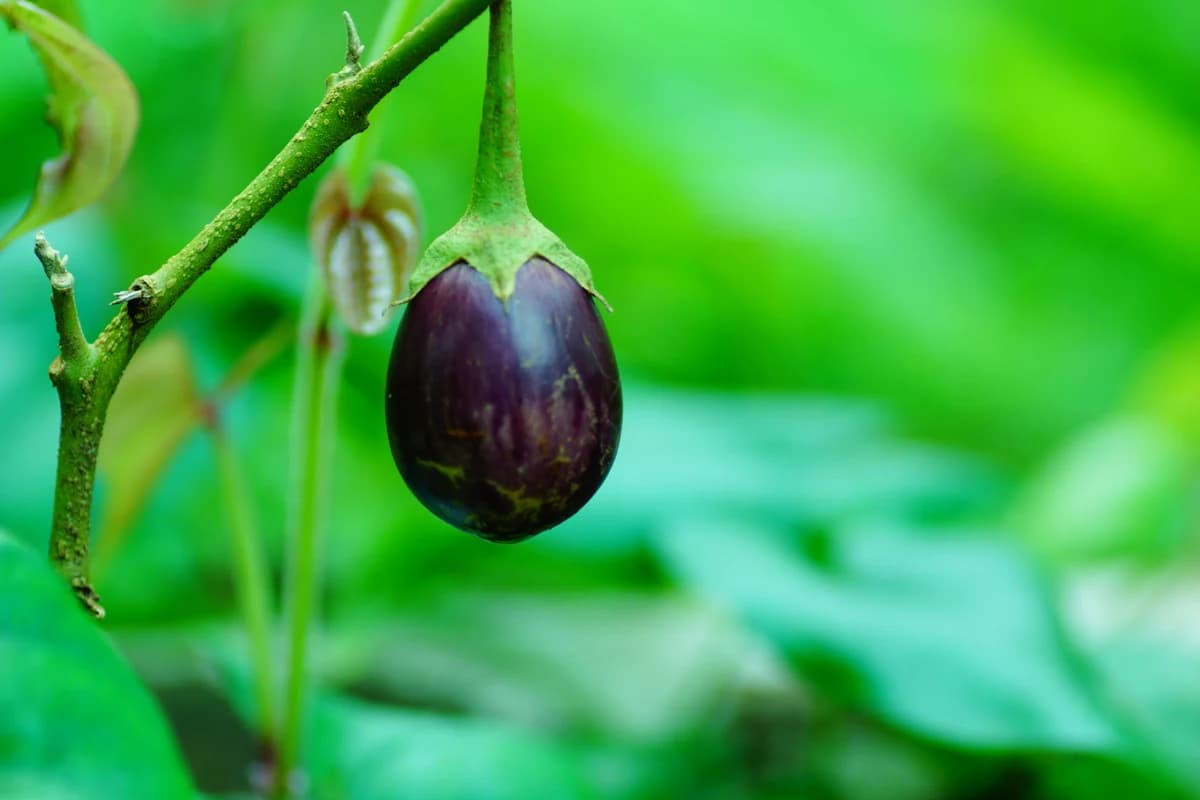
About This Plant
Eggplant is a heat-loving Solanaceae fruiting vegetable grown for glossy immature fruit used fresh, roasted, grilled, and cooked across Mediterranean, Asian, and tropical cuisines. It performs best in warm protected culture or summer outdoor beds, responds strongly to steady fertigation, and needs support for heavy fruit loads. Hydroponic and container systems can work well when EC, pH, calcium, potassium, airflow, and pollination conditions are kept stable.
How to Grow Eggplant
Learn how to grow Eggplant from seed to harvest in 100 days. Intermediate difficulty. Complete nutrient guide, pH/EC requirements, and growing conditions for hydroponics, soil & greenhouse.
Sources cited: 22.
Nutrient Requirements by Growth Stage
Eggplant is a heavy fruiting crop with strong N and K demand. Primary soilless studies support higher productive-stage N and K than the stub record: seedling 120N-25P-140K ppm, vegetative about 240N-40P-260K, flowering 220N-55P-360K, and fruiting 220N-60P-420K…
Sign in to view nutrient requirements
A free account unlocks NPK targets for all four growth stages, micronutrient levels, a per-stage nutrient calculator, and the full nutrition guide. Signing up takes one click. Truleaf is a free, non-profit project, and every new account helps it grow. No spam, ever.
Growing Environments
Eggplant can be grown outdoors, in greenhouses, indoors with strong lighting, and in containers. Outdoors it needs full sun, warm soil, and well-drained beds…
Temperature
Eggplant is a warm-season crop: germinate seed at 24-32C and grow established plants near 21-30C, with about 25C as a practical protected-culture target. Cool nights slow growth and fruit set, while heat stress can reduce flowering and marketable fruit. The original record stored 70-85 as if Celsius; this was a Fahrenheit range and has been corrected to Celsius.
Humidity
A 40-70% relative-humidity band with about 60% as a working target is appropriate for eggplant in protected systems. Higher humidity keeps fruit and leaves hydrated but increases leaf-wetness and disease pressure when airflow is weak…
Light
Eggplant needs full sun outdoors and strong supplemental light indoors. Controlled LED studies support long photoperiods and show greenhouse eggplant responds to supplemental DLI…
Airflow
Maintain gentle canopy airflow around 0.3-1.0 m/s to break humidity pockets in the broad eggplant canopy. Direct eggplant airflow trials are limited, so this field is medium-confidence and based on disease-prevention evidence plus protected-crop practice…
Sign in to view environmental requirements
A free account unlocks exact temperature, humidity, light and airflow targets, including germination and growth ranges, DLI, photoperiod and PPFD, plus the full environment guide. Signing up takes one click. Truleaf is a free, non-profit project, and every new account helps it grow. No spam, ever.
Hydroponic System Compatibility
Drip fertigation is the strongest hydroponic fit for eggplant because it supports large plants in coco, perlite, rockwool, or soil beds and allows stage-based EC and N/K control. DWC and ebb-flow are also workable with large reservoirs, excellent aeration, and support…
Growing Media
Coco coir with perlite is the preferred container and drip medium because it combines moisture retention with root-zone air. The modified-Hoagland trial found coco peat outperformed sand for vegetative growth under the same nutrient treatments…
Container Specs
Use at least a 19 L container for compact eggplant and 30 L or more for large fruiting cultivars. A practical minimum is 30 cm deep by 35 cm wide with excellent drainage…
Training & Support
Support eggplant at transplanting with stakes, cages, or string because fruit loads can snap brittle stems. University guidance recommends staking for optimum growth and yield, while greenhouse systems often prune plants to two to four main stems to improve light penetration, airflow, and harvest access…
Sign in to view system compatibility
A free account unlocks why each of the six systems fits or fails, plus growing media, container sizes, training methods, companion plants, and the full systems guide. Signing up takes one click. Truleaf is a free, non-profit project, and every new account helps it grow. No spam, ever.
Propagation
Propagate eggplant primarily by seed. Start seed indoors 8-10 weeks before the last frost, sow 6 mm deep in sterile soilless mix, and use bottom heat around 24-29C for 7-14 day emergence…
Harvesting
Harvest eggplant when fruit is market-sized but still physiologically immature, glossy, and firm. Cut fruit with pruners or a sharp knife, leaving a short stem; do not pull or twist because the woody stem can tear the plant…
Planting Calendar
For temperate calendars, sow indoors from February to April, 8-10 weeks before the last frost, then harden off seedlings for one to two weeks. Transplant in May or June after nights are reliably warm, with 45-60 cm plant spacing…
Common Issues
Key eggplant problems are blossom end rot, flower drop, spider mites, aphids, flea beetles, and soilborne wilts. Blossom end rot is a calcium transport disorder driven by moisture and root stress, not usually a simple soil calcium shortage…
Get the full science-backed guide
By signing up, you help keep Truleaf free and support the growth of our nonprofit project. Your account unlocks full details for every plant issue—including symptoms, causes, step-by-step solutions, and prevention—plus the month-by-month planting calendar, the complete guide, and all research sources. It only takes one click. No spam, ever.