About This Plant
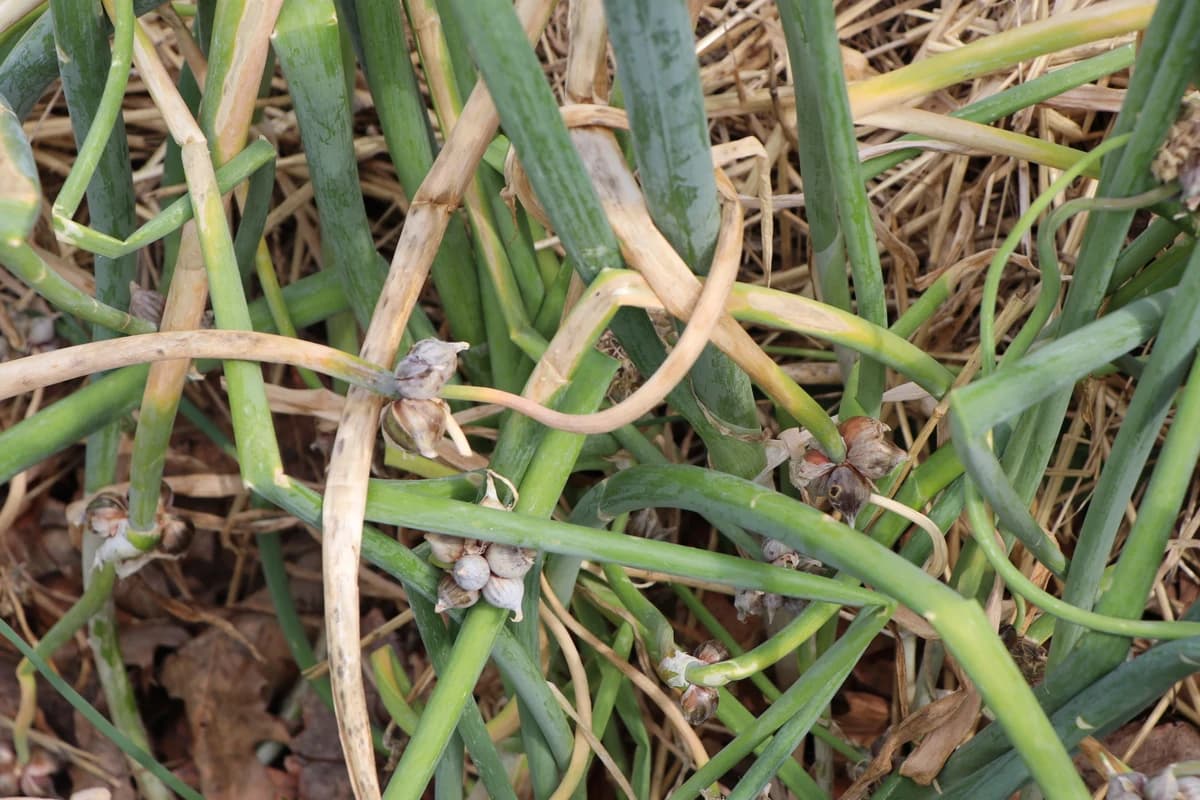
Egyptian walking onion is a cold-hardy perennial topset onion grown for scallion-like leaves, basal offsets, and edible aerial bulbils. Unlike seed-grown bulb onions, it is maintained mostly by vegetative division: top bulbils bend to the ground, root, and form new clumps. It fits outdoor perennial beds, containers, and greenhouse or hydroponic greens production when drainage and root oxygen are managed carefully.
How to Grow Egyptian Walking Onion
Learn how to grow Egyptian Walking Onion from seed to harvest in 90 days. Beginner difficulty. Complete nutrient guide, pH/EC requirements, and growing conditions for hydroponics, soil & greenhouse.
Sources cited: 7.
Nutrient Requirements by Growth Stage
Use moderate onion-style fertility rather than heavy late nitrogen. The hydroponic onion trial found half-strength modified Hoagland solution at pH 6.5 produced biomass comparable to stronger solutions, with solution composition of about 84 ppm N, 31 ppm P, and 117 ppm K for half-strength Hoagland…
Sign in to view nutrient requirements
A free account unlocks NPK targets for all four growth stages, micronutrient levels, a per-stage nutrient calculator, and the full nutrition guide. Signing up takes one click. Truleaf is a free, non-profit project, and every new account helps it grow. No spam, ever.
Growing Environments
Egyptian walking onion fits outdoor perennial beds, containers, greenhouses, and indoor hydroponic greens systems. Outdoors, it behaves as a hardy perennial clump and is especially useful where early spring allium greens are wanted…
Temperature
Egyptian walking onion should be managed as a cool-season perennial Allium rather than a warm-season crop. Onion seed can germinate above about 5C, with best germination near 24C, but this plant is normally started from bulbils or basal offsets instead of seed. For active leaf and offset growth, aim for cool to mild conditions around 15-21C and avoid prolonged root-zone heat above 27C. Established outdoor clumps tolerate frost and resume growth early in spring, while greenhouse and hydroponic plants perform best with solution temperatures near 18-22C.
Humidity
Keep relative humidity moderate, about 45-70%, with a 60% target in indoor and greenhouse systems. The Wisconsin allium guide emphasizes curing and drying with good air circulation, while disease sections link wet foliage and humid canopies with foliar problems in Alliums…
Light
Give full sun outdoors or about 250-400 PPFD indoors, targeting roughly 14 mol m-2 d-1 DLI for steady greens production. University of Minnesota notes that onions require full sun for best growth and that bunching onions, including Egyptian walking onions, are grown for green stalks…
Airflow
Maintain gentle continuous airflow around the hollow leaves, especially in greenhouse, indoor, and dense perennial clumps. Air movement shortens leaf wetness periods, helps suppress downy mildew and Botrytis, and is also important during postharvest curing of bulbils or offsets…
Sign in to view environmental requirements
A free account unlocks exact temperature, humidity, light and airflow targets, including germination and growth ranges, DLI, photoperiod and PPFD, plus the full environment guide. Signing up takes one click. Truleaf is a free, non-profit project, and every new account helps it grow. No spam, ever.
Hydroponic System Compatibility
All major hydroponic systems are usable, but system choice changes the harvest target. DWC, Kratky, and NFT are best for short-cycle greens from bulbils or divided offsets if crowns stay dry and roots have oxygen…
Growing Media
Use a well-drained, fertile medium with good organic matter. University of Minnesota recommends well-drained soil with pH 6.0-7.0 for onions, and Utah State gives a similar onion pH range of 6.0-7.8…
Container Specs
Use a container at least 20 cm deep and 30 cm wide for a small perennial clump. Onion and Allium roots are fibrous and shallow, so depth demand is modest, but drainage is non-negotiable…
Training & Support
No trellis, cage, stake, pruning system, topping, or formal training is required. The bending scape is part of the plant's normal propagation strategy: aerial bulbils make the stem top-heavy, the stem bends, and new plants root away from the original clump…
Sign in to view system compatibility
A free account unlocks why each of the six systems fits or fails, plus growing media, container sizes, training methods, companion plants, and the full systems guide. Signing up takes one click. Truleaf is a free, non-profit project, and every new account helps it grow. No spam, ever.
Propagation
Propagate Egyptian walking onion from aerial bulbils or lower offsets. The UF/IFAS tree onion guide states that the plant bears bulbils instead of flowers and seeds and recommends starting plants from top bulblets or lower offsets, barely covering sets and spacing plants 3-6 inches within rows…
Harvesting
Harvest can be continuous because the plant regrows from perennial basal offsets. Cut green leaves when they are at least usable scallion size, leaving the basal plate and inner growth intact…
Planting Calendar
Do not schedule this plant like a seed onion. Plant bulbils or divided lower offsets in early spring as soon as soil can be worked, or in early fall so roots establish before winter…
Common Issues
The highest-confidence pest issue is onion thrips, which causes silvery streaking and worsens in hot dry weather. Onion maggot can kill seedlings or new offsets by tunneling into basal tissue, especially where Alliums are replanted near old debris…
Get the full science-backed guide
By signing up, you help keep Truleaf free and support the growth of our nonprofit project. Your account unlocks full details for every plant issue—including symptoms, causes, step-by-step solutions, and prevention—plus the month-by-month planting calendar, the complete guide, and all research sources. It only takes one click. No spam, ever.