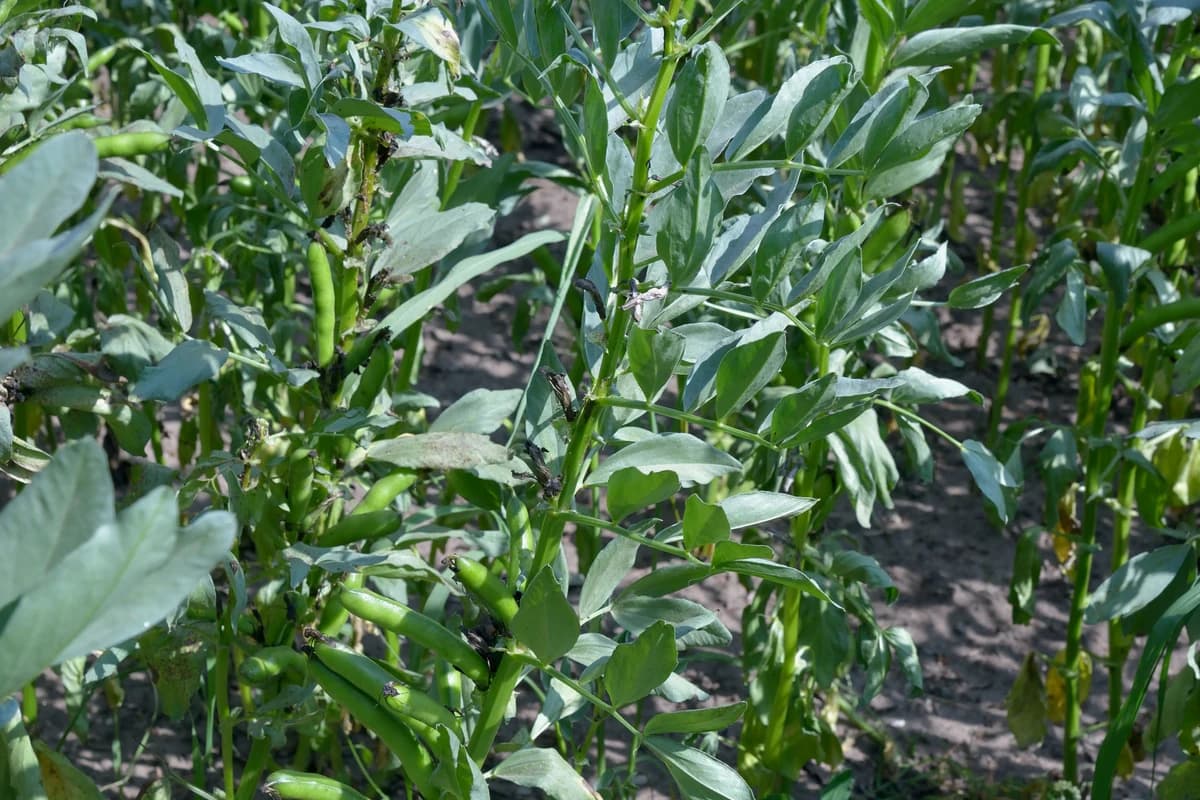
About This Plant
Fava bean (Vicia faba), also called broad bean, is a cool-season legume grown for fresh pods, green shell beans, dry seed, forage, and cover-crop nitrogen fixation. It performs best in mild weather, neutral to alkaline loams, and steady moisture, with heat during flowering being the main yield risk.
How to Grow Fava Bean (Broad Bean)
Learn how to grow Fava Bean (Broad Bean) from seed to harvest in 120 days. Intermediate difficulty. Complete nutrient guide, pH/EC requirements, and growing conditions for hydroponics, soil & greenhouse.
Sources cited: 17.
Nutrient Requirements by Growth Stage
Fava bean nutrition should be built around inoculation and soil-test correction, not high routine N. Well-nodulated crops fix much of their nitrogen, and reviews note that only small starter N may help nodulation while excess N can suppress it…
Sign in to view nutrient requirements
A free account unlocks NPK targets for all four growth stages, micronutrient levels, a per-stage nutrient calculator, and the full nutrition guide. Signing up takes one click. Truleaf is a free, non-profit project, and every new account helps it grow. No spam, ever.
Growing Environments
Fava bean is strongest outdoors in cool-season beds or fields, but greenhouse, indoor, and container production are possible when temperature, light, airflow, and pollination are managed. It prefers deep loams or clay/silt soils with steady moisture and pH roughly 6.5-9.0; it tolerates waterlogging better than many…
Temperature
Fava bean is a cool-season crop. Germination can begin in very cool soil, but reliable establishment is best around 15.5-18.3C and becomes unreliable below about 4C or above about 24C. Keep active growth and especially flowering or pod set near 15-20C; flowers can abort above about 27C, and hot dry podding weather sharply reduces yield.
Humidity
No source defines a fava-specific RH optimum, so humidity should be treated as protected-culture operating guidance. Target about 50-70% RH indoors or in greenhouses, keep leaves dry, and avoid condensation…
Light
Outdoors, grow fava bean in full sun with at least 6 hours of direct light and preferably a longer cool-season day. For indoor crops, 12-16 hours of broad-spectrum light at about 300-500 umol/m2/s is a practical target; 360 PPFD for 14 hours supplies roughly 18 mol/m2/day DLI…
Airflow
Use gentle continuous canopy air movement and real air exchange in enclosed spaces. Ventilation reduces condensation, mixes CO2 around leaves, and lowers the humid boundary layer that favors Botrytis, Ascochyta, rust, and leaf spots…
Sign in to view environmental requirements
A free account unlocks exact temperature, humidity, light and airflow targets, including germination and growth ranges, DLI, photoperiod and PPFD, plus the full environment guide. Signing up takes one click. Truleaf is a free, non-profit project, and every new account helps it grow. No spam, ever.
Hydroponic System Compatibility
Soil and media-based drip are the most defensible controlled systems because they support deep root volume, cool moisture, and tall plants. NFT has direct fava-bean research precedent in pipe hydroponics, but it should be treated as managed or experimental for production…
Growing Media
Use fertile, well-drained but moisture-retentive media. USDA notes fava grows best on well-drained clay, silt, or sandy soils with adequate moisture and pH 6.5-9.0, while Agriculture Victoria prefers deep loams and neutral to alkaline pH 7.0-9.0…
Container Specs
Container growing is feasible but should be sized for an upright legume, not a compact leafy crop. Use one plant in at least a 19 L container with 30 cm or deeper root volume, drainage holes, and a free-draining potting mix…
Training & Support
Fava bean is an erect bush legume rather than a climbing bean, so routine trellising is unnecessary. Support is optional for tall cultivars, high pod load, windy gardens, or container-grown plants…
Sign in to view system compatibility
A free account unlocks why each of the six systems fits or fails, plus growing media, container sizes, training methods, companion plants, and the full systems guide. Signing up takes one click. Truleaf is a free, non-profit project, and every new account helps it grow. No spam, ever.
Propagation
Propagate fava bean by seed. Direct sowing is standard because the large seeds establish quickly and tolerate cool early-season conditions; transplanting is possible for protected or overwintered production but is not the normal field method…
Harvesting
Harvest depends on the use. For fresh pods or green shell beans, pick repeatedly when pods are full and seeds are still tender, commonly about 90-120 days after spring planting…
Planting Calendar
Schedule fava bean so flowering and pod fill occur in cool weather. In many cool-temperate regions, sow early spring as soon as fields can be worked; in mild-winter areas, sow late summer or fall for overwintering and spring harvest…
Common Issues
The verified issue set is broader than the original record. Chocolate spot is a major Botrytis disease favored by cool humid weather, dense crops, and flowering-stage wetness…
Get the full science-backed guide
By signing up, you help keep Truleaf free and support the growth of our nonprofit project. Your account unlocks full details for every plant issue—including symptoms, causes, step-by-step solutions, and prevention—plus the month-by-month planting calendar, the complete guide, and all research sources. It only takes one click. No spam, ever.