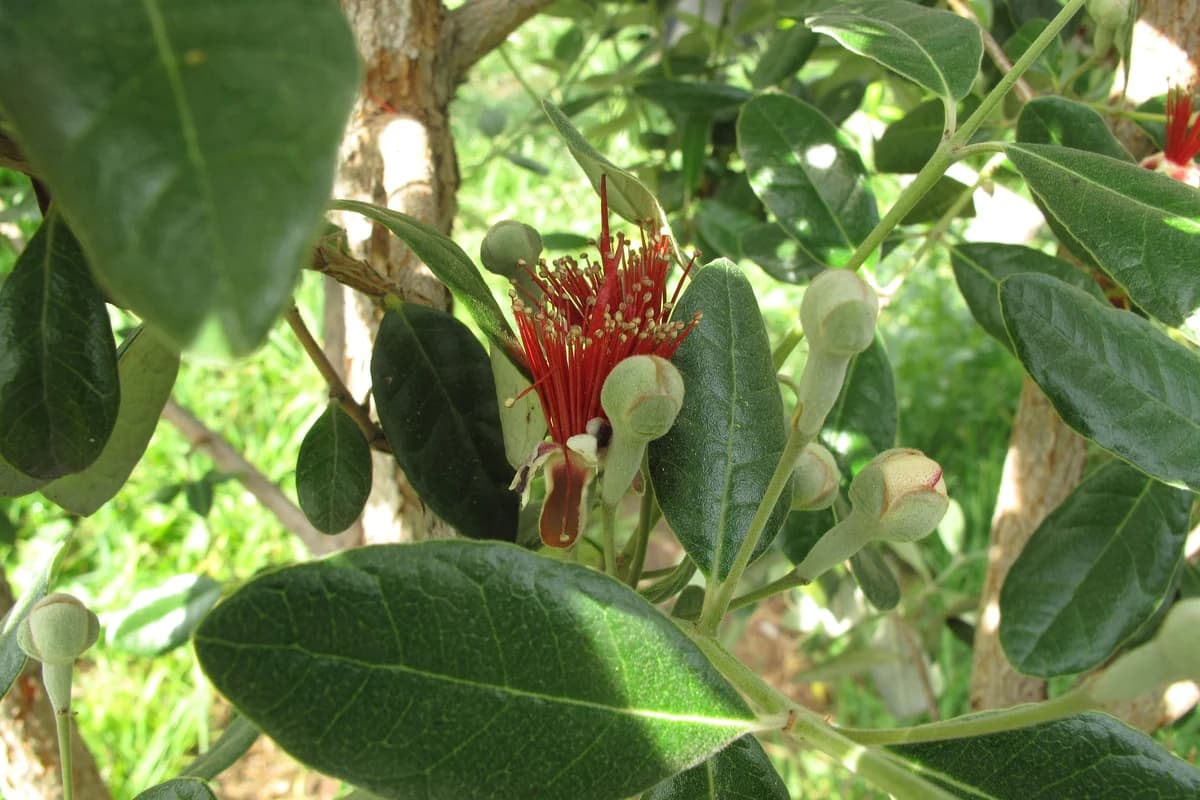
About This Plant
Feijoa, also known as pineapple guava, is a cool-subtropical evergreen shrub or small tree grown for aromatic green fruit and edible flowers. It tolerates drought, salt, and light frost once established, but best fruit quality comes from full sun, well-drained slightly acidic soil, steady moisture during bloom and fruit fill, and careful harvest handling because ripe fruit bruises easily.
How to Grow Feijoa (Pineapple Guava)
Learn how to grow Feijoa (Pineapple Guava) from seed to harvest in 730 days. Intermediate difficulty. Complete nutrient guide, pH/EC requirements, and growing conditions for soil & container.
Sources cited: 14.
Nutrient Requirements by Growth Stage
Direct feijoa hydroponic stage ppm is sparse. One complete nutrient solution for nine-month-old potted feijoa in quartz sand supplied approximately N 221, P 30, and K 240 mg/L, which supports the current vegetative NPK baseline but not flowering or fruiting ppm targets…
Sign in to view nutrient requirements
A free account unlocks NPK targets for all four growth stages, micronutrient levels, a per-stage nutrient calculator, and the full nutrition guide. Signing up takes one click. Truleaf is a free, non-profit project, and every new account helps it grow. No spam, ever.
Growing Environments
Feijoa is best as an outdoor or greenhouse fruit shrub, and it can be container-grown where winter protection or patio culture is needed. NC State lists it as a shrub/tree suitable for coastal, container, and patio locations, with full sun to partial shade and USDA zones 8a-10b…
Temperature
Feijoa is a cool-subtropical fruit tree rather than a hot tropical guava. UF/IFAS reports tree injury is likely below 20F and fruit injury below 28F, while UC ANR notes survival around 15F. Chilling is needed for flower bud initiation, with current estimates around 50-200 hours depending on cultivar and region. For active growth, keep plants roughly 10-30C with a 22C target; pollination and fruit set decline when temperatures exceed 32C with low humidity, and fruit heat damage can occur above 38C. Brazilian phenology work estimated reproductive base temperatures near 10.6-19.5C from sprouting to harvest, supporting mild rather than hot production conditions.
Humidity
Target moderate humidity around 50-70% for protected cultivation. The current 50-70% range is consistent with the farm-management review, which reports that feijoa can tolerate high rainfall only where light is good and relative humidity stays near 70%…
Light
Feijoa fruits best in full sun but tolerates light shade. NC State Extension lists full sun and partial shade as acceptable, while the Agronomy review recommends direct solar exposure of at least 1500 hours per year and notes that nursery and orchard plants should be grown in full sun or up to 30% shade…
Airflow
Airflow is a disease-management requirement for feijoa, especially in greenhouses and dense container canopies. The crop is vulnerable to anthracnose, Botrytis, postharvest rots, and root or basal stem rots under wet conditions…
Sign in to view environmental requirements
A free account unlocks exact temperature, humidity, light and airflow targets, including germination and growth ranges, DLI, photoperiod and PPFD, plus the full environment guide. Signing up takes one click. Truleaf is a free, non-profit project, and every new account helps it grow. No spam, ever.
Hydroponic System Compatibility
The current profile's DWC and NFT suitability is not supported for mature feijoa. Species guidance describes a woody shrub or small tree, 2-4 m high in UC ANR and 10-15 ft in NC State, requiring spacing, pruning, and a stable root zone…
Growing Media
Use a well-drained, organic-rich, slightly acidic medium. UC ANR states feijoa prefers well-drained sandy loam with high humus content, while the Agronomy review specifies slightly acidic soil at pH 6.0-6.5 and high organic matter…
Container Specs
Feijoa can be container-grown, but it is still a woody fruit shrub rather than a small hydroponic vegetable. NC State lists container and patio use and gives mature dimensions of 10-15 ft high with 5-6 ft width in its region…
Training & Support
Feijoa does not need a trellis, but it benefits from structural pruning. UC ANR recommends a single stem with three to four main branches as a training system…
Sign in to view system compatibility
A free account unlocks why each of the six systems fits or fails, plus growing media, container sizes, training methods, companion plants, and the full systems guide. Signing up takes one click. Truleaf is a free, non-profit project, and every new account helps it grow. No spam, ever.
Propagation
Feijoa can be propagated from seed, but seedlings are variable and slow; cultivar plants should be cloned. UF/IFAS propagation data list seed as the primary method, with moderate moisture, 75-80F (24-27C), and about 3-4 weeks to germination…
Harvesting
Feijoa maturity is hard to judge visually because fruit remain green. UC ANR recommends harvest in California from October to December, collecting fruit that falls when mature or picking light-green fruit gently to avoid bruising…
Planting Calendar
Calendar timing is climate dependent. In California, UC ANR lists fruit harvest from October through December…
Common Issues
The most important verified issues are postharvest damage, fruit rots, leaf spot, root-zone disease, nutritional imbalance, heat stress, and occasional pests. The farm-management review identifies anthracnose caused by Colletotrichum as the main disease, with Botrytis, Phytophthora, Pythium, and Rosellinia also…
Get the full science-backed guide
By signing up, you help keep Truleaf free and support the growth of our nonprofit project. Your account unlocks full details for every plant issue—including symptoms, causes, step-by-step solutions, and prevention—plus the month-by-month planting calendar, the complete guide, and all research sources. It only takes one click. No spam, ever.