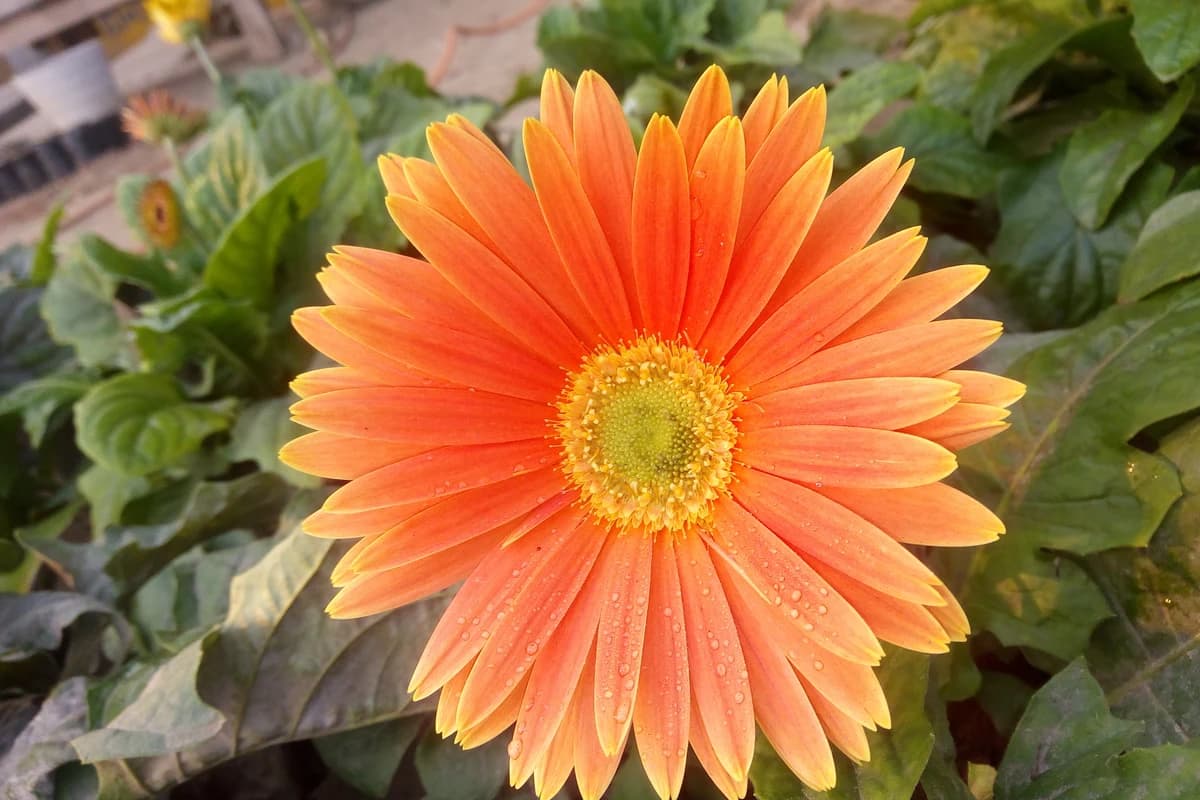
About This Plant
Gerbera daisy is a South African perennial ornamental grown for bright, long-stemmed blooms in containers, gardens, and greenhouse cut-flower systems. It performs best in sharply drained media, steady mild temperatures, careful crown moisture management, and balanced fertigation.
How to Grow Gerbera Daisy
Learn how to grow Gerbera Daisy from seed to harvest in 90 days. Intermediate difficulty. Complete nutrient guide, pH/EC requirements, and growing conditions for soil & container.
Sources cited: 11.
Nutrient Requirements by Growth Stage
The current active-production NPK center is confirmed: Şirin found the best Gerbera yield and quality in peat-perlite substrate with 150 ppm N, 31 ppm P, 234 ppm K, plus 100 ppm Ca and 30 ppm Mg. Zheng used a commercial potted-Gerbera solution with 178 ppm total N, 1.2 mM P, and 5.5 mM K, and showed final-stage…
Sign in to view nutrient requirements
A free account unlocks NPK targets for all four growth stages, micronutrient levels, a per-stage nutrient calculator, and the full nutrition guide. Signing up takes one click. Truleaf is a free, non-profit project, and every new account helps it grow. No spam, ever.
Growing Environments
Gerbera is suitable for containers, mild outdoor beds, and greenhouse benches. UF/IFAS specifically supports containers and Central/South Florida perennial bedding use, while greenhouse studies document potted subirrigation, perlite fertigation, and peat-perlite substrate culture…
Temperature
Gerbera performs best under mild greenhouse temperatures rather than heat or cold extremes. Controlled production work used day/night setpoints of 23/19 C, while postharvest production studies describe 17-28 C day and 14-18 C night as favorable for quality cut flowers. Use about 20-22 C for germination and 18-24 C as the practical growth target; protect crowns from freezes and avoid sustained hot humid conditions that raise disease pressure.
Humidity
Use moderate humidity with enough airflow for leaves and flower heads to dry quickly. Zheng et al…
Light
Gerbera tolerates full sun to part sun outdoors, with UF/IFAS recommending morning sun and afternoon shade in warm Florida gardens. Greenhouse cut-flower research used a 14-hour photoperiod with supplemental lighting for marketable flowers…
Airflow
Airflow is essential because Gerbera flowers, petioles, and crowns are vulnerable when moisture lingers. Penn State recommends spacing plants for good air circulation, maintaining low humidity, and avoiding late-day or overhead watering to limit Botrytis and leaf spot diseases…
Sign in to view environmental requirements
A free account unlocks exact temperature, humidity, light and airflow targets, including germination and growth ranges, DLI, photoperiod and PPFD, plus the full environment guide. Signing up takes one click. Truleaf is a free, non-profit project, and every new account helps it grow. No spam, ever.
Hydroponic System Compatibility
The strongest evidence supports substrate systems: drip fertigated peat-perlite/perlite and recirculating subirrigation or ebb-flow style benches. Keep drip lines or subirrigation cycles tuned so the root zone is moist but the crown dries between irrigations…
Growing Media
Use porous media with fast drainage and enough nutrient buffering. Şirin used a 1:1 perlite and peat mix for the highest-yielding nutrient solution trial, Zheng used 80% Canadian sphagnum peatmoss plus 20% perlite in 1.9 L pots, and Breś grew miniature Gerbera in perlite fertigation systems…
Container Specs
A 15 cm pot is a documented research minimum: Zheng et al. used 1.9 L pots measuring 15 cm diameter by 11 cm high for potted Gerbera subirrigation…
Training & Support
Gerbera does not need trellising because it grows as a basal rosette with individual leafless flower stems. The main support task is cultural: keep crowns exposed, remove old leaves and spent flowers, and stake individual stems only if a cultivar bends before harvest…
Sign in to view system compatibility
A free account unlocks why each of the six systems fits or fails, plus growing media, container sizes, training methods, companion plants, and the full systems guide. Signing up takes one click. Truleaf is a free, non-profit project, and every new account helps it grow. No spam, ever.
Propagation
Gerbera can be propagated by seed, division, and clonal tissue-culture-derived liners. UF/IFAS notes that plants are available as potted plants, pass-along divisions, and seed-grown plants, and gives division timing for Florida regions…
Harvesting
Harvest Gerbera primarily as a cut flower when blooms are open and stems are firm, then move stems into clean water quickly. Postharvest research shows vase life varies by cultivar and season, and Tonooka et al…
Planting Calendar
In temperate outdoor production, start seed indoors in late winter and transplant after frost, or plant clonal liners once soil and nights are mild. Greenhouse Gerbera can be scheduled year-round; potted production research used 4 weeks overhead fertigation followed by 4-5 weeks subirrigation until market stage…
Common Issues
Major verified risks are powdery mildew, Botrytis blight, leaf spots, crown/root rots, micronutrient chlorosis under high pH, greenhouse insects, and postharvest stem bending. Penn State lists Alternaria, Pseudomonas leaf spot, Botrytis, Fusarium, Pythium, Phytophthora, Rhizoctonia, and several viruses on Gerbera,…
Get the full science-backed guide
By signing up, you help keep Truleaf free and support the growth of our nonprofit project. Your account unlocks full details for every plant issue—including symptoms, causes, step-by-step solutions, and prevention—plus the month-by-month planting calendar, the complete guide, and all research sources. It only takes one click. No spam, ever.