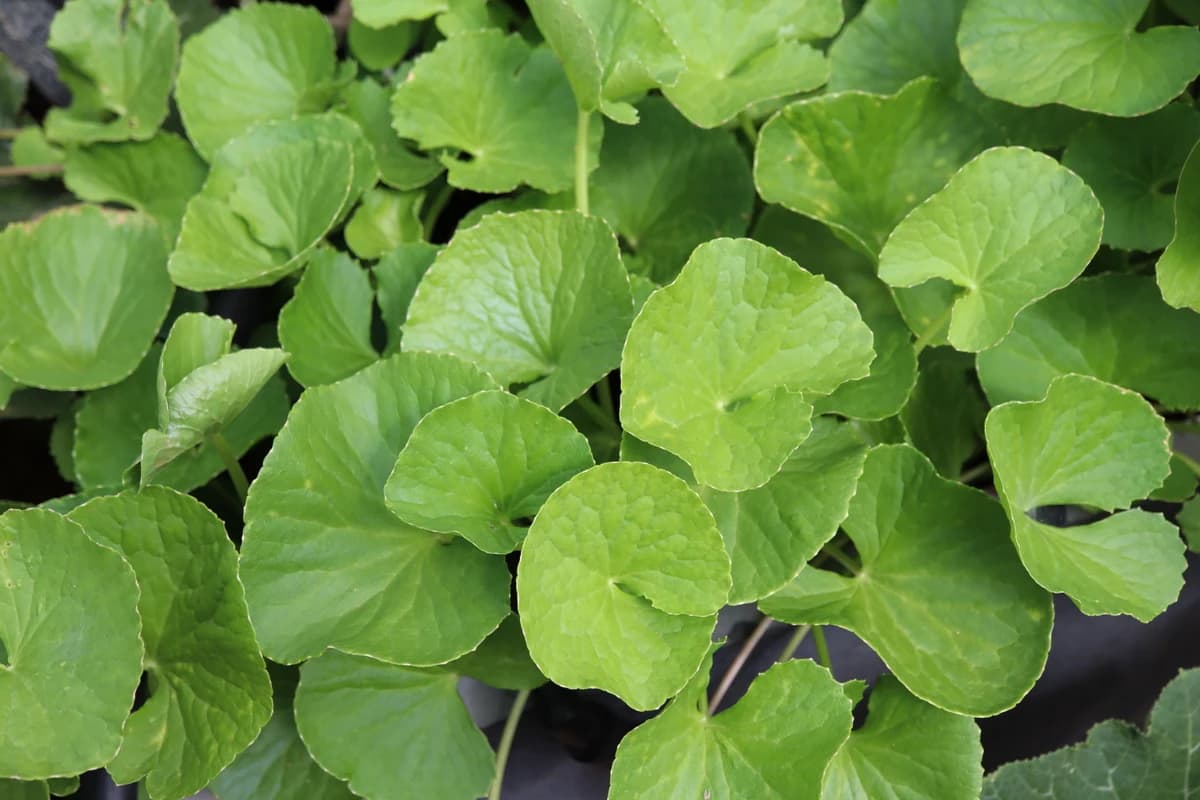
About This Plant
Gotu kola is a creeping tropical medicinal herb grown for edible leaves and centelloside-rich shoots. It performs best in warm, humid, constantly moist systems, with clean hydroponic or container culture preferred where raw material quality matters.
How to Grow Gotu Kola
Learn how to grow Gotu Kola from seed to harvest in 45 days. Intermediate difficulty. Complete nutrient guide, pH/EC requirements, and growing conditions for hydroponics, soil & greenhouse.
Sources cited: 10.
Nutrient Requirements by Growth Stage
The most direct hydroponic evidence supports a low-to-moderate leafy-herb solution rather than aggressive feeding. In the EC trial, plantlets acclimated at EC 0.2, then treatments from 0.6 to 2.4 dS/m were compared; the strongest growth response was at EC 1.2 with pH maintained at 5.6-6.1…
Sign in to view nutrient requirements
A free account unlocks NPK targets for all four growth stages, micronutrient levels, a per-stage nutrient calculator, and the full nutrition guide. Signing up takes one click. Truleaf is a free, non-profit project, and every new account helps it grow. No spam, ever.
Growing Environments
Gotu kola can be grown outdoors, in containers, greenhouses, and indoor hydroponic systems. Extension describes it as a tropical to subtropical perennial for moist to wet but well-drained sites, including containers in cooler regions…
Temperature
Grow gotu kola warm. Controlled hydroponic trials maintained 25 ± 3C, while a greenhouse and LED study used 25 ± 2C in rooms and 30/24C day/night under natural light. Seed work found useful germination from older seed in a warm 25-30C environment, so seedling starts should stay warmer than most cool-season herbs. Avoid chilling; this is a tropical to subtropical perennial rather than a frost-hardy groundcover.
Humidity
Maintain moderate-high humidity, but keep air moving. NFT and LED trials used 65 ± 5% RH, while the controlled-environment nutrient/light study held 60 ± 2% RH under LED chambers…
Light
Use moderate light for biomass and higher light only when centelloside concentration is the goal. A 2025 NFT study found best shoot growth at 150 PPFD, with 300 PPFD increasing key centellosides but reducing some growth traits…
Airflow
Gotu kola likes humidity, but dense mats need gentle airflow. Hydroponic smart-farm work used ventilation fans, humidifiers, and air conditioning to stabilize a greenhouse system, while DFT beds used compressors to add oxygen to the nutrient solution…
Sign in to view environmental requirements
A free account unlocks exact temperature, humidity, light and airflow targets, including germination and growth ranges, DLI, photoperiod and PPFD, plus the full environment guide. Signing up takes one click. Truleaf is a free, non-profit project, and every new account helps it grow. No spam, ever.
Hydroponic System Compatibility
NFT and DFT are the best-supported hydroponic systems. The EC and white-LED studies used NFT tanks with 15 L recirculating nutrient solution, while the 2025 smart-farm study built a multi-tier DFT greenhouse with active circulation and aeration…
Growing Media
Use media that hold water but still provide oxygen. NCSU Extension lists moist to wet but well-drained soils, while the production review describes natural success in moist sandy or clayey soils and says drier soils can work if watered regularly…
Container Specs
Use shallow, wide containers because gotu kola grows as a creeping, stoloniferous mat rather than a deep-rooted upright plant. A controlled-environment study used long shallow PP pots, 35 x 150 x 20 cm, and planted at 15 x 15 cm spacing in perlite troughs…
Training & Support
No structural training support is required. Gotu kola is a low, prostrate groundcover that spreads through creeping stolons…
Sign in to view system compatibility
A free account unlocks why each of the six systems fits or fails, plus growing media, container sizes, training methods, companion plants, and the full systems guide. Signing up takes one click. Truleaf is a free, non-profit project, and every new account helps it grow. No spam, ever.
Propagation
Vegetative starts are the most dependable route for uniform production. Hydroponic studies multiplied seedlings or plantlets through stolon propagation before transplanting uniform 4-5 leaf plantlets into NFT or DFT systems…
Harvesting
Harvest gotu kola as a recurring leaf-and-stolon crop. The older hydroponic establishment paper reported maximum dry matter around day 42 and highlighted a 40-45 day cycle for biomass and centellosides…
Planting Calendar
For outdoor temperate scheduling, start indoors in late winter or spring and transplant only after warm nights are stable. Direct sowing should wait until soils are warm because seed germination is favored at 25-30C and fresh seed can remain dormant…
Common Issues
The main risks are root-zone stagnation, fungal wilt, leaf-spot complexes, and small sap-feeding pests. Extension specifically warns that root rot can occur in poorly drained soils…
Get the full science-backed guide
By signing up, you help keep Truleaf free and support the growth of our nonprofit project. Your account unlocks full details for every plant issue—including symptoms, causes, step-by-step solutions, and prevention—plus the month-by-month planting calendar, the complete guide, and all research sources. It only takes one click. No spam, ever.