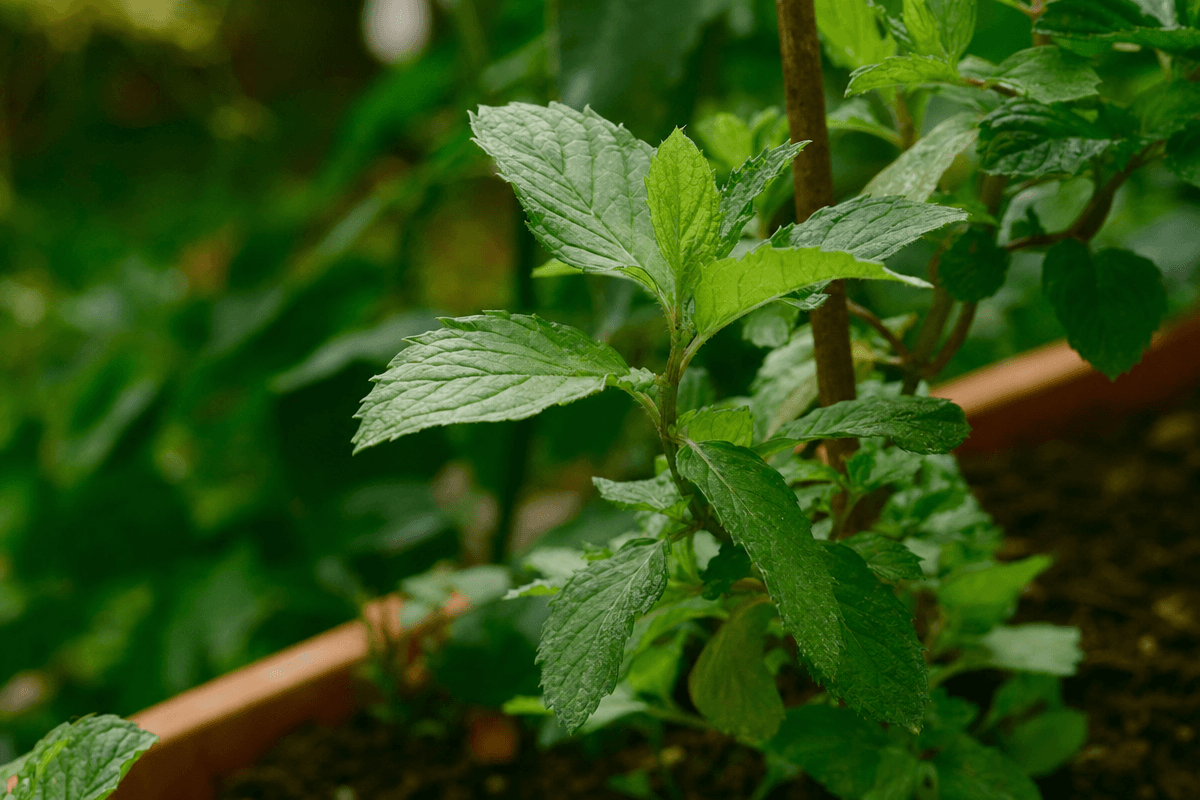
About This Plant
Mint is a vigorous aromatic herb grown for leafy shoots and repeated harvests, responding well to steady moisture, moderate fertility, and regular pruning.
How to Grow Mint
Learn how to grow Mint from seed to harvest in 60 days. Beginner difficulty. Complete nutrient guide, pH/EC requirements, and growing conditions for hydroponics, soil & greenhouse.
Backed by 23 peer-reviewed citations.
Nutrient Requirements by Growth Stage
Mint thrives in standard hydroponic nutrient solutions at moderate concentrations (EC 1.6-2.4 mS/cm). A full-strength Hoagland solution (N 210, P 31, K 234, Ca 200, Mg 48, S 64 mg/L) supports vigorous growth in Japanese mint…
Sign in to view nutrient requirements
A free account unlocks NPK targets for all four growth stages, micronutrient levels, a per-stage nutrient calculator, and the full nutrition guide. Signing up takes one click. Truleaf is a free, non-profit project, and every new account helps it grow. No spam, ever.
Growing Environments
Mint is highly adaptable and thrives indoors, outdoors, in greenhouses, and in containers. Indoor controlled environments produced the highest essential oil and vitamin content in comparative studies…
Temperature
Mint (Mentha spp.) grows optimally at 18-24C, with a sweet spot around 22C for vegetative biomass. Germination requires 18-25C, with fastest emergence at 22-24C. Growth slows significantly above 25C, and temperatures exceeding 30C can trigger heat stress, reducing yield and essential oil content — Heydari et al. (2018) documented significant yield reduction at 26-40C. Night temperatures of 14-15C are well-tolerated and may enhance essential oil accumulation. Established plants are remarkably cold-hardy, surviving to -40C in USDA zones 3-9 through rhizome dormancy, but active growth ceases below 15C.
Humidity
Mint performs well at 50-70% relative humidity, with 60% as the optimal target. Heydari et al…
Light
Mint requires a daily light integral (DLI) of 12-17 mol/m2/d for robust indoor growth, with 14 mol/m2/d recommended as a balanced target. Optimal PPFD ranges from 200-400 umol/m2/s, with 300 umol/m2/s providing a good balance of growth and energy efficiency…
Sign in to view environmental requirements
A free account unlocks exact temperature, humidity, light and airflow targets, including germination and growth ranges, DLI, photoperiod and PPFD, plus the full environment guide. Signing up takes one click. Truleaf is a free, non-profit project, and every new account helps it grow. No spam, ever.
Hydroponic System Compatibility
Mint performs well across all major hydroponic systems. NFT is widely considered the best fit, producing the highest yields in vertical A-type configurations (0.35 kg/plant) due to constant water and oxygen availability…
Growing Media
For hydroponic mint, clay pebbles (LECA) and coco coir are preferred media. Clay pebbles offer excellent drainage, reusability, and root support in DWC and ebb-and-flow systems…
Container Specs
For container-grown mint, use pots at least 25 cm deep and 25-30 cm in diameter. USU Extension recommends containers extending 25-38 cm below soil surface to contain rhizomes…
Training & Support
Mint requires no training or support structures. It is a low-growing perennial (30-90 cm tall) that spreads horizontally via underground stolons and above-ground runners…
Sign in to view system compatibility
A free account unlocks why each of the six systems fits or fails, plus growing media, container sizes, training methods, companion plants, and the full systems guide. Signing up takes one click. Truleaf is a free, non-profit project, and every new account helps it grow. No spam, ever.
Propagation
Mint is overwhelmingly propagated by vegetative means — stolons, stem cuttings, and division — rather than seed. Peppermint (M…
Harvesting
Mint is a quintessential cut-and-come-again herb that regrows vigorously after proper harvesting. Cut stems just above a leaf node using sharp scissors, leaving at least two pairs of leaves below the cut; each cut node produces two new branches, yielding progressively bushier plants…
Planting Calendar
Mint's planting calendar depends on propagation method. For seed starting (hobby only), sow indoors 8-10 weeks before the last frost, surface-sowing on moist compost at 20C and covering with plastic to maintain humidity…
Common Issues
Mint is susceptible to several serious diseases requiring vigilant monitoring. Mint rust (Puccinia menthae) is one of the most economically damaging, producing bright orange to brown pustules on leaf undersides and causing defoliation; eleven races are known in the Pacific Northwest…
Get the full science-backed guide
By signing up, you help keep Truleaf free and support the growth of our nonprofit project. Your account unlocks full details for every plant issue—including symptoms, causes, step-by-step solutions, and prevention—plus the month-by-month planting calendar, the complete guide, and all research sources. It only takes one click. No spam, ever.