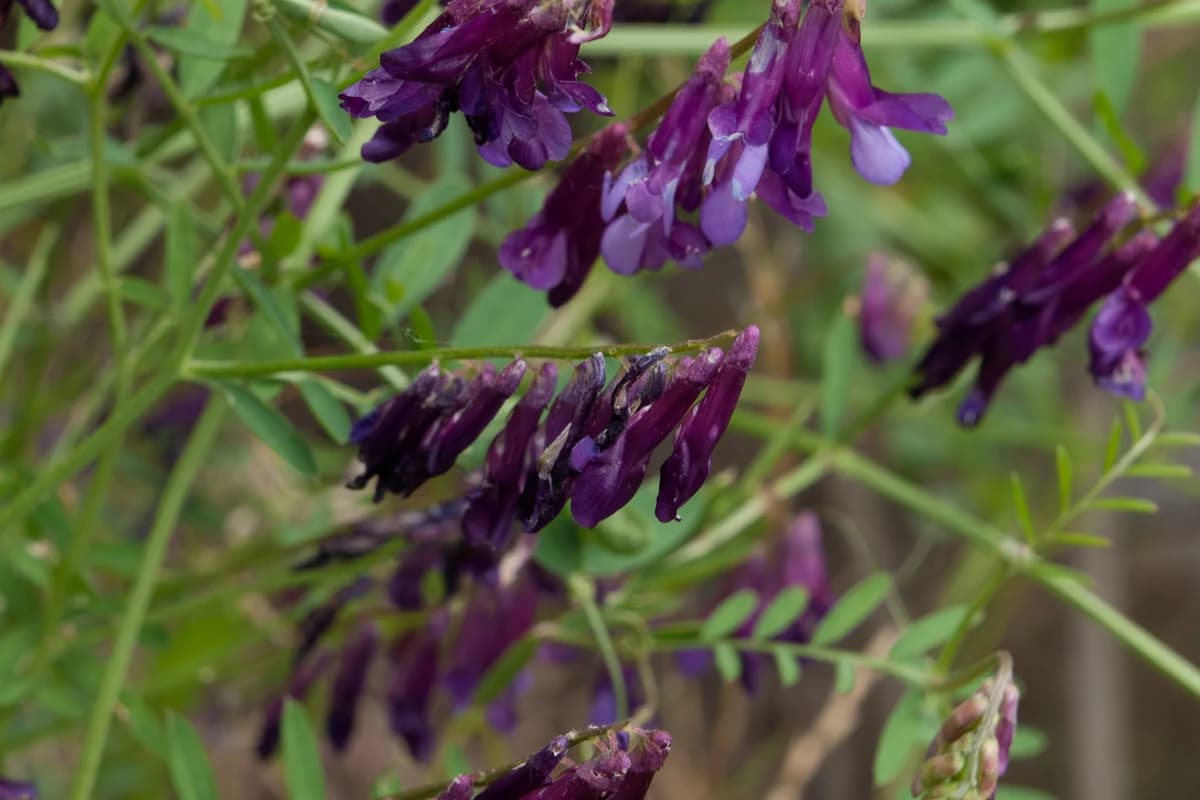
About This Plant
Hairy vetch is a cool-season annual or biennial legume grown mainly as a cover crop, green manure, forage, soil conditioner, and nitrogen source for following crops. It establishes by direct seed, fixes nitrogen through Rhizobium nodules when properly inoculated, and is usually terminated before or during bloom rather than managed as an edible fruiting crop.
How to Grow Hairy Vetch
Learn how to grow Hairy Vetch from seed to harvest in 220 days. Beginner difficulty. Complete nutrient guide, pH/EC requirements, and growing conditions for soil & container.
Sources cited: 13.
Nutrient Requirements by Growth Stage
Stage-specific hydroponic NPK ppm targets for hairy vetch were not found. The defensible nutrition model is soil-test based: well-nodulated hairy vetch generally does not need fertilizer nitrogen, but it needs compatible Rhizobium, adequate phosphorus, potassium, sulfur, and pH near 6.0-7.0…
Sign in to view nutrient requirements
A free account unlocks NPK targets for all four growth stages, micronutrient levels, a per-stage nutrient calculator, and the full nutrition guide. Signing up takes one click. Truleaf is a free, non-profit project, and every new account helps it grow. No spam, ever.
Growing Environments
Hairy vetch is best represented as an outdoor or greenhouse soil/media crop, not as an indoor production plant. Sources describe it as a field cover crop, green manure, forage, pasture component, erosion-control crop, and soil conditioner…
Temperature
Hairy vetch is a cool-season winter annual legume. USDA NRCS gives the optimum germination temperature as 15-23C, and Iowa guidance lists about 16C as the minimum soil temperature for germination. Controlled germination work found high final germination from 5-30C, fastest around 20C and 15/25C, but poor performance when the warm cycle reached 35C. For active growth and nitrogen fixation, use cool-to-mild conditions: 20-25C works in controlled seedling studies, while cold reduces biomass and biological N fixation even though the crop can overwinter.
Humidity
No complete source gives a hairy-vetch relative-humidity optimum. The verified requirement is moisture balance: seed needs moisture and good seed-to-soil contact for establishment, but the crop prefers well-drained soil and disease pressure rises in cool, wet, dense canopies…
Light
Hairy vetch is normally managed in open-field cover-crop, forage, orchard, and roadside systems, often in mixtures with cereal rye or other small grains. It tolerates some competition and shade in mixed stands, but high light supports spring biomass and nitrogen accumulation…
Airflow
No source provides a numeric airflow target for hairy vetch, but sources consistently support canopy drying and rotation as disease prevention. USDA NRCS and Mississippi State list anthracnose, leaf spot, downy mildew, stem and root rots, and rust, while Wisconsin notes vetch diseases and pest problems increase in…
Sign in to view environmental requirements
A free account unlocks exact temperature, humidity, light and airflow targets, including germination and growth ranges, DLI, photoperiod and PPFD, plus the full environment guide. Signing up takes one click. Truleaf is a free, non-profit project, and every new account helps it grow. No spam, ever.
Hydroponic System Compatibility
Current mature hydroponic suitability claims for DWC, NFT, aeroponics, ebb-flow, drip hydroponics, and Kratky are unsupported. The only nutrient-solution evidence found was short-term seedling or pot research, such as modified Hoagland solution under low-phosphorus stress; that does not validate production hydroponics…
Growing Media
Use well-drained soil as the preferred medium. USDA NRCS says hairy vetch prefers soil pH 6.0-7.0 and can survive about pH 5.0-7.5, while Cornell emphasizes a well-drained seedbed, avoidance of compaction, and high P and K requirements…
Container Specs
No complete source gives a pot size for hairy vetch. Container specifications are therefore conservative translations from the plant habit: USDA NRCS reports a taproot up to about 90 cm and weak vining stems that use tendrils for support…
Training & Support
Hairy vetch does not need horticultural staking or pruning, but it does benefit from agronomic support in mixtures. USDA NRCS says small grains such as rye, triticale, oats, wheat, or barley protect young seedlings and support the viny stems…
Sign in to view system compatibility
A free account unlocks why each of the six systems fits or fails, plus growing media, container sizes, training methods, companion plants, and the full systems guide. Signing up takes one click. Truleaf is a free, non-profit project, and every new account helps it grow. No spam, ever.
Propagation
Propagate hairy vetch by direct seeding. USDA NRCS recommends drilling or broadcasting in early September to mid-October for many cover-crop systems, inoculating seed with Rhizobium leguminosarum biovar viciae, and placing seed about 0.5-0.75 inch deep with good seed-to-soil contact…
Harvesting
Harvest means different things for hairy vetch. For green manure, terminate before a summer cash crop; NRCS recommends chemical termination 10-14 days before planting, while roller-crimping is most reliable at late bloom…
Planting Calendar
Schedule hairy vetch by climate and goal. Fall cover-crop use commonly starts in late summer to early fall: USDA NRCS gives early September to mid-October, SARE recommends 30-45 days before killing frost, Cornell lists late August to September in New York, and Iowa lists early August to mid-September for fall seeding…
Common Issues
The most important problems are nodulation failure, low phosphorus, wet-canopy diseases, root or stem rots, nematodes, seed pests, volunteer weediness, and grazing toxicity. USDA NRCS and Mississippi State list anthracnose, leaf spot, downy mildew, stem and root rots, rust, pea aphids, cutworms, armyworms,…
Get the full science-backed guide
By signing up, you help keep Truleaf free and support the growth of our nonprofit project. Your account unlocks full details for every plant issue—including symptoms, causes, step-by-step solutions, and prevention—plus the month-by-month planting calendar, the complete guide, and all research sources. It only takes one click. No spam, ever.