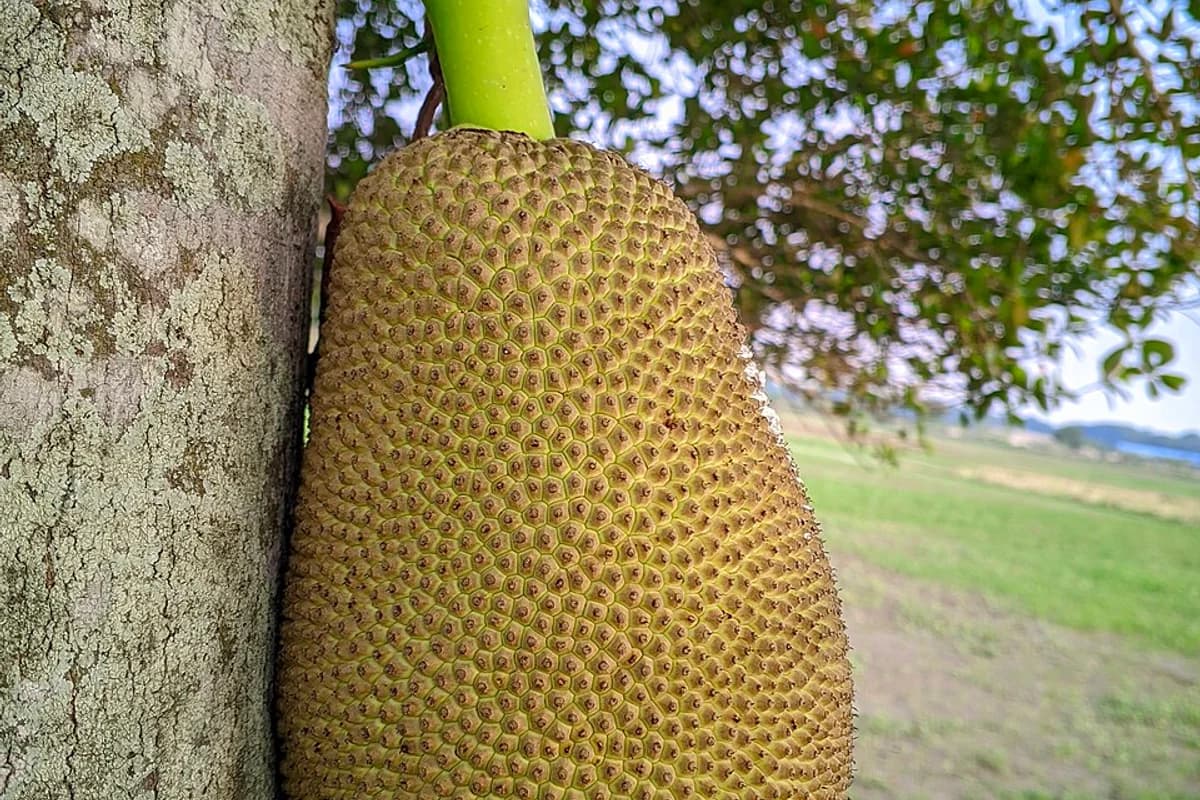
About This Plant
Jackfruit is a large tropical Moraceae fruit tree grown for enormous green cooking fruit, sweet ripe bulbs, edible seeds, and shade. It needs hot humid conditions, full sun, deep drainage, strong pruning discipline, and years of establishment before reliable harvests.
How to Grow Jackfruit
Learn how to grow Jackfruit from seed to harvest in 1275 days. Advanced difficulty. Complete nutrient guide, pH/EC requirements, and growing conditions for soil & container.
Sources cited: 8.
Nutrient Requirements by Growth Stage
Jackfruit nutrition evidence is orchard-based rather than hydroponic. UF/IFAS recommends repeated young-tree applications of 6-6-6, 8-3-9, or slow-release fertilizer with minor elements, then mature-tree feeding from bloom through postharvest pruning…
Sign in to view nutrient requirements
A free account unlocks NPK targets for all four growth stages, micronutrient levels, a per-stage nutrient calculator, and the full nutrition guide. Signing up takes one click. Truleaf is a free, non-profit project, and every new account helps it grow. No spam, ever.
Growing Environments
Jackfruit belongs outdoors in frost-free tropical or protected humid-subtropical sites, or in a greenhouse with enough headroom and root volume. It can be grown in containers while young and is sometimes kept as a patio tree, but normal mature size makes ordinary indoor production unrealistic…
Temperature
Treat jackfruit as a hot humid tropical to humid-subtropical tree. Morton (1987) reports best growth in tropical lowlands up to about 1600 m and notes young trees are killed by frost while mature trees may tolerate brief exposure to about -2 to -3C with damage. Elevitch and Manner (2006) place the optimal mean annual temperature range at 22-35C. UF/IFAS describes best growth in continuously warm USDA 10b-11 areas and recommends cold protection for young trees. The stored 21-32C germination range is plausible but formal cardinal-temperature seed trials for jackfruit have not been published. Active growth range of 24-35C is well supported.
Humidity
Jackfruit is adapted to humid tropics, but wet canopies drive disease risk. The practical target is warm moderate-to-high humidity with fast drying after rain or irrigation…
Light
Plant jackfruit in full sun for best growth and fruit production. Greenhouse or container trees should receive bright light and enough spacing to prevent shading from the large evergreen canopy…
Airflow
Airflow should be created with spacing and selective pruning. UF/IFAS recommends removing upright vigorous shoots, thinning the inner canopy after harvest, and removing old flowering shoots…
Sign in to view environmental requirements
A free account unlocks exact temperature, humidity, light and airflow targets, including germination and growth ranges, DLI, photoperiod and PPFD, plus the full environment guide. Signing up takes one click. Truleaf is a free, non-profit project, and every new account helps it grow. No spam, ever.
Hydroponic System Compatibility
Full-cycle DWC, NFT, Kratky, ebb-flow, and aeroponics are not supported by the literature for jackfruit. The tree becomes large, needs anchorage, and UF/IFAS warns it is not tolerant of continuously wet or flooded soil, with decline possible after only a few days of saturation…
Growing Media
Use deep, well-drained media. Morton (1987) reports jackfruit flourishes in rich, deep soil of medium or open texture, including deep gravel and laterite…
Container Specs
Container production is mainly for nursery trees, patios, or greenhouses. UF/IFAS reports jackfruit is strongly affected by root restriction and develops better if grown in large, deep 45-61 cm plastic pots before planting out…
Training & Support
Morton (1987) recommends training young jackfruit to a central leader with well-spaced scaffold branches. UF/IFAS adds that shoot-tip pruning in spring or summer forces lateral branching, and later removing or reducing the central leader encourages a lower spreading canopy…
Sign in to view system compatibility
A free account unlocks why each of the six systems fits or fails, plus growing media, container sizes, training methods, companion plants, and the full systems guide. Signing up takes one click. Truleaf is a free, non-profit project, and every new account helps it grow. No spam, ever.
Propagation
Seed is the most accessible method but jackfruit seeds are recalcitrant: Morton (1987) reports short viability and UF/IFAS recommends planting within a few days of extraction. Germination takes 3-8 weeks under warm conditions, which was used to correct the prior germinationTime value of 5 days to 24 days…
Harvesting
Harvest timing depends on use. Immature green fruit can be cut for cooking at one to three months old, while mature fruit takes about 150-180 days from flowering to maturity…
Planting Calendar
In south Florida, jackfruit can be planted whenever irrigation is available, but late spring or early summer at the start of the rainy season is preferred when water access is limited. The main Florida crop ripens in summer and fall, with occasional off-season fruit…
Common Issues
The main verified production risks are Rhizopus fruit rot during warm wet flowering and fruiting weather, waterborne root decline under flooding, and insect pests such as scales, mealybugs, aphids, borers, and fruit flies. Phytophthora palmivora has been confirmed as a jackfruit decline pathogen causing root rot,…
Get the full science-backed guide
By signing up, you help keep Truleaf free and support the growth of our nonprofit project. Your account unlocks full details for every plant issue—including symptoms, causes, step-by-step solutions, and prevention—plus the month-by-month planting calendar, the complete guide, and all research sources. It only takes one click. No spam, ever.