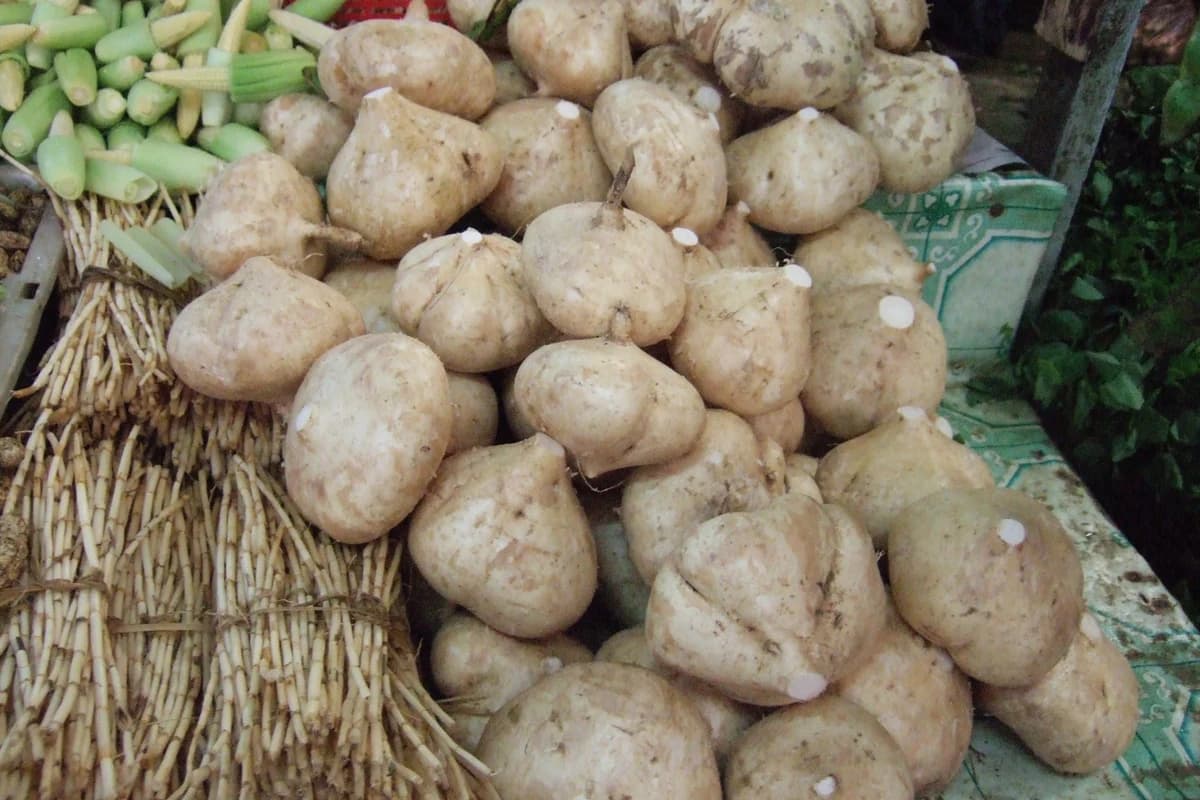
About This Plant
Jicama, also called Mexican yam bean, is a warm-season leguminous vine grown for its crisp edible storage root. It needs full sun, a long frost-free season, loose well-drained soil or deep media, and short-day conditions for reliable tuber bulking. Flowers and young pods are normally removed so the plant directs more growth into the edible root; all above-ground parts and mature seeds should be treated as toxic.
How to Grow Jicama
Learn how to grow Jicama from seed to harvest in 150 days. Intermediate difficulty. Complete nutrient guide, pH/EC requirements, and growing conditions for soil & container.
Sources cited: 13.
Nutrient Requirements by Growth Stage
Jicama is a nitrogen-fixing legume, so external nitrogen should be conservative rather than pushed like a heavy-feeding fruit crop. Field work in central Mexico recorded strong biological nitrogen fixation and late-season N remobilization into the tuber, while phosphorus was described as important for nodulation and…
Sign in to view nutrient requirements
A free account unlocks NPK targets for all four growth stages, micronutrient levels, a per-stage nutrient calculator, and the full nutrition guide. Signing up takes one click. Truleaf is a free, non-profit project, and every new account helps it grow. No spam, ever.
Growing Environments
Jicama can grow outdoors, in greenhouses, and in large containers, but all environments must provide warmth, full sun or bright light, deep root volume, and a long frost-free period. Greenhouses are useful in marginal climates because the crop often needs 150 or more warm days and short days for reliable tuber bulking…
Temperature
Jicama is a warm-season tropical root legume. Use warm germination conditions around 24-32C, then grow at roughly 20-30C with a practical controlled target near 26C. Field and review evidence favors warm days with cooler nights rather than sustained hot nights; do not treat 32C as the optimum. Frost stops production, so outdoor crops need a long warm season before autumn cold.
Humidity
Published jicama sources describe hot, moderately moist to humid growing conditions but do not define a precise relative humidity optimum. For indoor or greenhouse production, 60-80% RH with a 70% target is a practical range that supports warm-season vine growth while still allowing disease control…
Light
Grow jicama in full sun or bright greenhouse light, but remember that daylength controls storage-root development. Short days stimulate fleshy root growth; a classic daylength trial found much stronger root development under 9-hour short days than under long-day or night-interruption treatment…
Airflow
Use gentle but continuous airflow around the canopy and crown. Jicama vines can become dense, and disease reports include leaf spots, leaf blight, root rot, and southern blight under favorable moisture conditions…
Sign in to view environmental requirements
A free account unlocks exact temperature, humidity, light and airflow targets, including germination and growth ranges, DLI, photoperiod and PPFD, plus the full environment guide. Signing up takes one click. Truleaf is a free, non-profit project, and every new account helps it grow. No spam, ever.
Hydroponic System Compatibility
Prioritize soil, raised beds, large containers, or deep substrate beds with drip irrigation. DWC, NFT, Kratky, and production aeroponics should remain unsuitable because mature jicama forms a large storage root that needs darkness, anchorage, oxygen, and physical media support…
Growing Media
Use loose, deep, well-drained media. ECHO describes broad soil tolerance but good results in loosened soil, while the nitrogen-fixation field study notes edible tuber production is best suited to sandy, light-textured soils with moderate to favorable fertility and organic matter…
Container Specs
Containers must be large because the crop is a vigorous vine with a bulky edible root. Use one plant per container at least 45 cm deep and wide, around 38 L or larger, with excellent drainage…
Training & Support
Support or contain vines with trellis, stakes, or netting, then prune to keep the canopy manageable. Flower and young pod removal is strongly supported for edible-root production: the central Mexico field study removed reproductive structures weekly after flowering because it is a common practice for high tuber yield,…
Sign in to view system compatibility
A free account unlocks why each of the six systems fits or fails, plus growing media, container sizes, training methods, companion plants, and the full systems guide. Signing up takes one click. Truleaf is a free, non-profit project, and every new account helps it grow. No spam, ever.
Propagation
Start jicama primarily from seed. In short-season climates, sow indoors 4-10 weeks before the last spring frost, keep germination warm near 27C, and transplant only after frost danger has passed and the soil is warm…
Harvesting
Harvest once roots reach usable size and before frost. Government and extension sources place common harvest around 130-180 days from sowing, with some tropical or root-started crops sizing faster and long-season field trials running longer…
Planting Calendar
In temperate regions, start seed indoors in late winter or early spring, transplant after frost in May or June, remove flowers through summer, and harvest in autumn before frost. Tropical and subtropical schedules are tied to rainfall and daylength: ECHO notes spring planting during lengthening days, with tuberization…
Common Issues
Jicama is often described as relatively pest resistant because foliage and seeds contain rotenone-like compounds, but production problems still occur. Revise the issue list toward wet-media root rot, southern blight caused by Athelia rolfsii, excess nitrogen or flowering that suppresses root bulking, aphids and bean…
Get the full science-backed guide
By signing up, you help keep Truleaf free and support the growth of our nonprofit project. Your account unlocks full details for every plant issue—including symptoms, causes, step-by-step solutions, and prevention—plus the month-by-month planting calendar, the complete guide, and all research sources. It only takes one click. No spam, ever.