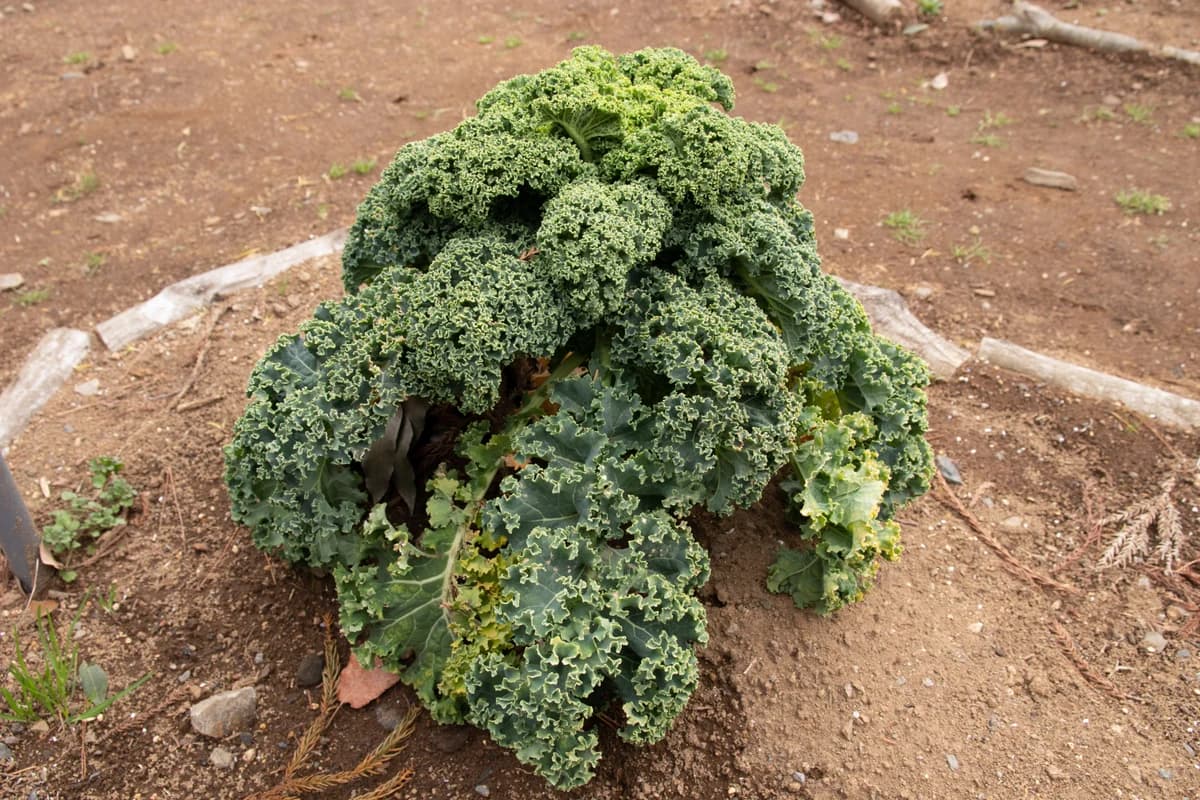
About This Plant
Kale is a nutrient-dense, non-heading Brassicaceae leafy green that thrives in hydroponic systems at 15-22°C. A heavy feeder with high calcium and sulfur demands critical for glucosinolate production, kale responds well to CO₂ enrichment at 800 ppm. Harvested as a cut-and-come-again crop, it produces baby leaves from 30 days and full-size leaves from 55-60 days, with continuous production for 3-6 months in controlled environments.
How to Grow Kale
Learn how to grow Kale from seed to harvest in 60 days. Beginner difficulty. Complete nutrient guide, pH/EC requirements, and growing conditions for hydroponics, soil & greenhouse.
Sources cited: 30.
Nutrient Requirements by Growth Stage
Kale is a heavy feeder requiring careful nutrient management. Maintain nitrogen at 150-200 ppm during vegetative growth with potassium at 185-260 ppm — the K:N ratio of approximately 1.4 is well-supported by Yang et al…
Sign in to view nutrient requirements
A free account unlocks NPK targets for all four growth stages, micronutrient levels, a per-stage nutrient calculator, and the full nutrition guide. Signing up takes one click. Truleaf is a free, non-profit project, and every new account helps it grow. No spam, ever.
Growing Environments
Kale is extremely versatile and thrives in all growing environments. Outdoors, it is a garden staple cold-hardy to well below freezing…
Temperature
Kale thrives in cool conditions. Germination occurs between 13-24°C, with fastest rates at 18-22°C. Vegetative growth is optimal at 20-23°C; the suitable range is 15-22°C. Temperatures above 30°C cause leaf senescence, reduced leaf area, and significant fresh-weight losses. In DWC systems, keep reservoir water at 18-21°C to maintain dissolved oxygen and prevent root pathogens. Kale is remarkably cold-hardy and can survive temperatures well below freezing in outdoor settings, with flavor improving markedly after frost exposure due to starch-to-sugar conversion in leaf tissue.
Humidity
Maintain relative humidity between 55-70% for balanced growth and disease prevention. In fully controlled plant factory environments with strong airflow, humidity up to 80-85% can maximise biomass production, as demonstrated by Chowdhury et al…
Light
Provide a photoperiod of 16 hours under artificial lighting. For baby kale and plant factory production, target 160-200 PPFD with a DLI of 10-14 mol/m²/day…
Airflow
Maintain gentle, consistent airflow of 0.3-0.7 m/s across the plant canopy in controlled environments. This range reduces leaf boundary layer resistance, promotes transpiration and calcium translocation to prevent tip burn, and discourages fungal pathogens…
Sign in to view environmental requirements
A free account unlocks exact temperature, humidity, light and airflow targets, including germination and growth ranges, DLI, photoperiod and PPFD, plus the full environment guide. Signing up takes one click. Truleaf is a free, non-profit project, and every new account helps it grow. No spam, ever.
Hydroponic System Compatibility
Kale can be cultivated in all six major hydroponic systems. NFT is the top commercial choice — Yang et al…
Growing Media
Rockwool cubes are the industry standard for kale seed germination and NFT propagation — buffer to pH 5.5-6.0 before use. Clay pebbles (hydroton) are excellent in DWC net cups and ebb-flow beds, providing superior drainage, physical support for kale's large canopy, and full reusability after sterilization…
Container Specs
Kale grows well in containers with proper specifications. Choose a pot at least 30 cm deep and 30 cm wide per plant — a 5-gallon (19 L) container is the practical minimum…
Training & Support
Kale does not require staking, caging, or trellising. Most varieties — including curly, Red Russian, and Scotch types — form compact, self-supporting plants that remain well below 60 cm…
Sign in to view system compatibility
A free account unlocks why each of the six systems fits or fails, plus growing media, container sizes, training methods, companion plants, and the full systems guide. Signing up takes one click. Truleaf is a free, non-profit project, and every new account helps it grow. No spam, ever.
Propagation
Kale is most easily grown from seed. Sow seeds 6-13 mm deep in seed-starting mix; germination occurs within 5-10 days at 15-21°C…
Harvesting
Kale is a cut-and-come-again crop. Begin harvesting outer leaves when they reach 15-20 cm in length — typically 30 days after transplant for baby leaves, or 55-60 days for full-size leaves…
Planting Calendar
Kale has two main growing windows reflecting its cool-weather preference. For a spring crop, start seeds indoors 6-8 weeks before last frost (typically January-March depending on zone) and transplant outdoors 2-4 weeks before last frost…
Common Issues
Kale faces both pest and disease challenges. The most significant pests are cabbage aphids (Brevicoryne brassicae), cabbage worms (Pieris rapae), flea beetles (Phyllotreta spp.), and whitefly (Aleyrodes proletella)…
Get the full science-backed guide
By signing up, you help keep Truleaf free and support the growth of our nonprofit project. Your account unlocks full details for every plant issue—including symptoms, causes, step-by-step solutions, and prevention—plus the month-by-month planting calendar, the complete guide, and all research sources. It only takes one click. No spam, ever.