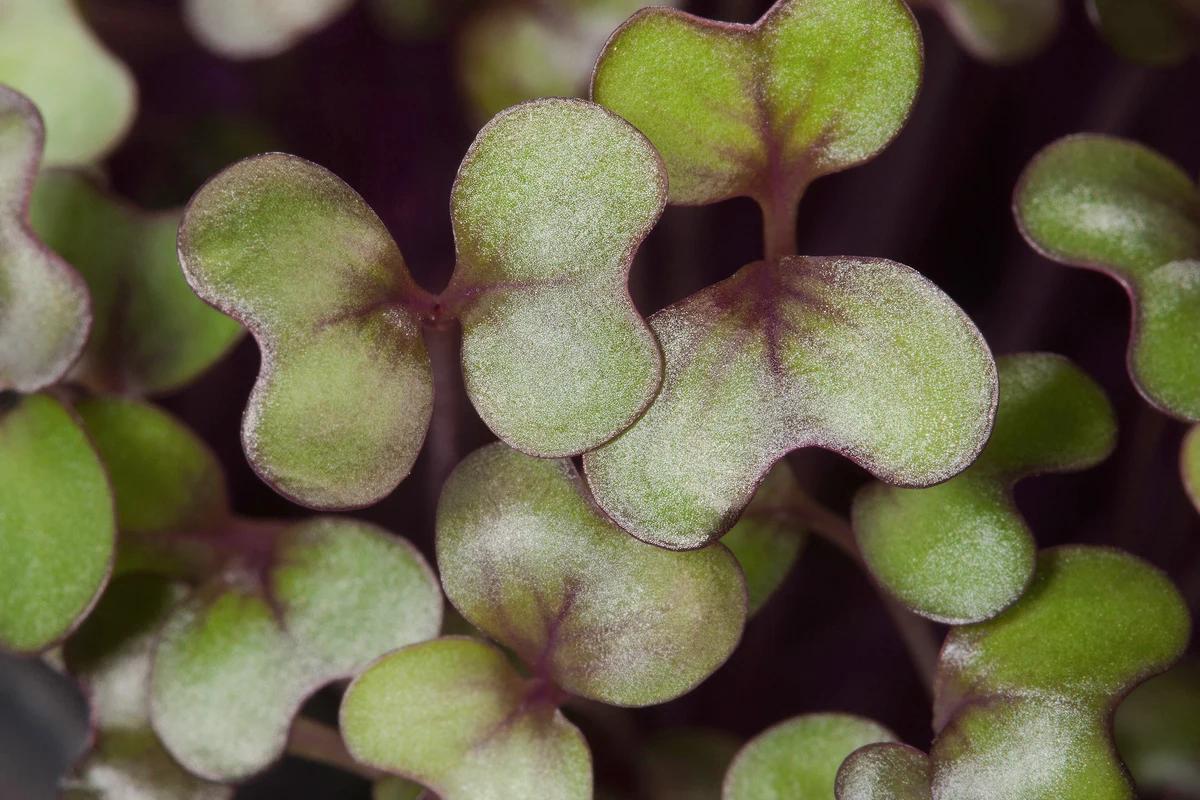
About This Plant
Young, immature kale (Brassica oleracea) seedlings harvested at the cotyledon or first-true-leaf stage about 10-14 days after sowing. Grown indoors as a dense, one-cut tray crop, they offer a mild, slightly peppery flavour and concentrated nutrition, and are fed a single dilute nutrient solution (or plain water) rather than a staged fertigation program.
How to Grow Kale
Learn how to grow Kale from seed to harvest in 13 days. Beginner-friendly. Planting, care, feeding and the right growing conditions.
Sources cited: 19.
Nutrient Requirements by Growth Stage
Feed kale microgreens as a single, dilute stage - there is no vegetative, flowering, or fruiting fertigation because the crop is cut at the cotyledon/first-true-leaf stage. Direct Brassica-microgreen work converges on roughly 103 ppm N, 16 ppm P, and 109 ppm K (half-strength Hoagland), with about 100 ppm Ca, 24 ppm…
Sign in to view nutrient requirements
A free account unlocks NPK targets for all four growth stages, micronutrient levels, a per-stage nutrient calculator, and the full nutrition guide. Signing up takes one click. Truleaf is a free, non-profit project, and every new account helps it grow. No spam, ever.
Growing Environments
Grow kale microgreens indoors on shelves or in a vertical farm, or in a protected greenhouse, always in shallow trays or containers. Outdoor production is not recommended: cut close to the substrate, the seedlings are vulnerable to rain splash, soil contamination, flea beetles, and uneven humidity.
Temperature
Kale microgreens grow best at 18-24C with an optimum near 21C; the on-species kale trial grew them at 21/17C day/night. Warm germination around 20-24C speeds even emergence, and Brassica microgreens tolerate up to ~26C during the light period, though warmth without adequate light encourages leggy growth.
Humidity
Hold relative humidity around 50-70% (optimum ~60%); the kale-microgreen chamber trial ran near 65% RH. After the blackout period, keep humidity in the lower half of the range (50-60%) with active airflow to suppress damping-off and surface mould in the dense canopy.
Light
A PPFD near 175 umol m-2 s-1 over a 16-hour photoperiod (DLI ~10 mol m-2 d-1) sits inside the validated window: kale microgreens were cultivated at 150-250 umol m-2 s-1, and sibling broccoli microgreens reach peak fresh weight even at 50-100. Microgreens need far less light than mature plants, and tissue nutrient…
Airflow
Gentle, continuous air movement (roughly 0.2-0.6 m/s) across the canopy is one of the most important controls for a dense microgreen tray: it keeps the stem bases and canopy dry, the primary defence against damping-off and saprophytic mould. Pair airflow with 50-60% humidity and bottom watering after emergence.
Sign in to view environmental requirements
A free account unlocks exact temperature, humidity, light and airflow targets, including germination and growth ranges, DLI, photoperiod and PPFD, plus the full environment guide. Signing up takes one click. Truleaf is a free, non-profit project, and every new account helps it grow. No spam, ever.
Hydroponic System Compatibility
Kale microgreens are a shallow-tray substrate crop, not recirculating hydroponics. Ebb-and-flow (flood-and-drain) benches are the one strong fit because they bottom-water the tray and keep the canopy dry…
Growing Media
Kale microgreens do best on clean soilless substrates. Natural fibre/hemp growing mats are the commercial standard; coconut coir and vermiculite are excellent home media, rockwool works well, and peat or seed-starting mixes are secondary options…
Container Specs
Grow in a shallow flat tray - a standard 10x20 inch (1020) plastic tray about 3-6 cm deep is typical - that drains freely and holds just 2-4 cm of substrate. Nest a drilled tray in a solid bottom tray so you can bottom-water after emergence…
Training & Support
No trellis, pruning, topping, or structural support is ever used. Kale microgreens are cut whole long before they develop any structure that would need support; a temporary cover or light weight during germination is a propagation aid for seed contact and humidity, not a training system.
Sign in to view system compatibility
A free account unlocks why each of the six systems fits or fails, plus growing media, container sizes, training methods, companion plants, and the full systems guide. Signing up takes one click. Truleaf is a free, non-profit project, and every new account helps it grow. No spam, ever.
Propagation
Kale microgreens are grown from seed only, as a single fast generation. Scatter dry seed densely and evenly across a moist substrate at roughly 10-16 seeds/cm2 (about 25-35 g per 1020 tray); the small smooth seed needs no presoak…
Harvesting
Harvest is a single cut at the cotyledon-to-first-true-leaf stage, about 10-14 days after sowing (the canonical 13 days sits inside this window; kale was measured at 11 days after sowing in a controlled 17-species trial). Cut the stems just above the substrate with sanitized scissors, keeping roots, media, and seed…
Planting Calendar
Because kale microgreens are grown indoors under controlled light and temperature, they are a year-round crop with no outdoor season. Sow a fresh tray on a rolling 1-2 week schedule to harvest in any month: day 0 sow, days 0-3 covered germination, then ~10 days of growth under light to an ~8-14 day harvest…
Common Issues
The main risks are damping-off, saprophytic surface mould, chlorosis on inert media, leggy/etiolated growth, slow or uneven germination, fungus gnats, and - because microgreens are eaten raw - food-safety contamination. The shared controls are clean sanitized trays, fresh media, bottom watering, gentle continuous…
Get the full science-backed guide
By signing up, you help keep Truleaf free and support the growth of our nonprofit project. Your account unlocks full details for every plant issue—including symptoms, causes, step-by-step solutions, and prevention—plus the month-by-month planting calendar, the complete guide, and all research sources. It only takes one click. No spam, ever.