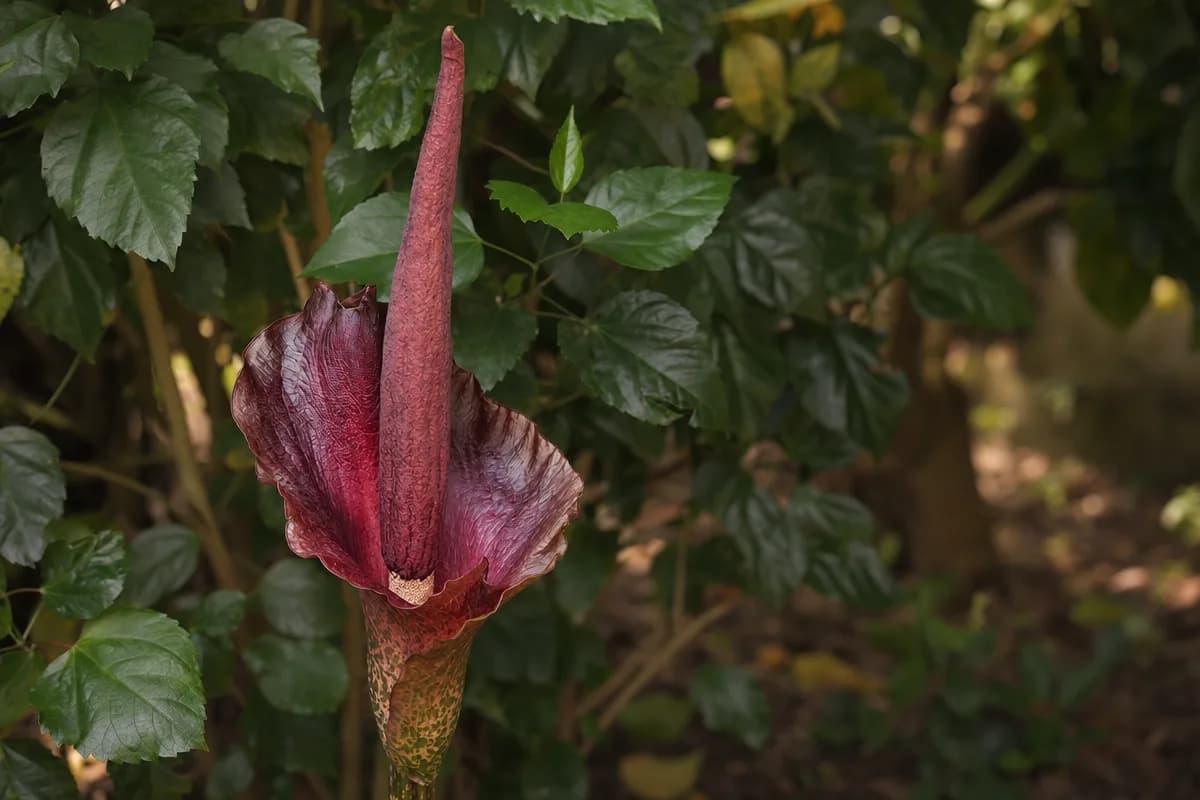
About This Plant
Konjac (Amorphophallus konjac) is a shade-demanding, corm-forming perennial aroid grown for the glucomannan stored in its underground corm. Unlike leafy or fruiting crops it is a multi-year crop: each spring a dormant corm sends up a single umbrella-like leaf that feeds the swelling corm through summer, then lodges into winter dormancy, and the corm is lifted, graded, and replanted for two to four seasons until it reaches market size. It wants 50-70% shade, warm humid conditions (20-30C, 70-90% RH), a deep free-draining substrate, and a potassium-forward feed that rises through corm bulking. Konjac is highly prone to bacterial soft rot, and the raw corm is a calcium-oxalate irritant that must be processed before it is safe to eat.
How to Grow Konjac
Learn how to grow Konjac from seed to harvest in 210 days. Intermediate difficulty. Complete nutrient guide, pH/EC requirements, and growing conditions for soil & container.
Sources cited: 23.
Nutrient Requirements by Growth Stage
Konjac is a moderate but potassium-hungry feeder whose demand shifts strongly across the season, so feed it stage by stage rather than on a flat recipe. It has no true hydroponic literature, so these ppm targets are analog-derived from field practice and the one published perlite nutrient solution for the genus…
Sign in to view nutrient requirements
A free account unlocks NPK targets for all four growth stages, micronutrient levels, a per-stage nutrient calculator, and the full nutrition guide. Signing up takes one click. Truleaf is a free, non-profit project, and every new account helps it grow. No spam, ever.
Growing Environments
Grow konjac outdoors as a partial-shade crop, or under a shaded greenhouse; it is not an indoor windowsill plant. It is a forest-margin geophyte that performs best under roughly 50-70% shade and suffers leaf scorch and rot in hot, wet, full-sun sites…
Temperature
Konjac is a warm-climate, frost-sensitive geophyte. Grow it at 20-30C with an optimum near 25C: a productive A. muelleri site averaged 23.7C (hottest month 26.4C, coldest 19.2C) and stayed frost-free year-round, and A. konjac prefers warm subtropical-to-tropical conditions. Gas-exchange optima for the shade-adapted leaf sit around 25C. Importantly, konjac has an obligate winter dormancy: as temperatures fall below ~10-15C the leaf lodges and the corm goes dormant, and dormant corms are lifted and stored cool rather than kept in active growth. Keep the corm above ~20C during the active season, because cold-wet conditions slow metabolism and predispose it to rot.
Humidity
Hold relative humidity high, about 70-90% with an optimum near 80%, matching konjac's humid understory habit; a productive genus site averaged ~78% RH. This band supports the single large leaf through the growing season…
Light
Konjac is a shade-demanding understory aroid, not a full-sun crop, and this is its single most important environmental requirement. Grow it under roughly 50-70% shade cloth, so only about 30-50% of full sunlight reaches the foliage; the optimum light transmission for the genus is around 45% of full sun…
Airflow
Konjac wants high humidity but not stagnant air. Maintain gentle, continuous airflow (roughly 0.2-0.8 m/s) across the canopy so leaf surfaces do not stay wet and humid pockets do not form inside the shaded stand…
Sign in to view environmental requirements
A free account unlocks exact temperature, humidity, light and airflow targets, including germination and growth ranges, DLI, photoperiod and PPFD, plus the full environment guide. Signing up takes one click. Truleaf is a free, non-profit project, and every new account helps it grow. No spam, ever.
Hydroponic System Compatibility
Konjac is a corm crop, and its system compatibility follows root/tuber rules rather than leafy-green ones. Water-culture systems are unsuitable: DWC submersion rots the corm, NFT film is far too shallow to develop or support a large corm, static Kratky offers no aerated substrate, and bare-root aeroponics cannot…
Growing Media
Konjac needs a deep, loose, free-draining and aerated substrate so the corm can swell without obstruction. The best trial substrate was river sand:humus:red soil in a 1:1:1 blend, where the 'humus' was half peat and half coconut coir; single-component media performed worse…
Container Specs
If you grow konjac in a container, choose a deep pot so the corm can swell freely. The best substrate trial used a bed about 50 cm deep, deeper than the root length at full fertility; 40 cm is a practical minimum depth and width, with 50 cm ideal for full-size corms…
Training & Support
Konjac needs no training or support. Each corm sends up a single self-supporting compound leaf on a sturdy erect petiole for the season, and the plant neither climbs nor sets supported fruit…
Sign in to view system compatibility
A free account unlocks why each of the six systems fits or fails, plus growing media, container sizes, training methods, companion plants, and the full systems guide. Signing up takes one click. Truleaf is a free, non-profit project, and every new account helps it grow. No spam, ever.
Propagation
Propagate konjac vegetatively from its corm rather than from seed. Each year a mature corm produces small daughter corms (cormels) around its base; separate these and replant them, and lift, grade, and replant the whole seed corms as well…
Harvesting
Harvest konjac as a dormant corm at the end of the growing season, once the single umbrella-shaped leaf has yellowed and lodged in autumn. Konjac is a multi-year crop, so in the early years you lift, grade and REPLANT the corm each spring rather than eating it, harvesting for use only when it reaches market size…
Planting Calendar
In warm-temperate to subtropical gardens, plant konjac seed corms or cormels in spring (April-May) once frost has passed and the soil has warmed. The single leaf expands and is fully developed by mid-summer, then yellows and lodges in autumn…
Common Issues
Konjac's most dangerous problem is bacterial soft rot, caused by Pectobacterium aroidearum (the older names Erwinia carotovora and P. carotovorum subsp…
Get the full science-backed guide
By signing up, you help keep Truleaf free and support the growth of our nonprofit project. Your account unlocks full details for every plant issue—including symptoms, causes, step-by-step solutions, and prevention—plus the month-by-month planting calendar, the complete guide, and all research sources. It only takes one click. No spam, ever.