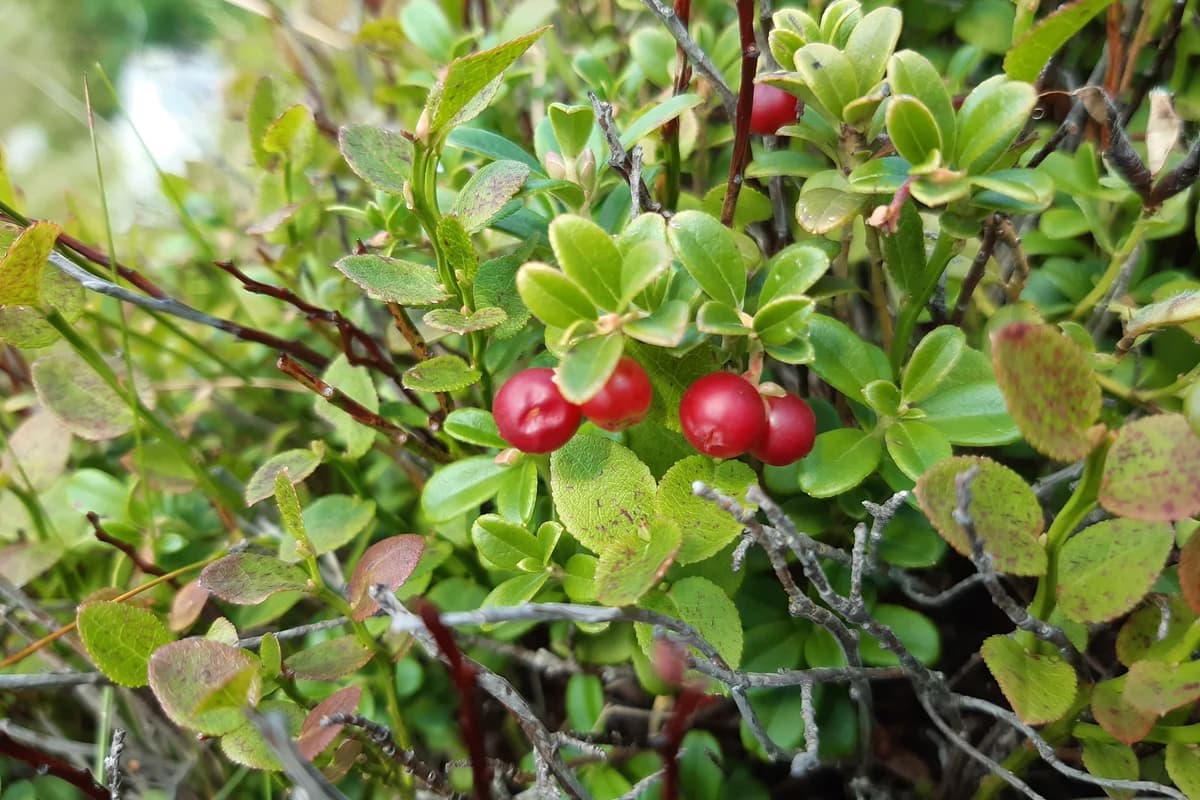
About This Plant
Lingonberry is a low, evergreen, rhizomatous shrub of cool temperate and boreal regions. It forms acidic, shallow-rooted beds and produces tart red berries on one-year-old shoots. Cultivars may bear one crop in late summer or a smaller summer crop followed by a larger autumn crop. The crop favors high light, evenly moist but freely drained peat-rich or light sandy soil, low fertilizer rates, and protection from waterlogging, salinity, and excessive nitrogen.
How to Grow Lingonberry
Learn how to grow Lingonberry from seed to harvest in 1 days. Intermediate difficulty. Complete nutrient guide, pH/EC requirements, and growing conditions for soil & container.
Backed by 17 peer-reviewed citations.
Nutrient Requirements by Growth Stage
Lingonberry is a low-input, salt-sensitive perennial. A young-container trial favored a cumulative 18-12-24 kg/ha N-P-K treatment; higher rates increased residual nitrate, media-extract EC, and shoot death [ref-1]…
Sign in to view nutrient requirements
A free account unlocks NPK targets for all four growth stages, micronutrient levels, a per-stage nutrient calculator, and the full nutrition guide. Signing up takes one click. Truleaf is a free, non-profit project, and every new account helps it grow. No spam, ever.
Growing Environments
Cool-climate outdoor fields and raised beds have the strongest production support. Greenhouse containers and multi-season outdoor containers are directly supported [ref-1][ref-4][ref-12]…
Temperature
Controlled studies grew established plants at 25/20 C day/night and aseptic seedlings at 22 plus or minus 2 C [ref-1][ref-13]. These settings support a tested span near 20-25 C but do not define physiological limits or an optimum. At bloom, even -2 C can damage flowers and prevent fruit set [ref-4].
Humidity
No species-specific mature-crop relative-humidity target was verified. The production guide instead specifies root-zone water management: about 0.5-0.75 inch weekly, avoidance of overwatering in heavy soil because it increases Phytophthora or Pythium risk, and no complete drying between irrigations [ref-4]…
Light
Established lingonberry is a high-light crop. A greenhouse study successfully used 550 umol/m2/s for 14 hours, equal to a DLI of 27.72 mol/m2/day [ref-1]…
Airflow
No species-specific canopy air speed was verified. Use circulation only as qualitative canopy management and avoid strong directed airflow during bloom because high wind can interfere with insect pollination [ref-4].
Sign in to view environmental requirements
A free account unlocks exact temperature, humidity, light and airflow targets, including germination and growth ranges, DLI, photoperiod and PPFD, plus the full environment guide. Signing up takes one click. Truleaf is a free, non-profit project, and every new account helps it grow. No spam, ever.
Hydroponic System Compatibility
Drip-fed acidic substrate is the supported system. Use peat-based media or light acidic soil, maintain even moisture without saturation, and monitor irrigation water for pH, sodium, chloride, and calcium [ref-1][ref-4]…
Growing Media
Use acidic, moisture-retentive media that drain freely. Peat moss with perlite is the best-supported container mix, while light sandy loam or loam with organic matter suits outdoor beds [ref-1][ref-4]…
Container Specs
Lingonberry can grow in containers, but no reviewed study establishes a minimum pot volume, width, depth, or material. Field guidance spaces plants 20-46 cm apart and places roots only 5-8 cm deep because the active root and rhizome system is near the surface [ref-4]…
Training & Support
No eligible source prescribes a trellis, cage, stake, or other structural training system for this dwarf rhizomatous shrub [ref-16][ref-4]. Leave new beds unpruned for four or five years…
Sign in to view system compatibility
A free account unlocks why each of the six systems fits or fails, plus growing media, container sizes, training methods, companion plants, and the full systems guide. Signing up takes one click. Truleaf is a free, non-profit project, and every new account helps it grow. No spam, ever.
Propagation
Use clean clonal stock when cultivar identity and rapid bed fill matter. Tissue-cultured plants can form spreading rhizomes in their first greenhouse year, while conventional stem cuttings may stay compact [ref-15][ref-16]…
Harvesting
Harvest by color rather than a fixed day count. Pick berries when evenly light red to dark red; green-tinged fruit can remain bitter [ref-4]…
Planting Calendar
Root stem cuttings and rhizome divisions in spring or late summer, then transplant established stock the following spring or fall [ref-4]. In Alaska, start seed or rhizome pieces under greenhouse control and move them to the field in spring; broadcast field seeding failed in the cited attempt [ref-11]…
Common Issues
Heavy soil and excessive irrigation increase Phytophthora-associated root-rot risk, while complete drying concentrates salts [ref-4]. Excess fertilizer and chloride can cause brown or black dieback that resembles root disease…
Get the full science-backed guide
By signing up, you help keep Truleaf free and support the growth of our nonprofit project. Your account unlocks full details for every plant issue—including symptoms, causes, step-by-step solutions, and prevention—plus the month-by-month planting calendar, the complete guide, and all research sources. It only takes one click. No spam, ever.