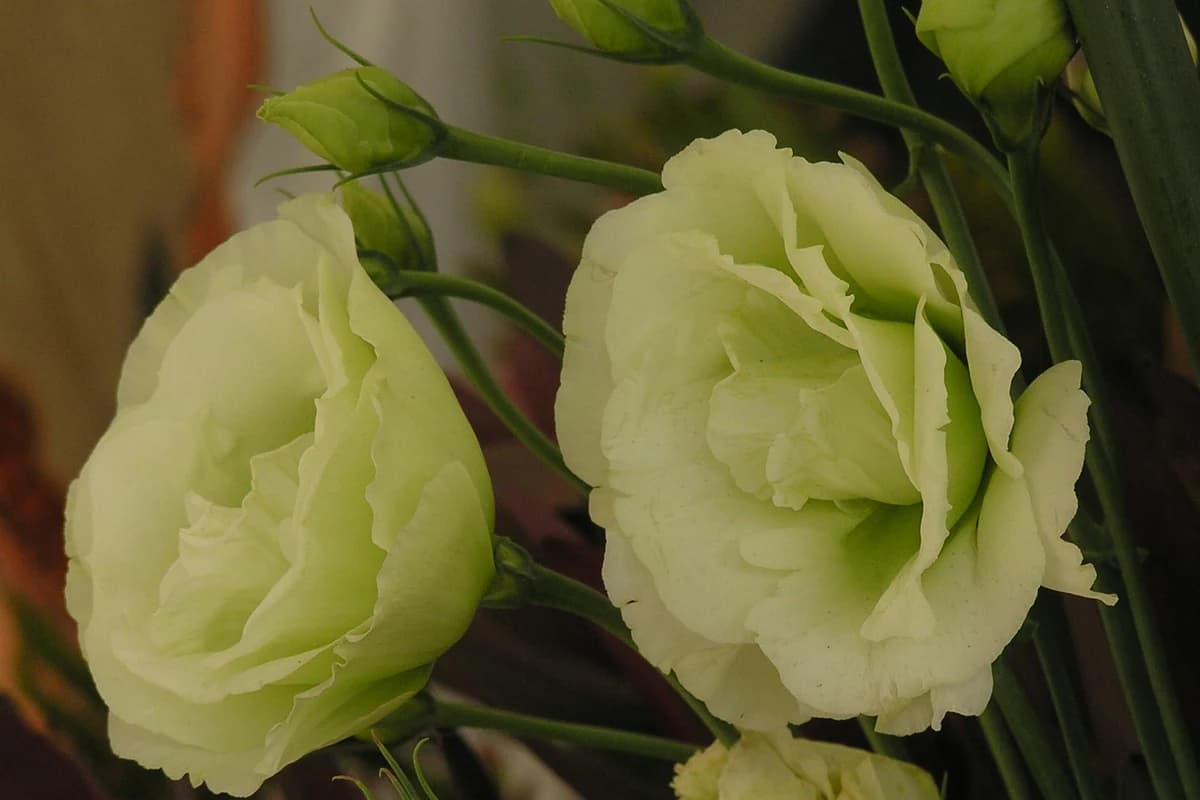
About This Plant
Lisianthus is a long-cycle cut flower raised mainly from tiny, light-requiring seed. Conventional seed emerges in about 9-11 days, but producing a transplantable plug commonly takes 2-3 months. Cultivar, season, temperature, light, and production system can shift sowing-to-harvest from about 112 to 240 days. Tall cut-flower plants need horizontal support and a moist, aerated root zone. Recirculating NFT, fertigated perlite, protected beds, and field or tunnel drip production are directly supported. Nutrient demand rises sharply after visible bud, while excess post-bud nitrogen under weak winter light can delay opening and increase bud blasting. Harvest when one or more lower florets are open, hydrate immediately, and keep stored stems upright and cool.
How to Grow Lisianthus
Learn how to grow Lisianthus from seed to harvest in 180 days. Intermediate difficulty. Complete nutrient guide, pH/EC requirements, and growing conditions for soil & container.
Backed by 54 peer-reviewed citations.
Nutrient Requirements by Growth Stage
Use a low-salt applied program unless a controlled cultivar protocol supports more nitrogen, and monitor pH and EC by one consistent extraction method. A direct plug-seedling nitrogen response plateau occurred at 280.1-336.2 ppm N, but phosphorus and potassium were fixed and no single N optimum was identified…
Sign in to view nutrient requirements
A free account unlocks NPK targets for all four growth stages, micronutrient levels, a per-stage nutrient calculator, and the full nutrition guide. Signing up takes one click. Truleaf is a free, non-profit project, and every new account helps it grow. No spam, ever.
Growing Environments
Lisianthus can be raised in indoor controlled propagation, containers, greenhouses, high tunnels, and outdoor beds when light, drainage, temperature, and support are adequate. Closed seedling production and greenhouse NFT allow tight scheduling, while field and tunnel systems need cultivar groups matched to local heat…
Temperature
Surface-sow seed and use 20-25 C for conventional germination; complete trials observed emergence in 9-11 days. Retain 20-24 C as a routine post-seedling operating band, not a physiological limit. A controlled El Paso Deep Blue study compared 14, 20, and 26 C and found faster flowering at the warmer treatments. Protect sensitive plugs and young transplants from heat, root binding, high salts, saturation, and severe wilting because these stresses can promote rosetting.
Humidity
Manage humidity to keep uncovered seed uniformly moist and to let established foliage and flowers dry promptly. Successful greenhouse crops recorded about 49-81% RH across day and night, while an NFT crop averaged about 70%…
Light
Use about 16 hours after the plug stage when faster growth and flowering are the goal. A post-seedling DLI near 15 mol/m2/day is supported as a modelled lateral-shoot-length target for El Paso Deep Blue, while leaf number, flower number, and dry weight continued responding across the tested 3-24 mol/m2/day range…
Airflow
Use very weak air movement around uncovered seed so the surface does not dry, then distribute conditioned air evenly through the established canopy. Ventilate and space mature crops so leaves and flowers dry promptly, especially where Botrytis and mildews are a risk…
Sign in to view environmental requirements
A free account unlocks exact temperature, humidity, light and airflow targets, including germination and growth ranges, DLI, photoperiod and PPFD, plus the full environment guide. Signing up takes one click. Truleaf is a free, non-profit project, and every new account helps it grow. No spam, ever.
Hydroponic System Compatibility
NFT is directly verified in experimental and commercial-scale lisianthus cut-flower production. Use recirculation, sanitation, clean source water, suitable slope and flow, and waterborne-disease monitoring…
Growing Media
Perlite is the best-supported enum-compatible soilless medium. A greenhouse trial used B12 perlite with 0-5 mm particles, daily fertigation, and 20-30% drainage…
Container Specs
Use a freely draining production container or bed geometry that fits the cultivar, density, irrigation method, and intended stem length. Eligible cultivation sources report plug-cell dimensions, field-bed density, and successful trial containers, but none compared finished-container sizes or established a biological…
Training & Support
Install taut horizontal support netting before tall stems make installation difficult. Applied guides support one or two tiers for cut-flower cultivars…
Sign in to view system compatibility
A free account unlocks why each of the six systems fits or fails, plus growing media, container sizes, training methods, companion plants, and the full systems guide. Signing up takes one click. Truleaf is a free, non-profit project, and every new account helps it grow. No spam, ever.
Propagation
Seed is the standard production method. Surface-sow one seed per plug cell, do not bury it, maintain uniform moisture without saturation, and provide light through emergence…
Harvesting
Harvest during the cool part of the day with clean tools when one or more lower flowers are open; the Utah local-market program prefers at least two open florets. Place stems directly into clean, cool water, remove field heat, strip leaves below the water line, and re-trim the ends…
Planting Calendar
For a temperate Northern Hemisphere baseline, produce plugs 2-3 months before transplanting and plant outdoor or tunnel crops after frost. Applied schedules place establishment in weeks 1-3 after transplant, vegetative growth in weeks 3-8, bud formation near weeks 9-10, and flowering and cropping near weeks 12-16…
Common Issues
For lower-leaf wilt and yellowing that progresses upward with root or stem-base rot, remove affected plants, protect clean areas from contaminated media or solution, and confirm Fusarium before treatment. Prevent Botrytis and mildews with dry foliage, spacing, ventilation, sanitation, and drip irrigation rather than…
Get the full science-backed guide
By signing up, you help keep Truleaf free and support the growth of our nonprofit project. Your account unlocks full details for every plant issue—including symptoms, causes, step-by-step solutions, and prevention—plus the month-by-month planting calendar, the complete guide, and all research sources. It only takes one click. No spam, ever.