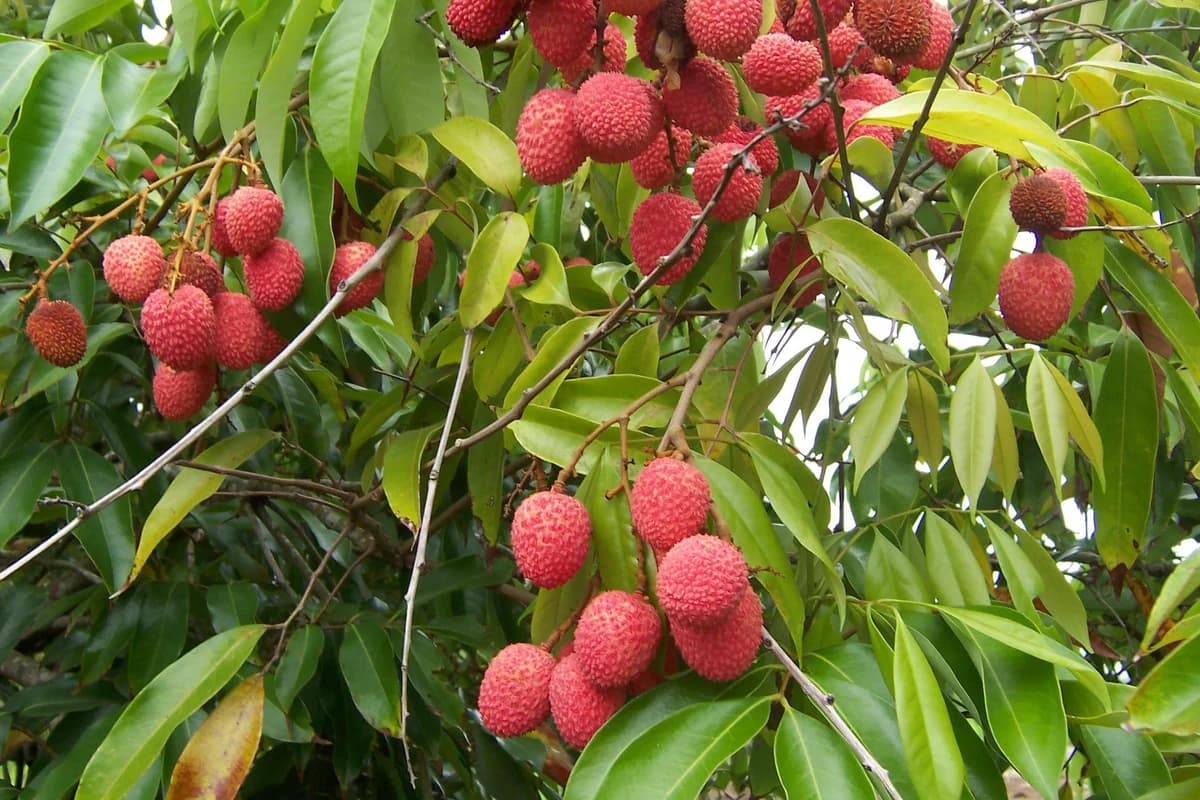
About This Plant
Lychee is a subtropical evergreen fruit tree grown mainly in deep, well-drained soil orchards. Productive trees need full sun, protection from persistent wind, cool nonfreezing weather below about 20 C for floral induction, and reliable moisture from flowering through harvest. Named cultivars are usually propagated by air-layering. Fresh seed may germinate in about three weeks but seedlings vary and often remain juvenile for ten years or more. Fruit must ripen on the tree, matures roughly 84-112 days after anthesis, and browns rapidly unless handled gently and cooled promptly.
How to Grow Lychee
Learn how to grow Lychee from seed to harvest in 60 days. Intermediate difficulty. Complete nutrient guide, pH/EC requirements, and growing conditions for soil & container.
Sources cited: 39.
Nutrient Requirements by Growth Stage
Base lychee nutrition on tree age, crop load, soil type, and paired leaf and soil tests. Match cultivar, leaf position, terminal type, leaf age, and sampling stage: leaf age alone can materially change P, K, and Zn, while calibrated Feizixiao N/P/K ranges differ between mature autumn shoots and fruit swelling…
Sign in to view nutrient requirements
A free account unlocks NPK targets for all four growth stages, micronutrient levels, a per-stage nutrient calculator, and the full nutrition guide. Signing up takes one click. Truleaf is a free, non-profit project, and every new account helps it grow. No spam, ever.
Growing Environments
Outdoor subtropical orchard production is the verified standard. Choose a full-sun site with deep drainage, irrigation access, and shelter from damaging wind…
Temperature
Manage lychee temperature by stage. Warm conditions support vegetative flushing, while flower induction needs cool, nonfreezing weather below about 20 C. Controlled work produced flowering after 15/10 C day/night exposure, and pollination performed best around 19-22 C. Extended temperatures above 30 C can reduce fruit set and quality. Young trees can be damaged near freezing, so the former 0-7 C night recommendation is unsafe as a general induction target.
Humidity
Lychee production guidance describes humid summer fruit development and warns against hot, very dry conditions, but it does not define a controlled relative-humidity optimum. Maintain reliable soil moisture from flowering through fruit development, allow foliage and fruit to dry after wet weather, and avoid using…
Light
Grow lychee in full sun or strong unobstructed greenhouse light. Persistent canopy crowding and heavy structural shade reduce flowering, fruit retention, and production, so maintain spacing and prune after harvest to preserve light through the canopy…
Airflow
Use an open sunny site with air movement through the canopy, but shelter establishing trees and flowers from persistent strong wind. Constant wind can tatter leaves, stunt shoots, abrade young trunks, and cause stem dieback; strong wind during bloom can also reduce bee activity…
Sign in to view environmental requirements
A free account unlocks exact temperature, humidity, light and airflow targets, including germination and growth ranges, DLI, photoperiod and PPFD, plus the full environment guide. Signing up takes one click. Truleaf is a free, non-profit project, and every new account helps it grow. No spam, ever.
Hydroponic System Compatibility
Use a full-sun soil orchard with irrigation adjusted to tree age, soil water, and crop stage. Drip irrigation is directly documented as an efficient way to water a large, well-drained soil or substrate root zone…
Growing Media
Use well-drained soil, preferably clay loam of moderate to high fertility. Acid sand can work where water and nutrients are managed carefully…
Container Specs
The verified evidence supports temporary nursery pots for rooted air layers and cuttings, followed by field planting. Pot rooted layers into a well-drained mix, protect them during establishment, and harden them before planting…
Training & Support
Lychee usually needs no permanent structural support. Stake a young tree only when establishment or wind exposure warrants it, using wood or bamboo and a degradable natural-fiber tie rather than wire or nylon…
Sign in to view system compatibility
A free account unlocks why each of the six systems fits or fails, plus growing media, container sizes, training methods, companion plants, and the full systems guide. Signing up takes one click. Truleaf is a free, non-profit project, and every new account helps it grow. No spam, ever.
Propagation
Propagate named lychee cultivars by air-layering, the main commercial method. Select a healthy sunlit mature branch, remove the bark and cambium at the girdle, enclose the wound in moist aerated medium, and detach only after a sufficient root mass forms…
Harvesting
Allow lychee to ripen fully on the tree because the fruit is nonclimacteric and will not become sweeter after removal. Use cultivar-typical red color, adequate size, sweetness, plumpness, and sugar-to-acid balance as maturity cues…
Planting Calendar
Use a local cultivar calendar. Across retained Northern Hemisphere subtropical guidance, harvest spans May through August, with Florida commonly running from mid-May to early July…
Common Issues
Monitor new flush, flowers, fruit, stems, and roots for anthracnose or pepper spot, litchi erinose mite, drainage-associated root rot or tree decline, regional downy blight, and rapid postharvest browning. Diagnose the organism before treatment…
Get the full science-backed guide
By signing up, you help keep Truleaf free and support the growth of our nonprofit project. Your account unlocks full details for every plant issue—including symptoms, causes, step-by-step solutions, and prevention—plus the month-by-month planting calendar, the complete guide, and all research sources. It only takes one click. No spam, ever.