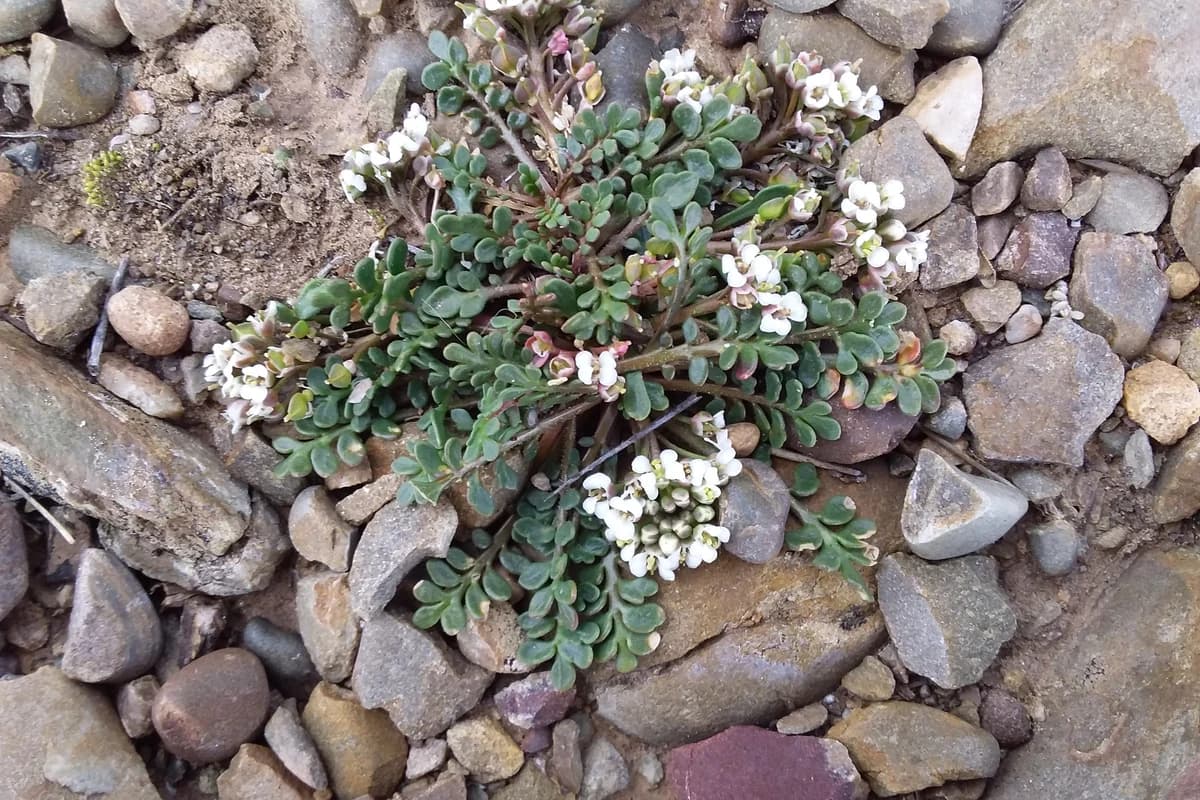
About This Plant
Maca is a low rosette-forming Brassicaceae crop from the high central Andes, grown for a swollen hypocotyl fused with the upper taproot. Commercial root production begins with tiny botanical seed and normally takes about 210-250 days in the documented Peruvian highland system. A separate second phase replants selected hypocotyls to produce flowers and botanical seed. Loose organic-rich soil, careful stand establishment, drainage, and timing with seasonal rain are central to production. Outdoor high-Andean fields and semi-controlled greenhouses are verified, and controlled-environment growth chambers have grown maca through early hypocotyl thickening; hydroponic solution recipes remain unverified.
How to Grow Maca
Learn how to grow Maca from seed to harvest in 240 days. Intermediate difficulty. Complete nutrient guide, pH/EC requirements, and growing conditions for soil & container.
Sources cited: 16.
Nutrient Requirements by Growth Stage
No verified paper or extension guide supports stage-specific maca nutrient-solution ppm, fertigation injection rates, or reservoir EC and pH. Both NPK lanes returned null for all four schema stages, so the 15% averaging rule had no numeric inputs and the existing ppm profile remains unverified…
Sign in to view nutrient requirements
A free account unlocks NPK targets for all four growth stages, micronutrient levels, a per-stage nutrient calculator, and the full nutrition guide. Signing up takes one click. Truleaf is a free, non-profit project, and every new account helps it grow. No spam, ever.
Growing Environments
Outdoor high-Andean soil production and semi-controlled greenhouse production are both directly verified. The field system is commonly rainfed, with supplemental irrigation used according to soil and crop need…
Temperature
Maca is adapted to cold high-Andean production, but successful growth is not confined below 12 C. It germinated and established as seedlings under 18-28 C greenhouse conditions and then grew and thickened hypocotyls in growth chambers held at 20/18 C. INIA describes representative field conditions around a 7 C mean, with -5 C minima and 15 C maxima, and a productive semi-controlled greenhouse averaged 22.5 C by day and 7.92 C by night, with its authors describing about 15-25 C as suitable guidance. These are production and chamber contexts rather than a controlled species response curve, and together they refute the previous 1.5-12 C universal band and any refrigerated hydroponic protocol. Germination is temperature-dependent: about 5-7 days at 25 C under moist conditions, but half-emergence took 11-26 days in colder alternating regimes.
Humidity
No eligible source tested a crop-wide relative-humidity optimum, and maca grew well below the previous 50-80% floor. One controlled study developed hypocotyls at about 25% chamber humidity, and a productive semi-controlled greenhouse averaged about 49% RH at 08:00, 30% at noon, and 35% at 15:00, with monthly…
Light
Provide bright, evenly distributed light while preventing severe self-shading. Maca developed hypocotyls under 350 micromol PAR/m2/s of overhead HPS in a controlled trial, where 16-hour days promoted early yellow maca shoot, root, and hypocotyl growth relative to 8-hour days through day 88; the authors called for…
Airflow
Use controllable ventilation in protected maca production. The verified greenhouse used ridge openings and adjustable insect-mesh and plastic side curtains; operators opened the curtains during midday heat and used four-metre windbreaks to protect the structure and crop from strong puna winds…
Sign in to view environmental requirements
A free account unlocks exact temperature, humidity, light and airflow targets, including germination and growth ranges, DLI, photoperiod and PPFD, plus the full environment guide. Signing up takes one click. Truleaf is a free, non-profit project, and every new account helps it grow. No spam, ever.
Hydroponic System Compatibility
The best verified protected system is a horizontal soil bed supplied by drip irrigation. Drip is therefore suitable when the root zone is soil or organically amended soil…
Growing Media
Use a solid, loose, organic-rich root zone. For full-cycle hypocotyl production, use finely worked, organic-rich loam (soil); fine tilth matters because maca seed is very small, while adequate root-zone volume and uniform moisture matter later as the hypocotyl expands…
Container Specs
No retained complete source establishes a mature maca container's minimum width, depth, volume, drainage specification, or material. The only mature production comparison used 2.6 L soil-filled vertical pots, and those pots performed worse than horizontal beds because of restricted roots, lower water retention, uneven…
Training & Support
The verified cultivation sources prescribe uniform broadcast sowing, thinning, hand weeding, selected-hypocotyl handling, and reproductive-phase spacing, but they do not explicitly prescribe or reject stakes, trellises, cages, string, netting, pruning, or topping. Absence of a support recommendation is not evidence…
Sign in to view system compatibility
A free account unlocks why each of the six systems fits or fails, plus growing media, container sizes, training methods, companion plants, and the full systems guide. Signing up takes one click. Truleaf is a free, non-profit project, and every new account helps it grow. No spam, ever.
Propagation
Commercial hypocotyl production starts from botanical seed. Broadcast the tiny seed into a finely worked, moist seedbed as the first rains begin, mixing it with soil or sand for even distribution; INIA gives 1.5-2.0 kg/ha of pure seed and the IPGRI chapter reports resulting stands of roughly 400,000-700,000 plants/ha…
Harvesting
Harvest the hypocotyl crop in dry weather about 210-250 days after sowing in the documented high-altitude Peruvian system; 240 days is a supported representative scalar rather than a fixed deadline. Sample the crop before lifting: only about 5-10% of foliage should remain green, and mature hypocotyls should resist…
Planting Calendar
The structured month arrays represent the central-Andean Southern Hemisphere system and must be shifted to local rainfall and temperature elsewhere. Prepare a fine seedbed before seasonal rain and direct-sow the root crop from September through November…
Common Issues
Verified field concerns include hypocotyl-boring insects, weevils associated with potato rotations, Copitarsia feeding, aphids, Oidium and downy mildew reports, Urocystis smut, Fusarium-like collar disease, and waterlogging-associated root rot. The 2000 guides use historical names, so identify the organism locally…
Get the full science-backed guide
By signing up, you help keep Truleaf free and support the growth of our nonprofit project. Your account unlocks full details for every plant issue—including symptoms, causes, step-by-step solutions, and prevention—plus the month-by-month planting calendar, the complete guide, and all research sources. It only takes one click. No spam, ever.