Cultivo de Batatas em Sacos: Até 6 kg, Sem Precisar de Horta
Cultive até 6 kg de batatas por saco com as variedades certas, o substrato adequado e a técnica de aterramento. Inclui dados de produção por tamanho de saco e o mito das torres desmistificado.
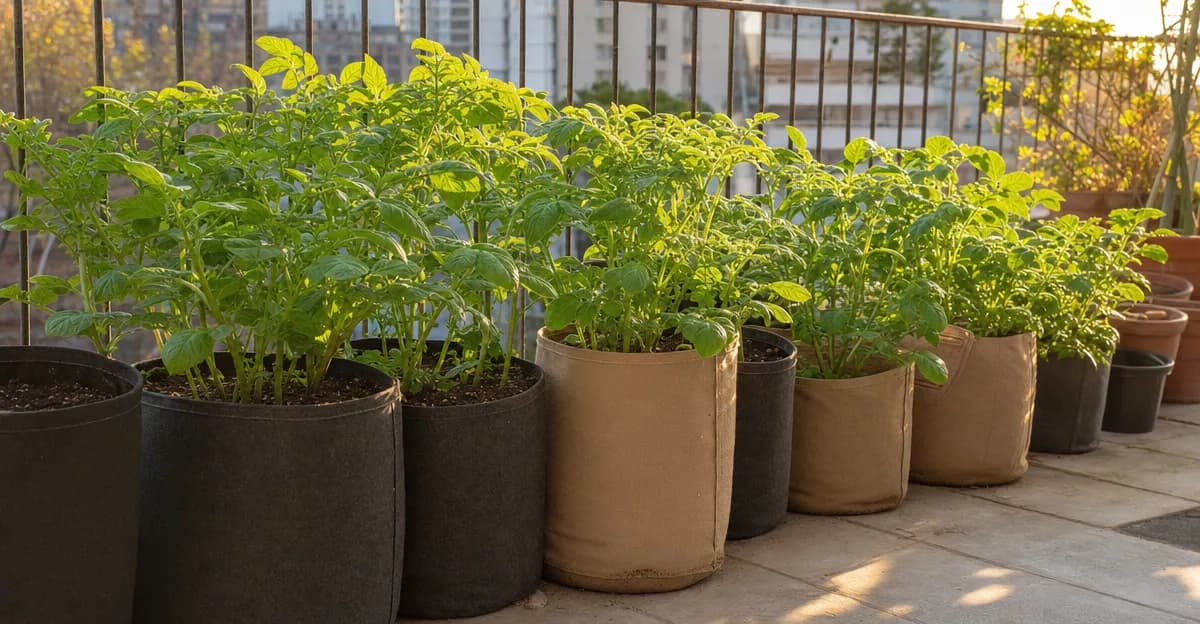
Conclusão principal: Um saco de cultivo de tecido de 38 a 57 litros (10 a 15 galões), um substrato simples e algumas batatas-semente são tudo o que precisa para colher entre 2,3 e 6 kg de batatas num pátio, varanda ou entrada de garagem -- sem necessitar de qualquer canteiro. Um ensaio financiado pelo USDA que comparou cinco métodos de cultivo de batata concluiu que os sacos produziram cerca de 65% do rendimento do cultivo tradicional no solo, a uma fracção do custo e do espaço, tornando-os o melhor ponto de entrada para o cultivo de batatas em contentores. Os sacos de cultivo oferecem ainda algo que o cultivo no solo não consegue proporcionar: a capacidade de controlar a qualidade do substrato, a drenagem e a temperatura desde o início, o que reduz o risco de problemas comuns como a sarna, a podridão e os tubérculos verdes.
Porquê Cultivar Batatas em Sacos?
A batata (Solanum tuberosum) é um dos legumes mais gratificantes para cultivar em casa, mas tradicionalmente exige bastante espaço no solo, preparação profunda do terreno e aterramentos repetidos com pá ou sacho. Os sacos de cultivo eliminam a maioria destes obstáculos:
- Não é necessário canteiro. Um saco de cultivo pode ser colocado em qualquer superfície soalheira -- um pátio, varanda, entrada de garagem ou escada de emergência. Isto torna a batata acessível a quem vive em apartamento ou arrendamento sem espaço para cultivar no solo.
- Colheita mais limpa. Em vez de cavar em solo argiloso ou pedregoso, inclina-se o saco sobre uma lona e retiram-se as batatas à mão. Sem tubérculos perfurados por dentes de forcado.
- Melhor drenagem. Os sacos de tecido drenam livremente por toda a superfície, tornando praticamente impossível encharcar a zona radicular -- uma vantagem essencial porque as batatas apodrecem rapidamente em solo saturado.
- Controlo do substrato. O meio de cultivo é preparado pelo próprio cultivador, o que permite alcançar as condições soltas, bem arejadas e ligeiramente ácidas que a batata prefere, sem necessidade de corrigir um canteiro inteiro.
- Portabilidade. Se uma geada tardia ameaçar, os sacos podem ser transportados para o interior ou para um abrigo. Se os sacos estiverem a aquecer demasiado sob o sol de verão, podem ser deslocados para a sombra da tarde.
- Isolamento de pragas. O cultivo acima do solo separa as batatas de pragas que habitam o solo, como larvas de estalão e ratos-campestres, e dificulta que o besouro-da-batata-do-Colorado encontre as plantas.
A contrapartida é clara: os sacos produzem menos por planta do que canteiros bem geridos no solo, e exigem regas mais frequentes. Mas para quem não tem terra, ou para qualquer pessoa que queira uma primeira colheita de batatas de fácil gestão, os sacos são o ponto de partida mais prático.
Escolher o Saco de Cultivo Certo
Nem todos os sacos são iguais. O material, o tamanho e a cor influenciam o desempenho das batatas.
Sacos de Tecido (Melhor Opção Geral)
Os sacos de polipropileno ou poliéster não tecido são a primeira escolha para batatas, de acordo com as recomendações das extensões universitárias. As suas vantagens são específicas para a fisiologia da batata:
- Poda aérea das raízes. Quando as raízes atingem a parede de tecido respirável, param de se alongar e ramificam-se. Isto cria uma rede radicular mais densa que absorve água e nutrientes com mais eficiência do que raízes enroladas num vaso de plástico.
- Excelente drenagem. O tecido expele o excesso de água por toda a superfície, reduzindo o risco das condições de encharcamento que causam perna-negra e podridão mole.
- Regulação da temperatura. A superfície respirável permite a dissipação do calor -- importante porque temperaturas do solo acima de 25°C começam a inibir a formação de tubérculos.
- Armazenamento compacto. Após a época de cultivo, os sacos de tecido dobram-se facilmente.
Os sacos de tecido de qualidade duram 3 a 5 épocas. Escolha sacos com gramagem mínima de 200 GSM (gramas por metro quadrado).
Contentores de Plástico (Baldes, Caixas)
Baldes de 19 litros (5 galões) e caixas de armazenamento funcionam, mas têm inconvenientes:
- É necessário fazer furos de drenagem manualmente (pelo menos 6 a 8 furos no fundo).
- O plástico retém o calor -- baldes escuros em plena exposição solar podem elevar a temperatura do solo bem acima do limiar que impede a formação de tubérculos.
- As raízes enrolam-se em vez de sofrerem poda aérea, o que pode reduzir a produção.
- Os baldes são gratuitos ou baratos, tornando-os uma opção económica razoável se a rega for gerida com cuidado.
Sacos de Juta e Burla
Os sacos de fibra natural (muitas vezes disponíveis gratuitamente em torrefactores de café) são totalmente biodegradáveis e proporcionam boa drenagem. No entanto, normalmente duram apenas uma época antes de se degradarem, e podem desenvolver bolor em condições persistentemente húmidas. Utilize-os se a sustentabilidade for uma prioridade, mas planeie substituí-los anualmente.
Que Tamanho Escolher?
O volume do contentor é um dos preditores mais sólidos da produção de batata. As fontes das extensões universitárias convergem numa recomendação clara:
| Tamanho do Saco | Batatas-Semente | Produção Esperada | Ideal Para |
|---|---|---|---|
| 19 L (5 gal) | 1-2 | 1,4-2,3 kg | Batatinhas novas; espaço limitado |
| 38 L (10 gal) | 3-4 | 2,3-4,5 kg | Melhor equilíbrio entre produção e espaço |
| 57 L (15 gal) | 4-5 | 3,2-6 kg | Produção máxima por saco |
| 76 L (20 gal) | 5-6 | 4,5-8 kg | Produção dedicada de batata |
Os Horticultores Mestres UC do Condado de Contra Costa reportam uma média de 3,2 kg por saco, com colheitas até 6 kg num bom ano com sacos de 57 litros (15 galões). Um saco de 38 a 57 litros é o ponto óptimo para a maioria dos cultivadores.
Importante: Evite contentores com mais de 60 a 90 cm de altura. A extensão UNH adverte que os contentores altos criam humidade desigual -- o topo seca enquanto o fundo permanece encharcado, o que causa podridão na base e stress hídrico no topo.
A Cor Importa
Os sacos de cor escura absorvem mais radiação solar e aquecem o solo mais rapidamente. Em climas frios, isto pode ser uma vantagem para plantações precoces. Em climas quentes, é um inconveniente. Se cultivar numa zona onde as temperaturas de verão ultrapassam regularmente os 29°C (85°F):
- Escolha sacos em bege, cinzento ou branco.
- Envolva os sacos escuros em juta ou tecido de ensombramento.
- Posicione os sacos onde recebam sol da manhã mas sombra da tarde.
Melhores Variedades de Batata para Sacos
A escolha da variedade tem um impacto maior no sucesso do cultivo em saco do que a maioria dos cultivadores percebe. Os factores-chave são o tempo de maturação e o tamanho da planta -- não a classificação amplamente repetida de "determinada vs. indeterminada", que vários especialistas em extensão identificaram como um mito adoptado da terminologia do tomate, sem qualquer base na ciência da batata.
Variedades de Estação Precoce (Melhor para a Maioria dos Cultivadores em Saco)
As variedades precoces (55 a 75 dias) produzem uma colheita rapidamente, o que significa menos tempo a combater os desafios de rega e calor que os sacos criam. São também suficientemente compactas para prosperar no volume radicular restrito de um saco.
| Variedade | Dias até à Maturação | Casca / Polpa | Notas |
|---|---|---|---|
| Yukon Gold | 65-75 | Amarela / Amarela | Uso múltiplo; fiável em contentores |
| Red Norland | 55-65 | Vermelha / Branca | Variedade mais precoce amplamente disponível; planta compacta |
| Red Pontiac | 60-70 | Vermelha / Branca | Excelente em contentores; tolerante ao calor |
| Fingerlings (várias) | 60-80 | Variável | Tubérculos naturalmente pequenos, ideais para sacos |
| Charlotte | 60-70 | Amarela / Amarela | Batata de salada popular; excelente para sacos |
| All Blue | 65-80 | Roxa / Roxa | Bom desempenho em contentores; aparência marcante |
| Maris Peer | 60-70 | Branca / Branca | Porte compacto; ideal para sacos pequenos |
Nota sobre o calendário das variedades: A extensão UNH sugere que as variedades de estação média e tardia podem produzir melhores rendimentos totais em contentores porque continuam a formar tubérculos durante um período mais longo. A recomendação de variedades precoces acima privilegia as vantagens práticas de uma janela de cultivo mais curta em sacos, onde a acumulação de calor e as exigências de rega aumentam com cada semana adicional.
Variedades de Estação Média (Maiores Produções, Mais Espera)
As variedades de estação média (75 a 95 dias) formam tubérculos durante um período mais longo, o que pode produzir rendimentos totais mais elevados se conseguir gerir a rega e a temperatura ao longo das semanas extra. Boas escolhas incluem Kennebec, Katahdin e German Butterball.
Variedades a Evitar em Sacos
- Variedades russet grandes (Russet Burbank, Ranger Russet): Necessitam de percursos radiculares profundos e produzem plantas demasiado grandes para os sacos.
- Colheitas principais de estação muito tardia (110+ dias): Ocupam o saco durante demasiado tempo, aumentando o stress térmico e o risco de doenças no período de cultivo prolongado.
- Batatas do supermercado: Muitas vezes são tratadas com inibidores de rebentação químicos e podem transportar doenças. Comece sempre com batatas-semente certificadas de um fornecedor de confiança.
Substrato para Sacos de Batata
A terra de jardim comum é o erro mais frequente no cultivo de batatas em contentor. A extensão da Universidade de Maryland explica que a terra de jardim é "demasiado densa para permitir uma boa circulação de ar e água" em contentores, compacta-se com regas repetidas e pode introduzir agentes patogénicos e sementes de infestantes.
A Mistura Padrão
As fontes das extensões convergem numa fórmula simples:
- 50% de substrato sem solo (à base de turfa ou fibra de coco, já com perlite incluído)
- 50% de composto envelhecido de qualidade
Esta mistura é leve, drena livremente, retém humidade suficiente para o desenvolvimento consistente dos tubérculos e proporciona a estrutura solta que os estolhos da batata precisam para se expandir.
Ajustes
- Para drenagem mais intensa (climas quentes, rega excessiva crónica): Adicione 10 a 20% extra de perlite à mistura.
- Para cultivo sem turfa: Substitua o substrato à base de turfa por uma alternativa à base de coco. A fibra de coco retém bem a água e tem um pH naturalmente ácido, que as batatas preferem.
- Reutilizar a mistura do ano anterior: Misture o substrato usado 50:50 com substrato fresco e composto para restaurar a estrutura e os nutrientes.
pH Alvo
As batatas têm melhor desempenho em solo ligeiramente ácido, com pH entre 5,0 e 6,2. Esta gama suprime também a sarna comum, uma doença bacteriana que piora à medida que o pH sobe acima de 6,5. A maioria dos substratos à base de turfa encontra-se naturalmente nesta gama. Teste com uma sonda económica em caso de dúvida.
Passo a Passo: Plantação de Batatas num Saco de Cultivo
O Que Precisa
- Saco de cultivo de tecido (38-57 litros / 10-15 galões)
- Batatas-semente certificadas (3-5 por saco de 38-57 litros)
- Substrato sem solo e composto (50:50)
- Fertilizante granulado equilibrado
- Cobertura morta (palha ou folhas trituradas)
- Localização soalheira (6-8 horas de sol directo)
Passo 1: Preparar as Batatas-Semente
Comece com batatas-semente certificadas de um centro de jardinagem ou fornecedor de sementes -- nunca batatas do supermercado.
- Batatas-semente pequenas (tamanho de bola de golfe ou menor): Plante inteiras.
- Batatas-semente maiores: Corte em pedaços de aproximadamente 40 a 55 g cada, com pelo menos um ou dois olhos (gomos de crescimento) por pedaço. Deixe os pedaços cortados secar durante 24 a 48 horas num local fresco e sombreado para formar uma calosidade protectora antes de plantar.
- Pré-rebentação (opcional): Coloque as batatas-semente num local luminoso e fresco (10-15°C) durante 2 a 3 semanas antes de plantar. Desenvolver-se-ão rebentos curtos e robustos a partir dos olhos, dando às plantas uma vantagem após a plantação.
Passo 2: Encher o Saco até um Terço
Enrole as laterais do saco para baixo até cerca de um terço da sua altura. Encha o fundo com 10 a 15 cm da mistura 50:50 de substrato e composto. Misture um fertilizante granulado de acordo com as instruções do fabricante.
Humedeça previamente a mistura antes de plantar. Deve ter a consistência de uma esponja bem espremida -- húmida por igual, mas sem pingar.
Passo 3: Colocar as Batatas-Semente
Coloque as batatas-semente na superfície do substrato com os olhos voltados para cima, espaçadas cerca de 15 cm entre si. Num saco de 38 litros, são tipicamente 3 a 4 batatas-semente; num saco de 57 litros, 4 a 5.
Cubra as batatas-semente com 8 a 10 cm de substrato. Regue suavemente até a humidade começar a escorrer pelo fundo ou pelas laterais do saco.
Passo 4: Posicionar o Saco
Coloque o saco num local que receba pelo menos 6 horas de sol directo por dia. Oito a dez horas é o ideal. Posicione o saco sobre uma superfície que permita a drenagem -- gravilha, pavimento ou um suporte de plantas ripado. Evite colocar sacos directamente sobre betão sólido em climas quentes, pois a superfície irradia calor para cima em direcção ao substrato.
Passo 5: Aterrar à Medida que as Plantas Crescem
Esta é a tarefa contínua mais importante. Quando os rebentos emergem e atingem 15 a 20 cm acima da linha do substrato, adicione mais mistura à volta dos caules, deixando os 8 a 10 cm superiores de folhagem expostos. Desenrole as laterais do saco à medida que adiciona substrato.
Repita este processo cada vez que os caules crescerem mais 15 a 20 cm, até o saco estar cheio. Normalmente aterrará 2 a 3 vezes ao longo da época de cultivo.
Passo 6: Cobrir a Superfície
Quando o saco estiver cheio e o aterramento concluído, adicione 5 cm de palha ou cobertura morta de folhas trituradas à superfície do substrato. Isto retém a humidade, regula a temperatura do solo e impede que os tubérculos superficiais sejam expostos à luz.
Calendário de Plantações Sucessivas para Colheita Contínua
Uma das maiores vantagens do cultivo em saco é a possibilidade de escalonar as plantações para colher batatas frescas ao longo de meses, em vez de tudo de uma só vez. Em vez de plantar todos os sacos no mesmo dia, plante um lote a cada 2 a 3 semanas. Com 4 a 6 sacos e variedades de estação precoce (55-70 dias até batatinhas), é possível colher batatas frescas continuamente desde o início do verão até ao outono.
Calendário de Exemplo por Zona Climática
Climas Frios (Zonas USDA 3-5):
| Plantação | Data | Variedade | Colheita Esperada |
|---|---|---|---|
| Lote 1 | Final de Abril | Red Norland | Final de Junho (novas) / Meados de Julho (maduras) |
| Lote 2 | Meados de Maio | Yukon Gold | Meados de Julho (novas) / Final de Agosto (maduras) |
| Lote 3 | Início de Junho | Mix de Fingerling | Início de Agosto (novas) / Meados de Setembro (maduras) |
| Lote 4 | Meados de Junho | Red Norland | Final de Agosto (novas) / Início de Outubro (maduras) |
Climas Quentes (Zonas USDA 7-9):
| Plantação | Data | Variedade | Colheita Esperada |
|---|---|---|---|
| Lote 1 (primavera) | Final de Fevereiro | Yukon Gold | Final de Abril (novas) / Final de Maio (maduras) |
| Lote 2 (primavera) | Meados de Março | Red Pontiac | Meados de Maio (novas) / Meados de Junho (maduras) |
| Lote 3 (outono) | Final de Agosto | Red Norland | Final de Outubro (novas) / Final de Novembro (maduras) |
| Lote 4 (outono) | Meados de Setembro | Charlotte | Meados de Novembro (novas) / Final de Dezembro (maduras) |
Em climas quentes, ignore completamente a plantação de verão -- as temperaturas do solo nos sacos ultrapassarão o limiar de 25°C (77°F) que interrompe a formação de tubérculos. A janela de outono é muitas vezes mais produtiva do que a da primavera porque os sacos arrefecem mais rapidamente do que o solo no local à medida que as temperaturas descem.
Reutilização de Sacos e Substrato entre Lotes
Quando colher um lote, pode replantá-lo imediatamente:
- Despeje o solo colhido sobre uma lona e retire todos os tubérculos restantes.
- Misture o substrato usado 50:50 com substrato fresco e composto.
- Plante novas batatas-semente no mesmo dia.
Não replante batatas no mesmo substrato -- use o saco renovado para uma cultura diferente (alface, feijão, ervas aromáticas) ou aguarde até à época seguinte para voltar a plantar batatas. Isto interrompe os ciclos de doenças e evita o esgotamento de nutrientes.
O Mito do Aterramento: O Que Funciona de Facto
A internet está repleta de afirmações de que se continuar a enterrar os caules da batata numa torre alta ou num saco fundo, os tubérculos formarão ao longo de todo o caule enterrado, produzindo "50 kg em 0,4 m²". Isto não é suportado pela fisiologia da batata nem por testes controlados.
Como as Batatas Formam Tubérculos de Facto
Os tubérculos de batata desenvolvem-se em estolhos -- caules horizontais subterrâneos que crescem para fora a partir do caule principal. Estes estolhos formam-se a partir dos primeiros nós acima do pedaço de semente e raramente mais alto. Todos os estolhos que se tornarão tubérculos desenvolvem-se nas primeiras 2 a 6 semanas após a emergência, independentemente de quanto caule adicional se enterre posteriormente.
Isto significa:
- O aterramento padrão (10-15 cm) é benéfico. Protege os tubérculos em desenvolvimento da exposição à luz (o que causa o esverdeamento tóxico), melhora a drenagem em torno da planta e aumenta moderadamente a zona onde os estolhos podem formar-se. A investigação mostra que o aterramento no momento certo pode aumentar o rendimento total de tubérculos em cerca de 50% comparado com a ausência de aterramento.
- O aterramento excessivo é contraproducente. Enterrar a maior parte da folhagem obriga a planta a gastar energia a fazer crescer novos caules para cima em vez de produzir tubérculos. Menos folhagem significa menos fotossíntese, o que significa menos amido para armazenar nos tubérculos.
- As torres com mais de 90 cm de caule enterrado desperdiçam esforço. O ensaio SARE concluiu que as torres de madeira produziram apenas cerca de 11% mais rendimento por planta do que os sacos (0,59 kg vs. 0,53 kg/planta), custando quase quatro vezes mais e exigindo mais de 60% de trabalho adicional. A Cultivariable relata que reduzir a altura da torre de 90 cm para 45 cm triplicou o rendimento efectivo por unidade de solo utilizado, porque as camadas mais profundas de solo nas torres altas não contribuíam em nada para a produção de tubérculos.
O Que "Indeterminate" Significa Realmente nas Batatas
Muitos blogues de jardinagem afirmam que as variedades de batata "indeterminate" formam tubérculos a vários níveis ao longo de um caule profundamente enterrado, enquanto as variedades "determinate" não o fazem. Esta classificação foi adoptada da terminologia do tomate e não tem qualquer base científica no melhoramento da batata. Nenhum programa universitário de melhoramento nem agência de certificação de sementes utiliza estas categorias. A diferença real entre batatas de estação precoce e tardia é o tempo de maturação, não a localização dos tubérculos.
Conclusão: Aterre as suas batatas 2 a 3 vezes durante a época, adicionando 10 a 15 cm de substrato de cada vez. Pare de aterrar quando o saco estiver cheio. Não construa torres esperando produzir batatas exponencialmente maiores.
Rega: O Principal Desafio no Cultivo em Saco
Os sacos de cultivo de tecido secam 2 a 3 vezes mais rapidamente do que os canteiros no solo, porque a água evapora pelas paredes respiráveis. Esta é a contrapartida da sua excelente drenagem, e torna a rega a tarefa de gestão mais importante no cultivo de batatas em saco.
Com Que Frequência Regar
| Condição | Sacos de Cultivo de Tecido | Para Comparação: No Solo |
|---|---|---|
| Clima fresco/ameno | A cada 2-3 dias | A cada 5-7 dias |
| Clima quente (24-29°C) | A cada 1-2 dias | A cada 3-4 dias |
| Pico do calor de verão (+29°C) | Diariamente, possivelmente duas vezes | A cada 2-3 dias |
O Teste do Dedo
Introduza o dedo 2 a 5 cm no substrato. Se estiver seco a essa profundidade, regue abundantemente até a humidade começar a escorrer pelas laterais ou pelo fundo do saco. Não regue segundo um calendário rígido -- verifique o substrato e responda ao que encontrar.
Regue pela Base
Regue sempre directamente a superfície do substrato. Evite molhar a folhagem, o que favorece o míldio e outras doenças fúngicas. Um regador sem crivo, ou uma linha de rega gota-a-gota introduzida no saco, são os métodos mais eficazes.
A Consistência é Mais Importante do que o Volume
As batatas são extremamente sensíveis a ciclos alternados de molhado e seco. Os Horticultores Mestres UC observam que a rega inconsistente causa cavidades internas e tubérculos nodosos e deformados. A investigação da Universidade de Delaware mostra que o excesso de rega causa coração-negro (morte interna dos tecidos por privação de oxigénio) e lenticelas alargadas que constituem pontos de entrada para a podridão bacteriana. O objectivo é uma humidade uniforme e consistente -- não inundações seguidas de secas.
Calendário de Rega Ajustado ao Clima para Sacos de Cultivo
O conselho padrão de "regar quando o primeiro centímetro estiver seco" funciona, mas uma abordagem mais calibrada tem em conta os desafios específicos dos sacos de cultivo em diferentes climas.
Climas Marítimos Frescos (Noroeste do Pacífico, Reino Unido, Norte da Europa)
Em condições amenas e húmidas onde as máximas diurnas raramente ultrapassam os 24°C:
- Semanas 1-3 (pré-emergência): Regue duas vezes por semana. O substrato retém bem a humidade no ar frio, e o excesso de rega antes de as raízes estarem estabelecidas pode causar podridão.
- Semanas 4-8 (crescimento vegetativo): Regue a cada 2-3 dias, aumentando para dia sim dia não quando o coberto vegetal se expandir. Monitorize após chuva -- os sacos de tecido podem absorver água de chuva suficiente para dispensar uma rega programada.
- Semanas 9-14 (engrossamento dos tubérculos): Este é o período crítico. Regue a cada 1-2 dias para manter a humidade estável. O engrossamento dos tubérculos requer água consistente para produzir tubérculos lisos e de tamanho completo. Até um período seco de 2 dias durante o engrossamento pode causar deformidades de crescimento secundário.
- Últimas 2 semanas (endurecimento da casca): Reduza gradualmente a rega quando a folhagem começar a amarelecer naturalmente. Pare de regar completamente 10-14 dias antes da colheita para deixar as cascas endurecer.
Climas de Verão Quente (Sul dos EUA, Mediterrâneo, Interior Oeste)
Onde as máximas diurnas ultrapassam regularmente os 29°C a partir de Junho:
- A rega matinal é essencial. Regue cedo (antes das 9h) para que as raízes absorvam humidade antes do calor máximo. A rega nocturna é uma alternativa de recurso, não um substituto -- o solo húmido durante a noite em condições quentes favorece problemas bacterianos.
- Durante ondas de calor (+32°C): Regue duas vezes ao dia -- de manhã cedo e ao fim da tarde. O objectivo é o arrefecimento por evaporação tanto quanto a hidratação. A temperatura do solo num saco escuro em pleno sol pode ultrapassar os 38°C sem uma gestão activa da humidade.
- Estratégia de ensombramento: Mova os sacos para a sombra da tarde quando as máximas sustentadas ultrapassarem os 32°C. A perda de rendimento por redução de luz é muito menor do que a perda de rendimento por iniciação de tubérculos destruída pelo calor.
- Cubra abundantemente: 8-10 cm de palha ou folhas trituradas sobre o substrato do saco. Só isto pode reduzir a temperatura à superfície do solo em 5-8°C.
Climas Continentais (Médio-Oeste, Nordeste, Oeste Montanhoso)
Onde as temperaturas variam amplamente entre estações:
- Primavera (plantação até Junho): Regue a cada 2-3 dias. As noites frias e o orvalho matinal reduzem a evaporação dos sacos. Esteja atento a geadas tardias -- os sacos acima do solo gelam mais rapidamente do que o solo no local.
- Verão (Julho-Agosto): Passe a regar diariamente durante tempo quente sustentado. As ondas de calor continentais são mais curtas mas mais intensas do que nos climas do Sul -- um período de 4 dias acima dos 32°C pode causar danos reais no desenvolvimento dos tubérculos num saco.
- Outono (colheita em Setembro): Reduza a rega à medida que as temperaturas descem e o crescimento abranda. Se se previr uma geada precoce, pode mover os sacos temporariamente para o interior -- uma vantagem sobre as batatas plantadas no solo.
Configuração de Auto-Rega para Sacos
Para cultivadores que não conseguem regar diariamente, uma configuração simples de rega gota-a-gota resolve o problema da consistência:
- Passe uma linha de 6 mm de rega gota-a-gota por cada saco, fixada à superfície do substrato.
- Ligue a um temporizador a pilhas configurado para 10-15 minutos, duas vezes ao dia.
- Ajuste o caudal para que o saco fique húmido por igual, sem acumular água no fundo.
- Verifique manualmente uma vez por semana para calibrar -- à medida que a planta cresce, as suas necessidades de água aumentam.
Esta configuração é particularmente valiosa durante períodos de férias. Uma única semana sem água durante o engrossamento dos tubérculos pode reduzir o rendimento em 30-50%.
Temperatura: O Desafio Oculto nos Sacos
A gestão da temperatura é provavelmente mais crítica para as batatas cultivadas em saco do que para qualquer outro legume em contentor. A formação de tubérculos de batata é altamente sensível à temperatura, e os sacos aquecem mais rapidamente do que o solo no local.
Limiares Críticos
A investigação sobre a fisiologia da batata identifica estes limites de temperatura para o desenvolvimento dos tubérculos:
- 15-20°C de temperatura do solo: Gama óptima para a iniciação e engrossamento dos tubérculos. Chen e Setter (2021) confirmaram que a batata cresce de forma óptima entre 15-22°C, com uma redução de 82% na acumulação de matéria seca dos tubérculos a 35°C.
- 24-25°C: A iniciação de tubérculos começa a abrandar. A extensão NDSU relata que temperaturas do solo tão baixas como 24°C podem desencadear distúrbios de crescimento secundário.
- 28-29°C: A iniciação de tubérculos é largamente interrompida. Os dados NDSU mostram que temperaturas sustentadas do solo de 28°C durante um mês causam crescimento secundário consistente e significativo. A estas temperaturas, a planta pode produzir rebentos de calor -- caules com folhas a emergir dos estolhos em vez de tubérculos.
Os distúrbios de crescimento secundário manifestam-se como tubérculos pontiagudos, em forma de halter ou nodosos. Temperaturas nocturnas do ar acima de 21°C também aumentam a respiração dos tubérculos, reduzindo o teor de amido e o peso final dos tubérculos.
Porquê os Sacos Aquecem Mais Rapidamente
Um canteiro de batatas no solo tem a massa térmica do solo circundante para amortecer as variações de temperatura. Um saco de tecido num pátio não tem essa protecção. O saco absorve radiação solar de todos os lados, e a grande área de superfície exposta significa que o calor entra mais rapidamente do que o substrato consegue dissipá-lo.
Como Manter os Sacos Frescos
- Escolha sacos de cor clara. O tecido em bege, cinzento ou branco reflecte mais radiação solar do que o preto.
- Ensombre o saco, não a planta. Posicione os sacos de forma a que a folhagem receba sol pleno, mas as paredes do saco fiquem na sombra de outras plantas, de uma mesa ou de um ensombramento específico.
- Eleve sobre superfícies quentes. Coloque os sacos sobre um estrado de madeira ou suporte de plantas em vez de directamente sobre betão ou asfalto, que irradiam calor acumulado para cima.
- Cubra a superfície do substrato. Cinco a oito centímetros de palha no interior do saco reduz a temperatura à superfície em 5-8°C.
- Regue de manhã. O substrato húmido resiste melhor a picos de temperatura do que o substrato seco, e a rega matinal dá ao saco um amortecedor térmico antes do calor máximo da tarde.
- Mova os sacos quando necessário. Uma das grandes vantagens do cultivo em saco -- se uma onda de calor ocorrer, deslize os sacos para a sombra da tarde durante alguns dias.
Colheita de Batatas em Sacos
O momento e a técnica de colheita são duas das maiores vantagens do método de cultivo em saco.
Quando Colher
Batatinhas novas (pequenas, casca fina): Prontas 7 a 8 semanas após a plantação, geralmente por volta da altura em que as flores aparecem na planta. Pode introduzir a mão no saco e sentir suavemente à procura de tubérculos pequenos sem perturbar a planta -- uma técnica impossível no cultivo no solo. As batatinhas novas devem ser consumidas em poucos dias; as suas cascas finas não se conservam bem.
Batatas maduras (tamanho completo, casca endurecida): Aguarde até a folhagem amarelecer e morrer naturalmente. Quando as ramas estiverem mortas, pare de regar e aguarde 10 a 14 dias. Este período de cura no saco permite que as cascas engrossem e endureçam, o que é essencial para o armazenamento.
O teste da casca: Esfregue a casca de um tubérculo com o polegar. Se a casca escorregar facilmente, a batata ainda está demasiado imatura para armazenamento. Se a casca se mantiver firme, está pronta para colher.
O Método de Despejo e Selecção
É aqui que o cultivo em saco realmente brilha:
- Estenda uma lona ou lençol velho ao lado do saco.
- Incline o saco de lado e deslize ou despeje o conteúdo sobre a lona.
- Vá com cuidado pelo substrato à mão, recolhendo todos os tubérculos.
- Escove o solo solto. Não lave as batatas se planear armazená-las -- a humidade na casca favorece a podridão.
- Reserve quaisquer batatas verdes, cortadas ou com nódoas. Pequenas manchas verdes podem ser retiradas à faca; batatas extensamente verdes devem ser descartadas porque contêm níveis elevados de solanina, um glicoalcaloide tóxico.
Armazenar a Colheita
- Cure as batatas sãs durante 10 a 14 dias num local escuro e bem ventilado a 10-15°C (50-60°F) com humidade elevada (cerca de 90-95%). Isto permite que os ferimentos menores sanem.
- Armazene as batatas curadas em sacos de papel ou rede num local escuro a 4-10°C (40-50°F). Não as armazene perto de maçãs ou peras -- o gás etileno produzido por estes frutos pode desencadear rebentação prematura.
- Não refrigere. Temperaturas abaixo de 4°C convertem os amidos da batata em açúcares, produzindo um sabor adocicado desagradável e cor escura quando cozinhadas.
Resolução de Problemas Comuns
| Problema | Causa Provável | Solução |
|---|---|---|
| Casca verde nos tubérculos | Exposição à luz durante o crescimento | Aterre com mais agressividade; use sacos opacos; cubra a superfície do substrato; armazene em escuridão total |
| Tubérculos pequenos / baixo rendimento | Superlotação, stress térmico ou rega inconsistente | Reduza batatas-semente por saco; gira a temperatura; regue de forma consistente |
| Tubérculos nodosos ou deformados | Ciclos alternados de molhado e seco (crescimento secundário) | Mantenha humidade uniforme; evite que os sacos sequem completamente |
| Cavidades internas em tubérculos grandes | Crescimento rápido após período de stress | Mantenha a rega consistente; evite períodos secos longos seguidos de rega intensa |
| Tubérculos moles e com mau cheiro | Podridão bacteriana mole por solo encharcado | Melhore a drenagem; não regue em excesso; não plante em substrato encharcado |
| Lesões escuras na base do caule | Perna-negra (bacteriana) | Comece com sementes certificadas; evite plantar em solo frio e húmido; remova plantas afectadas |
| Pó branco / manchas escuras nas folhas | Míldio tardio | Melhore a circulação de ar; remova folhagem afectada; evite rega por cima; plante variedades resistentes |
| Folhagem exuberante mas poucos tubérculos | Excesso de azoto ou solo demasiado quente | Reduza o fertilizante; verifique a temperatura do solo; ensombre as paredes do saco |
| Planta murcha apesar do solo húmido | Podridão radicular por saturação persistente | Verifique a drenagem; reduza a rega; mova para local mais seco |
| Tubérculos a rebentar antes da colheita | Solo demasiado quente no final da época | Colha prontamente quando as ramas morrerem; não deixe os tubérculos em solo quente |
Diagnóstico Avançado: Interpretar as Suas Plantas de Batata
Os cultivadores experientes conseguem diagnosticar a maioria dos problemas de batata em contentor antes de serem visíveis nos tubérculos. Este guia ajuda a traduzir sintomas acima do solo em medidas correctivas.
Sintomas nas Folhas e o Seu Significado
Amarelecimento de baixo para cima: Senescência normal de final de época se a planta estiver perto da maturação. Se acontecer a meio da época, suspeite de deficiência de azoto -- aplique composto ou fertilizante equilibrado por cima. Em contentores, o esgotamento de nutrientes acontece mais rapidamente do que no solo porque o volume de cultivo é pequeno e é lavado com cada rega.
Amarelecimento entre nervuras (clorose internervural) enquanto as nervuras permanecem verdes: Deficiência de magnésio ou ferro, muitas vezes desencadeada por pH que subiu demasiado. Teste o pH do substrato. Se tiver subido acima de 6,5 (o que pode acontecer quando se usa água dura para irrigação), uma rega com água de pH ajustado pode ajudar a reduzi-lo.
Folhas enroladas e coriáceas com uma tonalidade avermelhada ou arroxeada: Potencialmente vírus do enrolamento das folhas da batata (PLRV). É transmitido pela semente -- se o detectar, a batata-semente estava provavelmente infectada. Não há tratamento. Remova as plantas afectadas para evitar a propagação por afídeos para plantas saudáveis próximas. É por isso que as sementes certificadas são inegociáveis.
Lesões escuras com aspecto encharcado a expandir-se rapidamente nas folhas, fuzz branco na face inferior em tempo húmido: Míldio tardio (Phytophthora infestans). A doença da batata mais destrutiva. Actue imediatamente: remova as folhas afectadas, mova os sacos para um local seco e pare qualquer rega por cima. O míldio tardio propaga-se explosivamente em condições frescas e húmidas.
Pequenos furos nas folhas jovens: Danos de alimentação de altica. Danos menores são cosméticos e a planta irá superá-los. Infestações graves em jovens plântulas podem ser geridas com coberturas de linha até as plantas se estabelecerem.
Diagnóstico da Zona Radicular
Saliências brancas e inchadas na superfície dos tubérculos (lenticelas alargadas): Os tubérculos estão em solo excessivamente húmido. As lenticelas incham à medida que a planta tenta obter oxigénio através da casca do tubérculo. Reduza a frequência de rega e melhore a drenagem. Embora as lenticelas alargadas sejam maioritariamente cosméticas, constituem também pontos de entrada para bactérias de podridão mole.
Manchas rugosas e cortiçosas na casca do tubérculo (sarna): A sarna comum (Streptomyces spp.) prospera quando o pH do solo está acima de 5,5 e a humidade é irregular durante as primeiras semanas de formação dos tubérculos. A sarna é cosmética -- os tubérculos são seguros para comer após descascar -- mas indica que o pH do substrato pode estar demasiado elevado ou que a rega no início da época foi inconsistente.
Escurecimento interno visível ao cortar um tubérculo (coração-negro): O centro do tubérculo morreu por privação de oxigénio, causada por solo encharcado. Este problema é geralmente invisível pelo exterior. Se o encontrar, significa que a drenagem precisa de melhorar -- adicione mais perlite à mistura na época seguinte.
Padrões de Stress Térmico
O diagnóstico mais útil para cultivadores em saco é reconhecer os danos causados pelo calor nos tubérculos, porque os sintomas indicam exactamente quando ocorreu o stress:
- Forma pontiaguda ou de garrafa: O stress térmico durante o início do desenvolvimento dos tubérculos fez com que a extremidade em crescimento parasse temporariamente, retomando quando as temperaturas desceram.
- Forma de halter ou centro constricionado: Um período de stress térmico interrompeu o engrossamento, criando uma "cintura" no tubérculo onde o crescimento pausou.
- Nódulos a crescer na superfície do tubérculo: Os gomos laterais foram activados pelo calor, desenvolvendo protuberâncias secundárias. Isto chama-se "crescimento secundário" ou "tuberização secundária".
- Rebentos de calor (caules com folhas a crescer dos olhos do tubérculo): Calor severo forçou o tubérculo a sair da dormência enquanto ainda estava ligado à planta.
Todos estes sintomas apontam para a mesma causa raiz: a temperatura do solo ultrapassou o limiar de 25°C (77°F) durante fases críticas de crescimento. Se observar estes padrões, concentre-se na gestão da temperatura na época seguinte -- cor mais clara do saco, melhor posicionamento, rega mais consistente para arrefecimento por evaporação.
Cultivo Vertical de Batatas: O Que Funciona e o Que Não Funciona
"Cultivo vertical de batatas" é um dos termos mais pesquisados relacionados com batatas em contentor, e vale a pena abordá-lo directamente. Existem duas abordagens distintas:
O Que Funciona: Cultivo Padrão em Saco com Aterramento
O método descrito neste guia -- plantar num saco, aterrar 2 a 3 vezes à medida que a planta cresce e colher quando as ramas morrerem -- é uma forma de cultivo vertical. O saco ocupa apenas 0,09 a 0,19 m² de espaço no chão, e a planta cresce para cima enquanto os tubérculos se desenvolvem dentro da coluna de substrato do saco. Isto é prático, bem suportado pela investigação das extensões e produz rendimentos fiáveis.
O Que Não Funciona: Torres Altas e Empilhamento Profundo
O conceito de "torre de batatas" -- empilhar pneus, construir gaiolas de arame de 1,2 metros, ou encher recipientes altos com camadas sucessivas de substrato -- promete que as batatas se formarão a todos os níveis do caule enterrado. Como abordado na secção de aterramento acima, isto contradiz o funcionamento da fisiologia da batata. O ensaio SARE concluiu que as torres eram o método mais caro e intensivo em mão-de-obra sem qualquer vantagem de rendimento sobre os sacos. A extensão da Universidade de Maryland afirma agora directamente que "as 'torres' de batata geralmente não funcionam".
Se quiser maximizar o espaço vertical, use vários sacos padrão (38-57 litros) em vez de uma torre alta. Três sacos num pátio produzirão mais do que uma torre, sendo mais fáceis de regar, gerir e colher.
Maximizar a Produção por Saco: Técnicas Avançadas
Obter o rendimento máximo possível de cada saco requer atenção a detalhes que a maioria dos guias gerais ignora. Estas técnicas visam os factores que a investigação identifica como os principais impulsionadores do desempenho da batata em contentor.
Optimização do Tamanho dos Pedaços de Semente e do Espaçamento
Os pedaços de semente maiores produzem um crescimento inicial mais vigoroso, o que se traduz directamente em mais estolhos e, em última análise, mais tubérculos. A extensão UMN recomenda pedaços de semente de 40 a 55 g com pelo menos 2 olhos cada. Num saco, prefira o extremo superior desta gama -- o volume de substrato confinado beneficia de um estabelecimento radicular inicial agressivo.
Para um saco de 38 litros, 3 pedaços de semente espaçados uniformemente dá a cada planta volume de substrato suficiente para produzir tubérculos de tamanho completo. Aumentar para 4 pedaços de semente aumenta o número total de tubérculos, mas reduz o tamanho médio dos tubérculos. Se quiser batatas grandes para assar, plante 3; se quiser mais batatas de pequeno a médio calibre para assar ao forno, plante 4.
Calendário de Fertilização
As batatas têm duas necessidades nutricionais distintas:
- Crescimento inicial (plantação até ao aterramento): Azoto elevado para construir folhagem. Maior superfície foliar significa mais fotossíntese, o que significa mais amido disponível para encher os tubérculos.
- Engrossamento dos tubérculos (após o aterramento final até à colheita): Reduza o azoto e aumente o potássio. O excesso de azoto durante o engrossamento promove o crescimento contínuo de folhagem em detrimento do desenvolvimento dos tubérculos.
Um calendário prático de fertilização para sacos:
- Na plantação: Misture um fertilizante granulado equilibrado (10-10-10 ou semelhante) no substrato inicial, na dose indicada na embalagem.
- No primeiro aterramento: Aplique por cima meia dose do mesmo fertilizante, misturado na nova camada de substrato.
- No aterramento final: Mude para um adubo baixo em azoto e rico em potássio (como 0-0-60 de potassa ou fertilizante para tomate) a metade da dose recomendada.
- Após o aterramento final: Pare de fertilizar. Deixe a planta concentrar-se em encher os tubérculos de amido.
Optimização da Exposição à Luz
As batatas precisam de pleno sol para o rendimento máximo, mas as plantas cultivadas em saco têm uma vantagem: pode rodar o saco. Se o seu local de cultivo tem luz solar direccional (como uma varanda virada a leste), rode o saco 90 graus a cada 3 a 4 dias para garantir um desenvolvimento uniforme da folhagem em todos os lados. O crescimento desigual do coberto vegetal significa fotossíntese desigual, o que significa desenvolvimento desigual dos tubérculos.
Dupla Cultura num Único Saco
Em climas com épocas de cultivo superiores a 120 dias, pode colher uma cultura precoce e replantá-la no mesmo saco para uma segunda:
- Plante uma variedade precoce (Red Norland, 55-65 dias) logo que as temperaturas do solo o permitam.
- Colha como batatinhas novas às 7 a 8 semanas.
- Refresque o substrato misturando 30 a 40% de composto fresco.
- Replante imediatamente com outra variedade precoce.
- Colha a segunda cultura antes da geada de outono.
Isto duplica efectivamente a produção de um único saco por época, embora cada colheita individual seja menor do que uma única cultura de época completa.
Ficha de Referência Rápida
| Parâmetro | Valor |
|---|---|
| Nome botânico | Solanum tuberosum |
| Melhor tamanho de saco | Saco de cultivo de tecido de 38-57 L (10-15 gal) |
| Sol | Pleno sol, 6-8+ horas/dia |
| Substrato | 50% substrato sem solo + 50% composto |
| pH do substrato | 5,0-6,2 (extremo inferior reduz a sarna) |
| Batatas-semente por saco | 3-5 (saco de 38-57 L) |
| Profundidade de plantação | 8-10 cm abaixo da superfície do substrato |
| Aterramento | 2-3 vezes; adicionar 10-15 cm de cada vez |
| Temperatura do solo para plantação | 7°C mínimo, 10-18°C ideal |
| Temperatura óptima para formação de tubérculos | 15-20°C no solo |
| Rega | Verificar a cada 1-2 dias; regar quando os 2-5 cm superiores estiverem secos |
| Dias até batatinhas novas | 55-70 a partir da plantação |
| Dias até batatas maduras | 80-100+ a partir da plantação |
| Produção esperada (38 L / 10 gal) | 2,3-4,5 kg |
| Produção esperada (57 L / 15 gal) | 3,2-6 kg |
| Plantas companheiras | Feijão, milho, couve, rábano-forte, cravo-de-defunto |
| Manter afastado de | Tomate, curgete, pepino, girassol |
Perguntas Frequentes
Quantas batatas posso cultivar num saco de 19 litros (5 galões)? Plante 1 a 2 batatas-semente num saco de 19 litros e espere 1,4 a 2,3 kg de batatinhas novas. Os 19 litros são o tamanho mínimo prático -- obterá melhores resultados com sacos de 38 a 57 litros.
Posso reutilizar o substrato dos sacos de batata do ano passado? Sim, mas misture-o 50:50 com substrato fresco e composto para restaurar a estrutura e os nutrientes. Não cultive batatas no mesmo substrato dois anos seguidos -- rotacione com uma cultura diferente (alface, ervas aromáticas, feijão) para reduzir a transmissão de doenças.
Devo comprar batatas-semente "determinadas" ou "indeterminadas"? Esta classificação não é reconhecida por programas universitários de melhoramento nem por agências de certificação de sementes. Escolha variedades pela classe de maturação (precoce, média, tardia) e tamanho dos tubérculos. As variedades de estação precoce como Yukon Gold e Red Norland são a escolha mais segura para sacos.
Preciso de aterrar as batatas em sacos? Sim. Aterre 2 a 3 vezes durante a época, adicionando 10 a 15 cm de substrato de cada vez. O aterramento protege os tubérculos em desenvolvimento da luz (que causa esverdeamento tóxico) e aumenta moderadamente o rendimento. Mas não aterre em excesso -- enterrar mais de dois terços da folhagem em qualquer momento é contraproducente.
Posso cultivar batatas em sacos numa varanda? Absolutamente. Uma varanda soalheira com 6 ou mais horas de luz directa é ideal para batatas cultivadas em saco. Coloque os sacos sobre um prato ou tabuleiro para reter a água de drenagem, e posicione-os onde não sejam castigados pelo calor reflectido pelas paredes. O peso é a principal consideração -- um saco de 57 litros cheio pesa cerca de 18 a 23 kg, por isso verifique a capacidade de carga da sua varanda.
Porque é que as minhas batatas ficam verdes? A casca verde significa que o tubérculo foi exposto à luz, seja durante o crescimento (aterramento insuficiente) ou durante o armazenamento. A cor verde é clorofila, mas sinaliza a co-produção de solanina, um composto tóxico. Descasque as zonas verdes antes de comer; descarte os tubérculos extensamente verdes.
Quando devo parar de regar antes da colheita? Quando a folhagem amarelecer e começar a morrer, pare de regar e aguarde 10 a 14 dias antes de colher. Isto permite que as cascas endureçam, o que é essencial para o armazenamento. Colher em solo húmido também aumenta o risco de podridão bacteriana.
Posso plantar batatas em sacos no outono? Nas zonas USDA 8-10 com invernos amenos, a plantação no outono (Setembro-Outubro) é possível e evita o calor de verão que torna o cultivo em saco desafiante. Em zonas mais frias, mantenha a plantação na primavera quando as temperaturas do solo atingirem pelo menos 7°C.