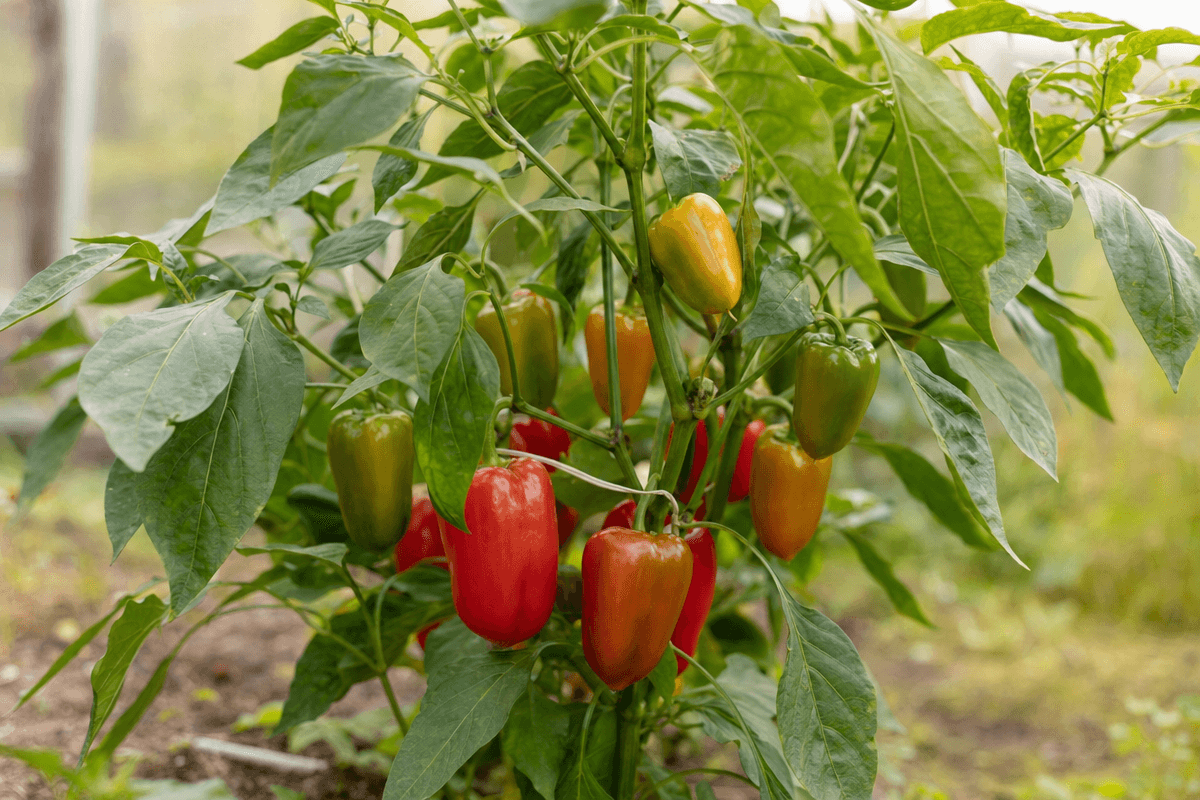
About This Plant
Bell pepper is a warm-season fruiting crop grown for thick-walled immature fruits and benefits from stable warmth, high potassium during fruiting, and support for heavy branches.
How to Grow Bell Pepper
Learn how to grow Bell Pepper from seed to harvest in 142 days. Intermediate difficulty. Complete nutrient guide, pH/EC requirements, and growing conditions for hydroponics, soil & greenhouse.
Sources cited: 23.
Nutrient Requirements by Growth Stage
Bell pepper NPK management follows a clear stage-dependent pattern. During seedling phase (EC 1.5-2.0), use N=100, P=30, K=100 ppm…
Sign in to view nutrient requirements
A free account unlocks NPK targets for all four growth stages, micronutrient levels, a per-stage nutrient calculator, and the full nutrition guide. Signing up takes one click. Truleaf is a free, non-profit project, and every new account helps it grow. No spam, ever.
Growing Environments
Bell pepper performs well in all four environments but protected cultivation is superior. GREENHOUSE is optimal: Nguyen & Lantzke (2022) showed 248% yield improvement (97 vs 39.1 t/ha) with protected production, and reject rates dropped from 57% to 22%…
Temperature
Bell pepper is a warm-season Solanaceae crop requiring consistently warm temperatures. For seed germination, maintain substrate temperatures of 26-32C (80-90F), with 29C (85F) being optimal; germination occurs in 7-14 days at these temperatures. Seeds germinate poorly below 21C. Watkins & Cantliffe (1983) demonstrated germination at 15C and 25C, proving seeds can germinate below 26C but with significantly delayed emergence due to slow endosperm weakening. During vegetative growth and fruiting, maintain 21-29C (70-85F) with an optimal setpoint of 24C. Night temperatures should be 16-21C; below 16C weakens growth, while consistently above 21C causes flower drop. Nguyen & Lantzke (2022) confirmed exposure above 34C causes significant flower and fruit drop, while below 10C induces male sterility. For fruit set, keep daytime temperatures below 29C.
Humidity
Bell pepper thrives at moderate-to-high humidity reflecting its tropical/subtropical origins. Maintain 50-75% RH with 65% as the optimal target…
Light
Bell pepper is a high-light, day-neutral fruiting crop. Target DLI 20-30 mol/m2/d with 25 as optimal…
Airflow
Bell pepper requires consistent gentle air movement (0.3-1.0 m/s) to support pollination, prevent fungal diseases, and maintain uniform conditions. The minimum 0.3 m/s ensures boundary layer disruption for gas exchange and prevents stagnant humid microclimates…
Sign in to view environmental requirements
A free account unlocks exact temperature, humidity, light and airflow targets, including germination and growth ranges, DLI, photoperiod and PPFD, plus the full environment guide. Signing up takes one click. Truleaf is a free, non-profit project, and every new account helps it grow. No spam, ever.
Hydroponic System Compatibility
Drip irrigation is the optimal and industry-standard system. Nguyen & Lantzke (2022) achieved 97 t/ha with drip fertigation…
Growing Media
Rockwool slabs are the industry standard for commercial greenhouse bell pepper production, providing excellent moisture-to-air ratio and compatibility with drip fertigation. For germination, use 1-inch rockwool cubes soaked in pH 5.5 water…
Container Specs
Minimum 5-gallon (19L) container with 30cm depth and diameter; 7-gallon (26L) recommended for optimal yields. One plant per container…
Training & Support
Bell peppers require staking or caging to support heavy fruit loads (150-250g per fruit, 6-15 simultaneously). Insert bamboo or metal stakes (90-120cm) 5-7cm from stem at planting time, pushing 15cm into media…
Sign in to view system compatibility
A free account unlocks why each of the six systems fits or fails, plus growing media, container sizes, training methods, companion plants, and the full systems guide. Signing up takes one click. Truleaf is a free, non-profit project, and every new account helps it grow. No spam, ever.
Propagation
Bell peppers are primarily propagated by seed. Start indoors 8-10 weeks before last frost…
Harvesting
Bell pepper is a non-destructive harvest crop -- plants continue producing for months in hydroponic systems. Harvest timing depends on color stage: green-mature at 60-70 DAT, fully colored (red/yellow/orange) at 80-90 DAT…
Planting Calendar
Sow indoors February-April, 8-10 weeks before last frost. Use bottom heat at 27-32C until emergence…
Common Issues
Bell pepper faces diverse diseases, pests, and physiological disorders. Most significant diseases: bacterial spot (Xanthomonas spp.) causing leaf lesions and fruit scabbing, and Phytophthora blight (P…
Get the full science-backed guide
By signing up, you help keep Truleaf free and support the growth of our nonprofit project. Your account unlocks full details for every plant issue—including symptoms, causes, step-by-step solutions, and prevention—plus the month-by-month planting calendar, the complete guide, and all research sources. It only takes one click. No spam, ever.